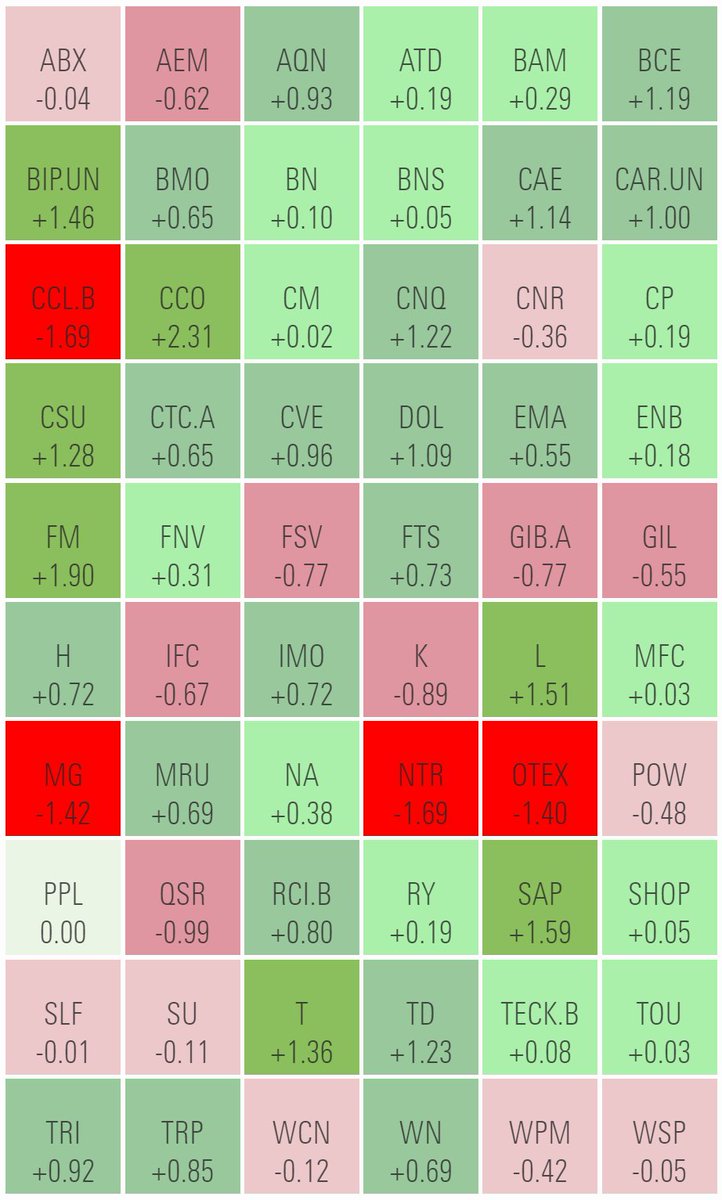
Canadian markets closed higher today with the S&P/TSX 60 up 0.31%. Sectors were mostly mixed with gains in consumer defensives, energy, utilities and communications offsetting losses in materials, technology and consumer cyclicals. Outperformers included $CCO, $FM, and $SAP.
A call for doers.
My thoughts on Walter Isaacson’s Elon Musk biography.
I’ve been following Elon Musk and his companies for the better part of a decade. I started investing in Tesla, the electric car/energy/AI company, in 2012. That started me down a rabbit hole that I haven’t been able to escape to this day. I’ve spent more time than I care to admit researching all his companies, the industries they play in, the man himself, and everything on the periphery.
In 2017, I had the opportunity to work at Tesla, which I did for the better part of 4 years. I left the company in 2021, with a ridiculous amount of knowledge, a ton of scars, friends for life, and financial independence. I knew my time was up once I couldn’t muster the same fire I had when I first entered the company. Without the fire, the company will chew you up and spit you out. Working at a Musk company is not for the faint of heart. The second I came to the realization and before feeling like I’m being chewed up, I moved on. Easily the best job I’ve ever had.
Now that I gained one of the biggest luxuries a human can have - time - I was left wondering about so many things from my time at Tesla.
How did Elon create such an insanely successful company, in one of the hardest industries in the world, with Tesla?
How come everyone I worked with was so maniacal about working as hard as they could while putting themselves through insane pain? What is the secret sauce?
How did he do the same exact thing with SpaceX, a rocket company?
How does he have time to have 4 more companies on top of that?
How does he have 10 kids on top of that?
How does he have time to have relationships on top of that?
And most importantly - is Elon an Alien?
I did not understand. A normal person would probably say “yeah, that’s pretty crazy right? So what are your plans tonight?” But a lunatic like me has been searching for the answer, on top of many more, that he and his companies raise.
I’ve been so obsessed about this that 5 weeks after I left the company, once I became so bored that my pastime became throwing things at my wife, I started creating YouTube videos on a complete whim about my time at Tesla.
And now, almost 2 years to the date after I left on 9/17/21, Walter’s book comes out and answers SO MANY QUESTIONS I’ve had about the man, his companies, and what makes him tick.
First - I want to give a giant shout out to Walter for writing one of the easiest books that I’ve ever read. Fast, to the point, with no filler, it reads in a way that makes it near impossible to put down. I wish more books were written this way. It’s no wonder he’s been so successful as an author. A truly incredible job.
And what’s more, this writing style is complemented by the fact that Elon Musk has figured out how to live 10 lives in 1.
As you read the book, all the way from his childhood to present day, I was continually thinking “how the hell is this the story of ONE person?”
A quick summary of Elon’s life:
Raised South Africa in a brutal household with an abusive father.
Witnessed a ton of violence, and was subject to it as a child from many angles.
Traveled on his own to Canada as a teenager, and later to the US.
Ends up building Zip2, which helps fund PayPal, which helps fund Tesla, SpaceX, Boring Company, Neuralink.
Almost died from Malaria.
Survives multiple near-catastrophic business failures with Tesla and SpaceX.
Marries, has children, divorces, marries, divorces again, has more children, today 10 in total.
Buys Twitter, renames it X.
Funds OpenAI, then funds competitor to OpenAI in X AI.
Constantly deals memes on X.
I mean seriously - who has time for all of this? And the dude is only 52. WTF.
But as you dig deeper, and you follow his story from beginning to end, it becomes clear the kind of person Musk is. Given all his epic strengths and giant weaknesses, if I were to summarize Elon Musk in a sentence, it would be this:
Elon believes that if he doesn’t optimize his life to work as hard as he possibly can to solve the most existential problems that face humanity, civilization’s chances of long term survival are significantly lowered.
How he arrives at that conclusion, and what he does in order to execute against it, is where Walter’s storytelling comes in, aided by Elon’s hectic, chaotic, epic, and confusing life.
In achieving this mission of making humans multiplanetary, transitioning the world to sustainable transport, ensuring AI is maximally positive for humanity, and ensuring free speech never dies, among others, he has surrounded himself with a group of people that trust him and his decision making to a level most leaders can only dream of. It also helps that these folks are some of the most brilliant minds that humanity has to offer.
Don’t believe me? All you have to do is look at Tesla’s valuation, which is more than most of its competitors combined, or the capability of SpaceX, which is humiliating the rest of the rocket industry with the amount of payload the company is capable of putting into orbit. This is not by mistake. Elon Musk has an embarrassment of talent around him and he has figured out how to put them to work to maximize results.
This same talent is witness to Elon’s most demanding and darkest side. In the quest of his missions, which he deems to be of extreme importance and extremely time critical, there’s no one that’s spared if they aren’t able to keep up with his sense of urgency and his extremely high standard of excellence, which in my opinion, can be quite unrealistic in times of stress.
There’s no doubt that after some people read the book and see how Elon handles folks that are not able to keep up, they would think twice about his approach. No feelings are spared. You will get chewed out. It requires a certain level of talent, patience, sacrifice, and foresight in order to avoid Elon’s dark side.
Some have figured it out. Many are still trying. Even more have faced the consequences. And even if some have figured it out, at some point, they’ll face his intensity and ruthless approach.
I had an intuition that this was the case. I heard stories while I was at Tesla on Elon’s approach. But one thing is obvious - it works. It may not be optimal when it comes to maximizing people's overall well-being. Let’s face it - it’s likely the complete opposite. But it does filter for only those that can survive the nonstop and constant demands that he, and his companies, put on themselves.
The rewards are companies that are changing what it means to be successful.
This is the big battle that I face when reading the story - the achievements of Elon and his companies are truly incredible. You’d be hard-pressed to find success stories that rival what he’s achieved with Tesla and SpaceX. But it comes at a giant price, both for himself and those around him.
The urgency that he has in fulfilling the missions of his companies - a type of anxiety I will call it - will oftentimes land him in very questionable situations. Like calling all-hands on deck surges that last multiple days and require around-the-clock work, putting himself and the entire team through a huge amount of stress that could feel necessary, but sometimes yield questionable results.
Or getting himself in some very questionable back and forths right here on X that, in my opinion, are a result of little sleep and a giant amount of stress, which don’t allow him to take a few extra minutes to fully diagnose the situation before pulling the trigger. And we’re not even talking about examples from his personal life that could cause you to raise an eyebrow more than once.
However, it must be said that when Elon does get himself into some deep doo-doo, he is extremely fortunate to have a support system that truly cares for him and are constantly trying to help him in any way they can, especially the members of his family. There may be an insane amount of drama in his life, but there’s also an insane amount of love.
And so, after reading the book, it becomes quite clear that no, Elon indeed is not an Alien. Very far from it. He’s very human. He just loves to live in the extremes, which appears hugely impacted by his genetics and his childhood.
Love him or hate him, from my standpoint, I think one thing is clear. Elon’s intentions are pure. He’s in it to be a service to humanity. He’s almost like an insanely powerful laser that civilization has at its disposal that is aimed at some of the most difficult problems we face. But sometimes, that laser starts pointing itself at things that don’t need a laser, and all of a sudden you have a mess on your hands.
For me, this book highlights just how difficult it is to make large-scale change. To change the fabric of society. To make mind-blowing technology. It highlights the kind of work ethic, sacrifice, and hard work that’s required to make things great. It highlights that one should never stop asking ‘why’, regardless of how insignificant you may think something is. That in the quest to make things that will dramatically help people, no stone should ever be left unturned.
But on that quest, even those with the best intentions could end up creating actions that are tough to justify.
Ultimately, it’s a call for more people to do things. To be willing to experience pain and anguish to pursue things that are really important. To leave ego at the door as much as possible and be willing to ask all the tough questions that need to be asked. To never back down from a challenge, regardless of how difficult it seems, and to surround yourself with people who are willing to walk through the fire with you, ready for war.
Just remember to wear your sunscreen, because flying close to the sun is a very hot place.
Thank you @WalterIsaacson, @elonmusk, and everyone involved for a thoroughly enjoyable read.
Warren Buffett turns 93 today!
To celebrate, I'm sharing the greatest lecture he ever gave together with his 94 (!) best investment quotes.
1. Rule No. 1 is never lose money. Rule No. 2 is never forget Rule No. 1.
2. Diversification is a protection against ignorance. It makes very little sense for those who know what they're doing.
3. Do not take yearly results too seriously. Instead, focus on four or five-year averages.
4. All there is to investing is picking good stocks at good times and staying with them as long as they remain good companies.
5. American business - and consequently a basket of stocks - is virtually certain to be worth far more in the years ahead.
6. An investor should act as though he had a lifetime decision card with just twenty punches on it.
7. And so the important thing we do with managers, generally, is to find the .400 hitters and then not tell them how to swing.
8. The most important quality for an investor is temperament, not intellect. You need a temperament that neither derives great pleasure from being with the crowd or against the crowd.
9. Bitcoin has no unique value at all.
10. Buy a stock the way you would buy a house. Understand and like it such that you'd be content to own it in the absence of any market.
11. The years ahead will occasionally deliver major market declines - even panics - that will affect virtually all stocks. No one can tell you when these traumas will occur.
12. I insist on a lot of time being spent, almost every day, to just sit and think. That is very uncommon in American business.
13. Buy companies with strong histories of profitability and with a dominant business franchise.
14. For the investor, a too-high purchase price for the stock of an excellent company can undo the effects of a subsequent decade of favorable business developments.
15. I believe in giving my kids enough so they can do anything, but not so much that they can do nothing.
16. The world went mad. What we learn from history is that people don’t learn from history.
17. The key to investing is not assessing how much an industry is going to affect society, or how much it will grow, but rather determining the competitive advantage of any given company and, above all, the durability of that advantage.
18. Among the various propositions offered to you, if you invested in a very low cost index fund - where you don't put the money in at one time, but average in over 10 years - you'll do better than 90% of people who start investing at the same time.
19. Because if you're wrong and rates go to 2 percent, which I don't think they will, you pay it off. It's a one-way renegotiation. It is an incredibly attractive instrument for the homeowner and you've got a one-way bet.
20. Cash is to a business as oxygen is to an individual: never thought about when it is present, the only thing in mind when it is absent.
21. Don't get caught up with what other people are doing. Being a contrarian isn't the key but being a crowd follower isn't either. You need to detach yourself emotionally.
22. For 240 years it's been a terrible mistake to bet against America, and now is no time to start.
23. I never attempt to make money on the stock market. I buy on the assumption that they could close the market the next day and not reopen it for five years.
24. I have no views as to where it (gold) will be, but the one thing I can tell you is it won't do anything between now and then except look at you. Whereas, you know, Coca-Cola will be making money, and I think Wells Fargo will be making a lot of money, and there will be a lot -- and it's a lot -- it's a lot better to have a goose that keeps laying eggs than a goose that just sits there and eats insurance and storage and a few things like that.
25. I just sit in my office and read all day.
26. I won't say if my candidate doesn't win, and probably half the time they haven't, I'm going to take my ball and go home
27. If returns are going to be 7 or 8 percent and you're paying 1 percent for fees, that makes an enormous difference in how much money you're going to have in retirement.
28. We want products where people feel like kissing you instead of slapping you.
29. If you aren't willing to own a stock for ten years, don't even think about owning it for ten minutes.
30. The most important investment you can make is one in yourself.
31. If you buy things you do not need, soon you will have to sell things you need.
32. If you don't feel comfortable making a rough estimate of the asset's future earnings, just forget it and move on.
33. If you like spending six to eight hours per week working on investments, do it. If you don't, then dollar-cost average into index funds.
34. If you're in the luckiest 1% of humanity, you owe it to the rest of humanity to think about the other 99%.
35. If you're smart, you're going to make a lot of money without borrowing.
36. In the 20th century, the United States endured two world wars and other traumatic and expensive military conflicts; the Depression; a dozen or so recessions and financial panics; oil shocks; a flu epidemic; and the resignation of a disgraced president. Yet the Dow rose from 66 to 11,497.
37. In the 54 years (Charlie Munger and I) have worked together, we have never forgone an attractive purchase because of the macro or political environment, or the views of other people. In fact, these subjects never come up when we make decisions
38. In the business world, the rearview mirror is always clearer than the windshield.
39. Investors should remember that excitement and expenses are their enemies.
40. It is a terrible mistake for investors with long-term horizons to measure their investment 'risk' by their portfolio's ratio of bonds to stocks.
41. It is not necessary to do extraordinary things to get extraordinary results.
42. It takes 20 years to build a reputation and five minutes to ruin it. If you think about that, you'll do things differently.
43. The one thing I will tell you is the worst investment you can have is cash. Everybody is talking about cash being king and all that sort of thing. Cash is going to become worth less over time. But good businesses are going to become worth more over time.
44. It's been an ideal period for investors: A climate of fear is their best friend. Those who invest only when commentators are upbeat end up paying a heavy price for meaningless reassurance.
45. It's better to hang out with people better than you. Pick out associates whose behavior is better than yours and you'll drift in that direction.
46. It's better to have a partial interest in the Hope diamond than to own all of a rhinestone.
47. It's far better to buy a wonderful company at a fair price than a fair company at a wonderful price.
48. Just pick a broad index like the S&P 500. Don't put your money in all at once; do it over a period of time.
49. Keep things simple and don't swing for the fences. When promised quick profits, respond with a quick "no”.
50. Lose money for the firm, and I will be understanding. Lose a shred of reputation for the firm, and I will be ruthless.
51. Many management teams are just deciding they're gonna buy X billions over X months. That's no way to buy things. You buy when selling for less than they are worth. ... It's not a complicated equation to figure out whether it is beneficial or not to repurchase shares.
52. The difference between successful people and really successful people is that really successful people say no to almost everything.
53. Most people get interested in stocks when everyone else is. The time to get interested is when no one else is. You can't buy what is popular and do well.
54. Never invest in a business you cannot understand.
55. Your premium brand had better be delivering something special, or it’s not going to get the business.
56. One can best prepare themselves for the economic future by investing in your own education. If you study hard and learn at a young age, you will be in the best circumstances to secure your future.
57. The most important thing to do if you find yourself in a hole is to stop digging.
58. One thing that could help would be to write down the reason you are buying a stock before your purchase. Write down "I am buying Microsoft at $300 billion because..." Force yourself to write this down. It clarifies your mind and discipline.
59. Only when the tide goes out do you discover who's been swimming naked.
60. Opportunities come infrequently. When it rains gold, put out the bucket, not the thimble.
61. Price is what you pay. Value is what you get.
62. Read 500 pages like this every day. That's how knowledge works. It builds up, like compound interest. All of you can do it, but I guarantee not many of you will do it.
63. Risk comes from not knowing what you're doing.
64. If a business does well, the stock eventually follows.
65. Since I know of no way to reliably predict market movements, I recommend that you purchase Berkshire shares only if you expect to hold them for at least five years. Those who seek short-term profits should look elsewhere.
66. Someone's sitting in the shade today because someone planted a tree a long time ago
67. The best thing that happens to us is when a great company gets into temporary trouble... We want to buy them when they're on the operating table.
68. Speculation is most dangerous when it looks easiest.
69. Stay away from it. It's a mirage, basically...The idea that it has some huge intrinsic value is a joke in my view.
70. The best chance to deploy capital is when things are going down.
71. The stock market is a no-called-strike game. You don't have to swing at everything -- you can wait for your pitch.
72. There is nothing wrong with a 'know nothing' investor who realizes it. The problem is when you are a 'know nothing' investor but you think you know something.
73. This does not bother Charlie and me. Indeed, we enjoy such price declines if we have funds available to increase our positions.
74. Too-big-to-fail is not a fallback position at Berkshire. Instead, we will always arrange our affairs so that any requirements for cash we may conceivably have will be dwarfed by our own liquidity.
75. There are all kinds of businesses that Charlie and I don’t understand, but that doesn’t cause us to stay up at night. It just means we go on to the next one, and that’s what the individual investor should do.
76. You can’t buy what is popular and do well.
77. We never want to count on the kindness of strangers in order to meet tomorrow's obligations. When forced to choose, I will not trade even a night's sleep for the chance of extra profits.
78. We will reject interesting opportunities rather than over-leverage our balance sheet.
79. We've long felt that the only value of stock forecasters is to make fortune tellers look good. Even now, Charlie and I continue to believe that short-term market forecasts are poison and should be kept locked up in a safe place, away from children and also from grown-ups who behave in the market like children.
80. What is smart at one price is stupid at another.
81. What we learn from history is that people don't learn from history.
82. When stock can be bought below a business's value it is probably the best use of cash.
83. When trillions of dollars are managed by Wall Streeters charging high fees, it will usually be the managers who reap outsized profits, not the clients.
84. When we own portions of outstanding businesses with outstanding managements, our favorite holding period is forever.
85. When you have able managers of high character running businesses about which they are passionate, you can have a dozen or more reporting to you and still have time for an afternoon nap. Conversely, if you have even one person reporting to you who is deceitful, inept or uninterested, you will find yourself with more than you can handle.
86. Whether we're talking about socks or stocks, I like buying quality merchandise when it is marked down.
87. Widespread fear is your friend as an investor because it serves up bargain purchases.
88. You are neither right nor wrong because the crowd disagrees with you. You are right because your data and reasoning are right.
89. You can't borrow money at 18 or 20 percent and come out ahead.
90. You can't produce a baby in one month by getting nine women pregnant.
91. The most important quality for an investor is temperament, not intellect… You need a temperament that neither derives great pleasure from being with the crowd or against the crowd.
92. You don't need to be a rocket scientist. Investing is not a game where the guy with the 160 IQ beats the guy with 130 IQ. You only have to be able to evaluate companies within your circle of competence.
93. The size of your circle of competence is not very important; knowing its boundaries, however, is vital.
10 Biases that distort your Decision-Making:
1. Self-Serving Bias - Our failures are situational, but our successes are our responsibility.
2. Curse of knowledge - Once we know something, we assume everyone else knows it, too.
3. Dunning-Kruger Effect - The less you know, the more confident you are. The more you know, the less confident you are.
4. Belief Bias - We judge an argument's strength not by how strongly it supports the conclusion but by how plausible the conclusion is in our own minds.
5. Escalation of Commitment - We invest more in things that have cost us something rather than altering our investments, even if we face negative outcomes.
6. Gambler's Fallacy - We think future possibilities are affected by past events.
7. Zero-Risk Bias - We tend to reduce small risks to zero, even if we can reduce more risk with another option.
8. Outgroup Homogeneity Bias - We perceive out-group members as homogenous and our own in-groups as more diverse.
9. Clustering Illusion - We find patterns and clusters in random data.
10. Blind Spot Bias - We overlook biases in our own decision-making and see them more in others.
Which of these is troubling you the most?😅
The Curse of Knowledge is up there for me.