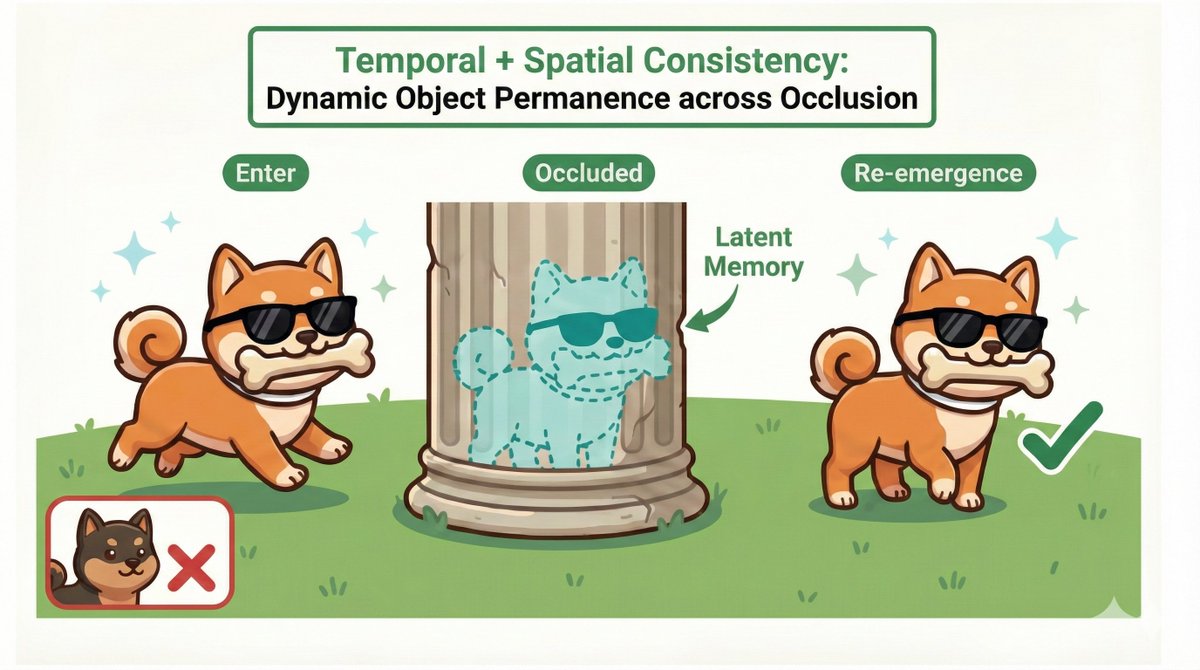
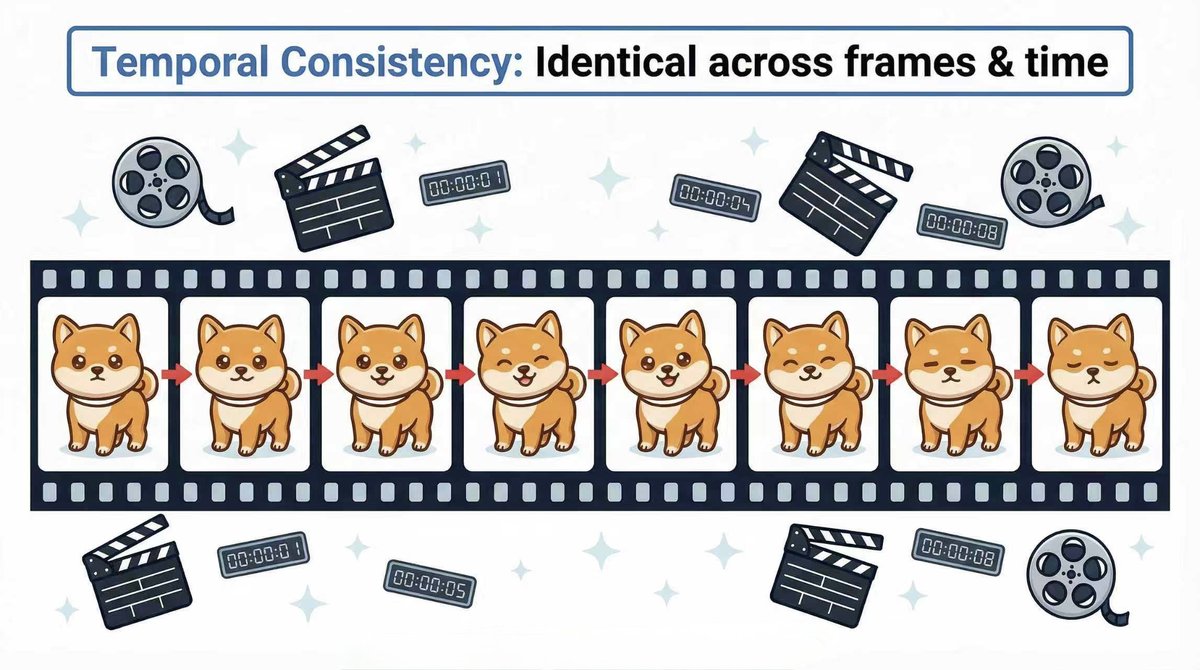
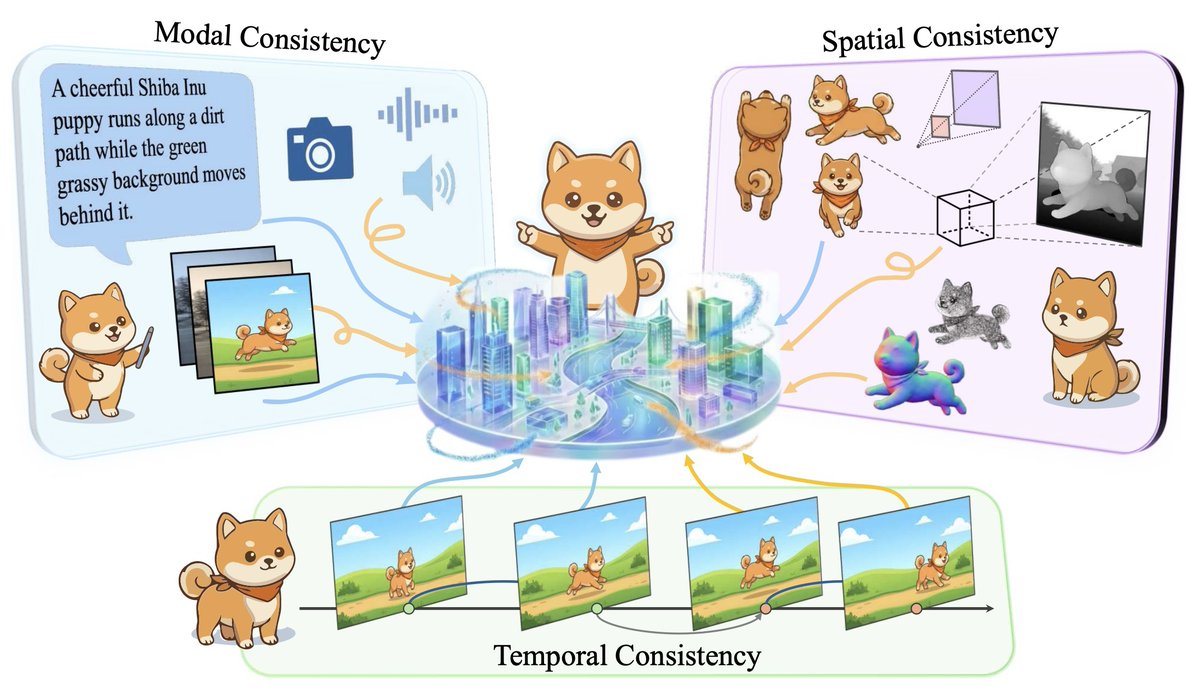
Most “world models” today are incomplete.
A general world model must satisfy three constraints:
• Modality Consistency
• Spatial Consistency
• Temporal Consistency
We call this the Trinity of Consistency. 🧵
In our paper, we:
• Propose the Trinity of Consistency as a defining principle
• Introduce CoW-Bench, a diagnostic benchmark based on multi-frame reasoning and constraint satisfaction
CoW-Bench evaluates not just individual consistency —
but pairwise integration.
The next paradigm is becoming clear:
Let UMMs act as semantic compilers —
and integrate their Prompt-as-Action capability
with the spatiotemporal consistency of video generation models.
This is how we bridge human intent and physical dynamics.
Existing approaches are imbalanced:
🎥 Video world models → strong in space & time, weak in semantics
🧠 Unified multimodal models → strong in semantics, weak in physical realism
True world models must unify both.
Given a reaction, which enzyme catalyses it? Given an enzyme, what can it perform? A geometric foundation model that answers both
Of the ~250 million protein sequences in UniProt, fewer than 0.3% have been manually curated for function. Meanwhile, 40–50% of known enzymatic reactions lack any associated enzyme sequence—orphan reactions. Traditional approaches rely on EC number classification, which groups distinct reactions under the same code, or sequence homology tools like BLASTp, which fail when similarity is low. Neither directly models whether a specific enzyme structure can catalyse a specific reaction.
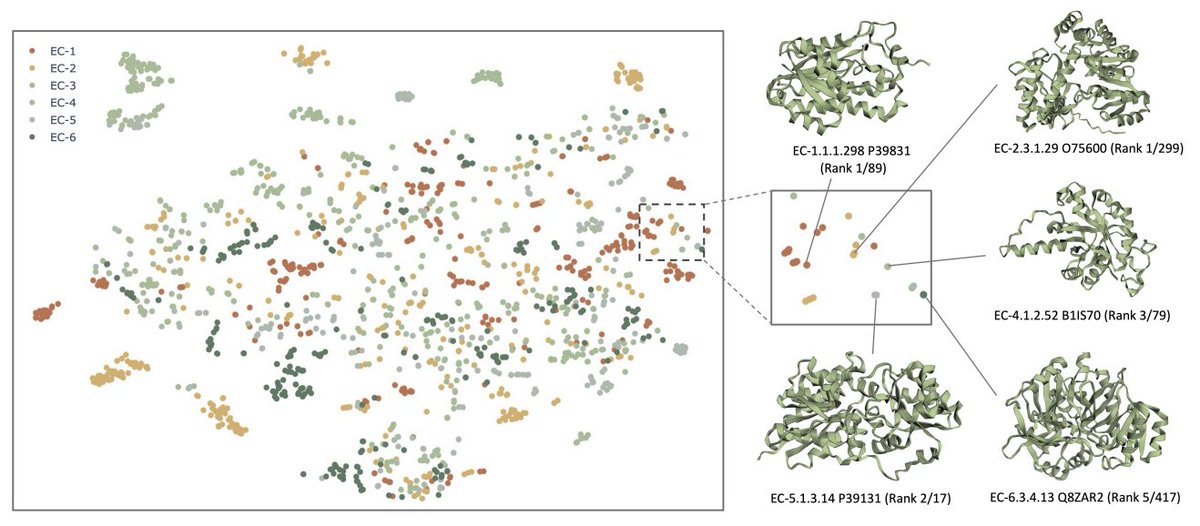
Yong Liu and coauthors introduce EnzymeCAGE, a geometric foundation model trained on ~1.5 million structure-informed enzyme–reaction pairs across 3,273 species. The key architectural choice is to focus on the catalytic pocket rather than the full protein. A GNN encodes pocket geometry—backbone coordinates, dihedral angles, side-chain torsions—extracted via AlphaFill from AlphaFold structures, while ESM Cambrian embeddings capture global evolutionary context. On the reaction side, SchNet encodes 3D substrate and product conformations, with a reacting-area weight matrix that upweights atoms at the reaction centre. Geometry-enhanced cross-attention then models pocket–reaction interactions to output a catalytic compatibility score.
On unseen enzymes, EnzymeCAGE achieves 58% top-10 success rate—a 45% improvement over baselines including CLIPZyme, ESP, and MMseqs2. For orphan reactions, enzyme retrieval improves by 41%. It works even when test enzymes share less than 30% sequence identity with training data, where homology methods break down. An emergent capability is catalytic site identification: attention weights consistently highlight experimentally validated active-site residues, despite this never being a training objective.
In two case studies—withanolide biosynthesis and glutarate pathway reconstruction—EnzymeCAGE correctly retrieves catalytic enzymes where all baselines fail, ranking positive P450s within the top 6–13 among 107 candidates at only ~40% sequence similarity to training proteins.
The design principle: by decomposing catalysis into pocket geometry, reaction centre chemistry, and their 3D interaction—rather than relying on sequence similarity or coarse EC labels—the model learns transferable representations of catalytic compatibility that generalize across enzyme families.
Paper: https://t.co/GWME8Dw9rY
At launch, SeqStudio is optimized for protein-level analysis, delivering integrated predictions alongside natural-language functional summaries. As we broaden to additional data types and analysis modalities, we would love your feedback to help guide what comes next.
We're excited to introduce SeqStudio, an AI-powered platform for seamless protein function annotation. SeqStudio unifies BLAST, InterProScan, TMHMM, Foldseek, and LLM-driven reasoning into a single, intuitive workspace.
link:
https://t.co/vN9IvRnM5c
#protein#AI#tool
For a long time, I wished for one place where I could understand my protein sequences holistically — a place that brings together homology, domains, topology, and structure, and then makes sense of it all. Today, that vision becomes reality with SeqStudio.
We’d appreciate your help sharing this milestone — post about ODesign, discuss it with your colleagues, and explore how this next-generation foundation model can accelerate your molecular design research!
We’re thrilled to announce the release of ODesign, the first general-purpose molecular world model. ODesign enables scientists to design proteins, peptides, nucleic acids, small molecules, and metal ions for any biological target, with fully controllable precision and speed.
With over 50× higher design throughput than comparable models, it compresses multi-day molecular design cycles into just a few hours — reshaping the productivity frontier of AI-powered drug discovery.
ODesign acts as a universal molecular biologist, understanding the language of proteins, RNAs, DNAs, small molecules, and ions, and generating atomic-level structures that obey real chemical and physical laws.
@AllThingsApx Thank you for your sharing. You might also be interested in our recent work analyzing AFDB's bias: https://t.co/Ci5GcZMWik. Would love to hear your thoughts!