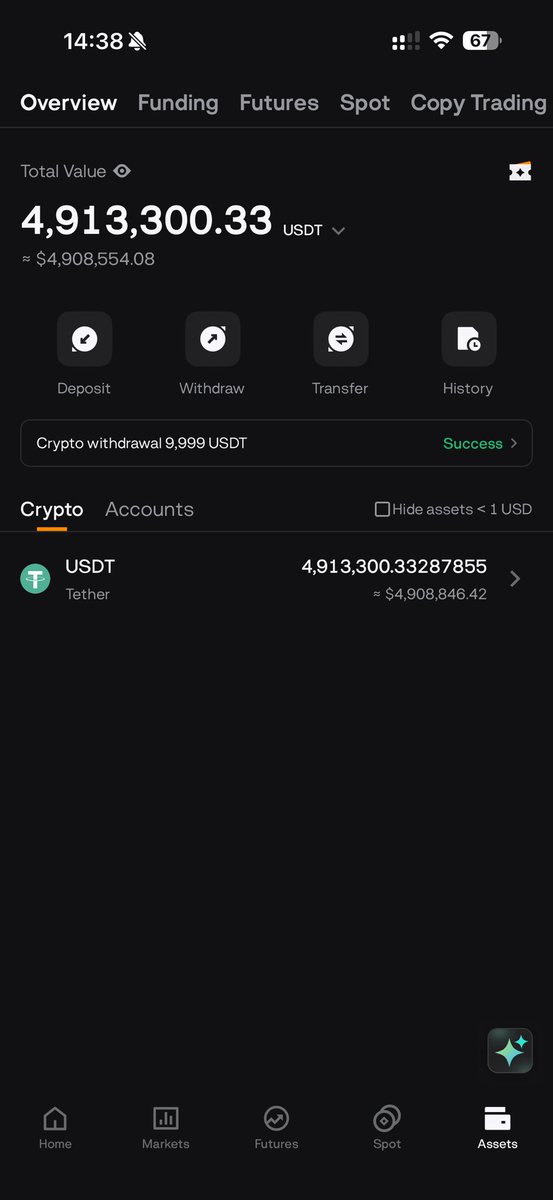
$500k → $5M in 3 months.
Done. ✅
Point blank: This was the hardest challenge I’ve ever done.
For 3 months straight I got hit with nonstop hate and negativity. Opinions coming from everywhere. Irrational pumps that made no sense trying to shake me out every week.
Trading at this size brought a level of psychological pressure I’ve never experienced before. There were moments it felt really heavy, but I stayed disciplined, and kept believing in myself.
Grateful to everyone who rode with me through all the noise.
The result is in the screenshot. The full live journey is on my YouTube.
Love me or hate me… I did it anyway 😚
Another weekend, another flush, and this time in both directions.
Bitcoin slid from $59.7K to $58.4K while most people were away from their screens. Thin weekend liquidity, a few heavy sell orders, and down it went, straight into the longs stacked underneath.
Then it ripped straight back above $60K, and squeezed the shorts who piled in at the lows.
$60.9M liquidated in 24 hours. $27.1M in longs on the way down, $33.8M in shorts on the way back up.
And once again, one exchange dominates. Binance alone accounts for $39.3M of those liquidations, 64% of the entire market. $16.5M in longs and $22.8M in shorts.
Two out of every three liquidations happened on one venue.
This is the same pattern I've been posting about for weeks. It's not a crash, just a steady bleed with sweeps in both directions. Weekends are when liquidity is thinnest and it takes the least effort to move price into the clusters. And it's always the same people paying for it: retail on Binance, longing the dip and shorting the bottom.
Price is still below my points of interest. Until those are reclaimed, every bounce is just a chance for the next batch of traders to get trapped.
The structure of this market is broken, and history shows what usually comes next.
Let's compare it to previous bear markets.
2014: Bitcoin peaked at about $1,163 and bottomed at $152. A drop of 87%.
2018: peaked near $19,783 and bottomed around $3,122. A drop of 84%.
2022: peaked near $69,000 and bottomed at $15,476. A drop of 78%.
This cycle peaked at $126,208. The low so far is $55,156. That's 56%.
If this were a normal bear market, we'd be nowhere near the bottom yet. Every previous one went far deeper.
But here's the structural part most people are ignoring.
In a healthy market, the previous cycle's all-time high becomes the new floor. Old resistance turns into support. For this cycle, that level was $69K, the 2021 high.
It's gone. Bitcoin is trading around $60K, below the level that was supposed to hold this whole cycle together.
The same thing happened in 2022. Bitcoin lost the 2017 high of $19.7K, and that's when the real capitulation started. It didn't bottom until $15.5K.
That's not a market finding its bottom. That's a market making lower highs and losing every level that matters, one by one.
Could this cycle be different? Maybe. ETFs and institutions were supposed to make the drawdowns smaller. But right now, the structure says otherwise.
Do you think this time is really different?
Crypto didn't just lose price this month. It lost trust, and that's much harder to win back.
Think about what an institution saw over the last few weeks.
The biggest exchange in the world suffered the largest hack in crypto history, around $6.3B gone. Withdrawals were frozen. And the founder's explanation for the sell-off afterwards was "nobody knows for sure."
Then came the wallet drains, the exploits, the security scares across tech. Every week, another headline telling big money that crypto still isn't safe to hold.
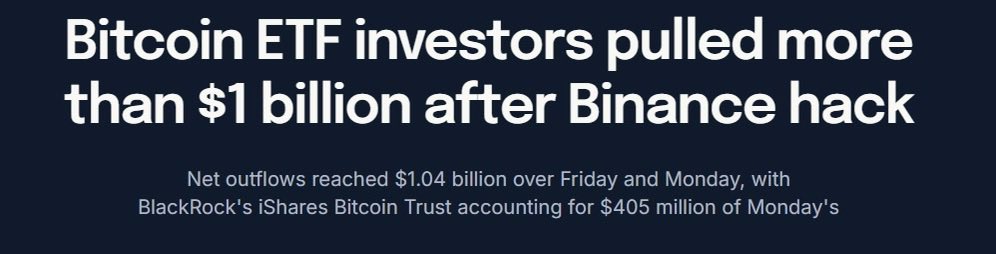
Then the ETFs, the product that was supposed to bring institutions in for good, saw around $1.9B in outflows in just seven sessions. That's not retail panic. That's the exact money that was supposed to stay.
And look at how the market itself behaves. Wicks to $55K, squeezes to $64K, $115M in liquidations in a day, and over half of them on one exchange. Price moving on leverage and a tech CEO's headline instead of real demand.
Now put yourself in the shoes of a fund manager. You report to a risk committee. You have to explain every drawdown. How do you justify more exposure to a market where one venue drives most of the liquidations, the biggest exchange just got drained, and price moves 5% in an hour because of an options expiry?
You don't. You wait.
That's what this market is missing. Not a catalyst. Trust. And trust doesn't come back with a green candle. It comes back slowly, after the risk is gone and the price makes sense.
That's why I think institutions will step in much lower than here, at levels where the risk finally looks worth it. Until then, the big money is on the sidelines, and retail is the one buying the dip.
Nobody is going to save this market.
Every bull I talk to is waiting for something. The ETF inflows to come back. The Fed to pivot. A new narrative. One big headline that flips everything back to green.
Look at what's actually happening.
The ETFs aren't buying the dip. US spot Bitcoin ETFs saw around $1.9B in outflows over just seven trading sessions earlier this month. The same "institutional demand" that was supposed to put a floor under price is walking out the door.
The Fed isn't coming to the rescue. Hot inflation data has traders betting on another rate hike, not a cut. Higher rates and a stronger dollar have never been good for risky assets, and right now crypto is the riskiest of them all.
And the narrative has moved on. The money that used to chase crypto is chasing AI. A trillion-dollar AI IPO and a Nvidia CEO headline moved markets more this month than anything happening in crypto.
So what exactly is the bullish catalyst?
Bulls are waiting for a rescue, and the market doesn't owe them one. Markets don't bottom because people need them to. They bottom when the sellers are finished, and right now the sellers are still in control.
That doesn't mean Bitcoin is dead. It means the bounce won't come from hope. It'll come when the leverage is gone, the weak hands are out and price reaches a level where real money actually wants to buy.
I think that level is a lot lower than $60K.
$500k → $5M in 3 months.
Done. ✅
Point blank: This was the hardest challenge I’ve ever done.
For 3 months straight I got hit with nonstop hate and negativity. Opinions coming from everywhere. Irrational pumps that made no sense trying to shake me out every week.
Trading at this size brought a level of psychological pressure I’ve never experienced before. There were moments it felt really heavy, but I stayed disciplined, and kept believing in myself.
Grateful to everyone who rode with me through all the noise.
The result is in the screenshot. The full live journey is on my YouTube.
Love me or hate me… I did it anyway 😚
Tomorrow at 08:00 UTC, about $6.8B in Bitcoin options expires on Deribit. One of the biggest expiries of the month.
Here's what's interesting. Max pain for this expiry sits around $71–73K, the price where the most options would expire worthless. Bitcoin is trading around $60K, more than $10K below it.
Normally, price gets pulled toward max pain into expiry. This time, the market didn't even try. Sellers were strong enough to ignore one of the most watched levels in the options market.
That tells you who's in control.
And here's why I'll be watching what happens after it's gone. Big expiries come with a lot of hedging, and that hedging can hold price in place. Once the contracts settle, those hedges roll off, and the market gets to show its real direction, without anything holding it in place.
Now look at where the next big money is positioned. The largest put open interest across all expiries sits at $60K, $58K, $50K and $40K, and most of those $40K puts expire on Christmas Day.
Some of that is protection. But serious money doesn't pay for protection at $50K and $40K unless it thinks those prices are possible.
I've had $48K on my chart since $81.4K. The options market is starting to point in the same direction.
Watch what price does once this expiry is gone. That's when you'll see who was really in control.
Half the accounts calling the bottom right now are getting paid to say it.
Crypto Twitter doesn't make money on being right. It makes money on your attention and your emotions.
Fear gets clicks. Hope gets clicks. And nothing gets more engagement than telling people exactly what they want to hear. If you're down 40% on your bags, "the bottom is in" is the best thing anyone could say to you. You want it to be true, so you believe it. You like it, you share it, you follow the account that said it, and you go buy more.
That's the business. Not analysis, just your hope, packaged and sold back to you.
So when the market is down 56% from the top and the timeline is suddenly full of "generational buying opportunity," "bottom is in" and "last chance below $60K," ask yourself one question: who benefits if you believe them?
They called the bottom at $100K. At $80K. At $70K. At $60K. Not one of those calls has worked, and the same accounts are making the same call again today, with the same confidence.
A real analyst can tell you why they're wrong when they're wrong. An account farming your emotions just moves on to the next bottom call and hopes you don't scroll back.
I post my levels before the move, and I tell you exactly where I'm wrong. I've been bearish since $81.4K, and that's never been the popular thing to say.
Before you buy someone's bottom call, scroll back through their last five. Then decide who you're listening to.
Preserve your capital. Right now, that's the only thing that matters.
Bear markets don't make you rich. They decide who's still around when the next bull market starts.
Every cycle looks the same in hindsight. Bitcoin dropped 87% in 2014, 84% in 2018 and 78% in 2022. This time we're down about 56% from the top so far. Each of those bear markets ended with an opportunity that made people life-changing money, but only the people who still had capital left to use it.
Most never got that chance. They didn't lose everything in one crash. They lost it slowly, buying every dip with leverage, revenge trading every loss, and convincing themselves the bottom was in at every bounce. By the time the real bottom arrived, they had nothing left to buy it with.
This market is built to wear you out. Fake pumps, sharp wicks, longs wiped on the way down, shorts squeezed on the way up. If you trade every move, it will slowly take your account, one "good setup" at a time.
So here's how I'm approaching it:
Smaller size. Less leverage. Stops I actually respect. Fewer trades, only at my levels. And when the market makes no sense, I sit in cash and watch.
Being in cash during a bear market isn't missing out. It's staying alive long enough to take the trades that matter.
The goal right now isn't to win big. It's to survive. The winning comes after.
People keep calling me bearish. Fine. But tell me what there is to be bullish about.
Here's every Bitcoin bear market, from all-time high to the bottom:
2013: $1,163 → $152 (−87%)
2017: $19,783 → $3,122 (−84%)
2021: $69,000 → $15,476 (−78%)
This cycle: $126,208 → $55,156 so far. That's −56%.
Every previous bear market went deeper. Way deeper.
My target is $48K. That's a −62% drawdown, and it would still be the mildest bear market Bitcoin has ever had. If drawdowns keep shrinking at the same pace, the next one lands closer to −70%. That's around $38K.
So no, $48K isn't me being bearish. It's me being generous.
Spot isn't leading. Every pump is leverage, and every pump fades. The flip levels at $81.4K, $74.4K, $62.5K and $60.3K are all lost. And the people calling the bottom at $60K are the same ones who called it at $75K.
Show me the bullish case, and I'll listen. But "it always goes up eventually" isn't a reason to buy here.