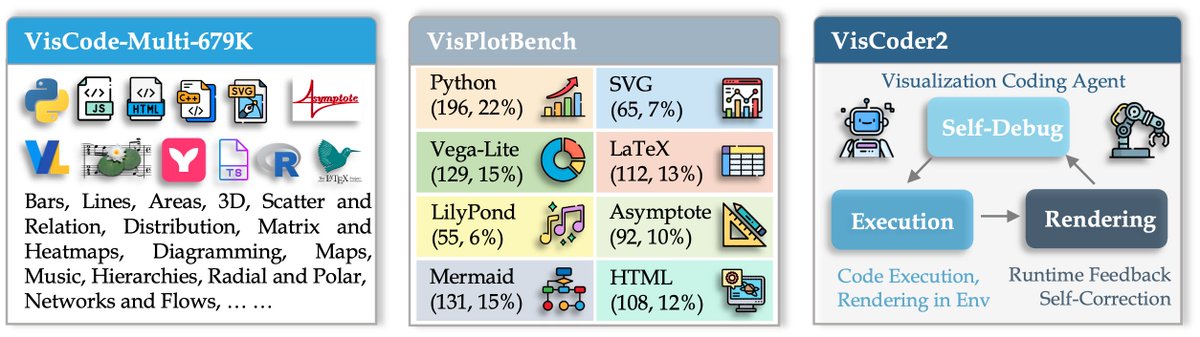
📢 Introducing VisCoder2: Building Multi-Language Visualization Coding Agents!
Existing LLMs often fail in practical workflows due to limited language coverage, unreliable execution, and a lack of iterative correction mechanisms.
We introduce 3 resources to address this:
VisCode-Multi-679K: A 679K dataset across 12 languages.
VisPlotBench: A benchmark spanning 8 languages with multi-round self-debug protocols.
VisCoder2: A model family that iteratively executes, renders & self-debugs, approaching GPT-4.1 performance (82.4% pass rate).
🌐 Project Page: https://t.co/Otdg27tN1N 📄 Paper: https://t.co/tVVPaJk1HZ 🤗 HF Collections:https://t.co/Prnckxa8kM
More below 👇 (0/7)
I’m Xiangchao Chen, one of the contributors to this work — an engineer-researcher exploring embodied AI, agent learning, and hardware-grounded robotics.
I’m new here and would love to connect with others working on RL, AI systems, or embodied intelligence. 👋
Excited to share our new paper here:
📄 Agent Learning via Early Experience
Many agent env lack verifiable rewards or require long, costly rollouts, making RL brittle; meanwhile SFT on expert demos is hard to scale and generalizes poorly
We propose a practical middle ground👇
🌀Agent Learning via Early Experience🌀
📝: https://t.co/ntrEzbaRD3
- SFT for agents is sparse; RL on long-horizons is hard
We provide new mid-training signals that work:
1) Implicit next state world modeling task
2) Self-reflection on alternate states
- Strong improvements over 8 environments and multiple model families
- Works well for subsequent RL!
🧵1/5
When rewards are available, initializing RL (e.g., GRPO) from Early-Experience checkpoints yields higher post-RL ceilings than imitation-only starts — a strong bridge from IL to RL.