@rauchg@Kyrannio I’m working on agentic infrastructure too snd the cybersecurity layer is crucial ; I also think the token model to price will change in the future so Ai can scale .
Breaking News: A Vincent van Gogh painting sold for $190.4 million, an auction record for the artist, after an ownership dispute was settled.
https://t.co/n0cFhwrHjJ
We just raised $5.7M for @PolarBrowser, the AI browser that beats Anthropic and OpenAI on every major web agent benchmark.
- 4,500,000+ actions taken for users, automating sales, recruiting, and ops
- One company cancelled Clay and saves 25+ hrs/wk per person
- Team is from MIT, YC, Prod, Citadel, Jane Street, Perplexity, Modal, and Apple
100 hours of work. From 30 seconds of typing.
Download the world's most powerful AI browser: https://t.co/lUOm01Stm0
“In the face of overwhelming odds, I’m left with only one option: I’m gonna have to science the shit out of this.”
Andy Weir, The Martian
“I must not fear. Fear is the mind-killer. Fear is the little-death that brings total obliteration. I will face my fear… And when it has gone past I will turn the inner eye to see its path. Where the fear has gone there will be nothing. Only I will remain.”
Frank Herbert , Dune
@lorigilbertlac@firesidealpha Always take a deeper look the people you think are crazy ; they might be the shining star ✨🌟✨ of the next unicorn 🦄 there is magic 🪄 in manifesting dreams ✨ it’s the crazy ones who don’t listen to others to define their journey
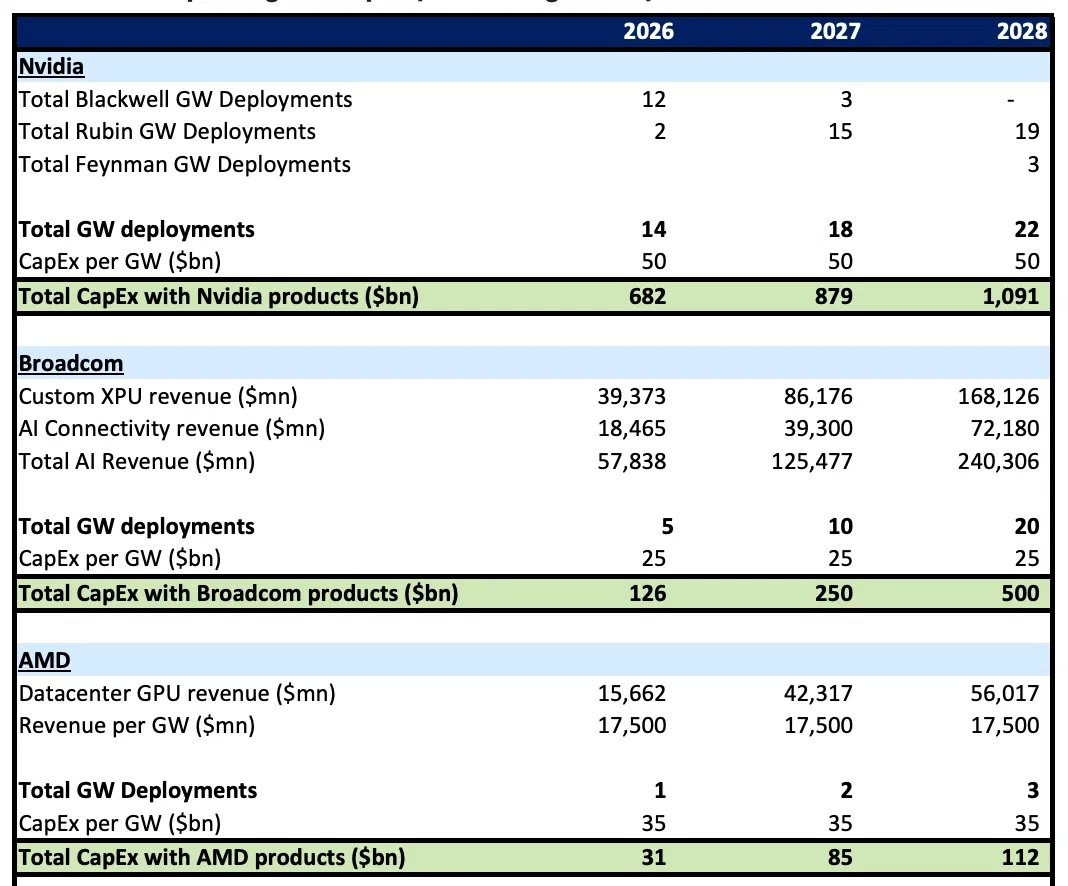
Pretty insane that Goldman forecasts ~$3.8T in AI infrastructure spending tied to $NVDA, $AVGO and $AMD systems through 2028:
• Nvidia ~$2.7T (63% of CapEx, 47% of GW)
• Broadcom ~$876B (21% of CapEx, 31% of GW)
• AMD ~$228B (5% of CapEx, 6% of GW)
Nvidia still captures majority of spending but the gap between dollars spent and capacity deployed shows just how quickly custom silicon from $META, $GOOGL, $AMZN and $MSFT is gaining ground.
@Vvikramai@Selkis_2028 The race also is to get the Energy innovation and infrastructure upgraded so this country can scale and innovate with the large frontier models and open model too ; otherwise development is going to be pushed offshore and this will weaken the U.S.
@DavidLinthicum Your podcast on the incident is amazing and worth listening to by others to understand the depth of the incident and how to derisk your enterprise while keeping Microsoft.✨
Maybe the USG should take a strategic investment in Nvidia or create a side SPV to fund and protect the emerging Neo clouds and open market to remove the fears. Wasn’t Nvidia going to release their own Open model too ? Your statement regarding Jensen not working for the government thus not being exposed to their confidential secrets makes sense. I want the U.S. to protect the emerging AI innovation echo system and Nvidia is part of its foundation.✨
🚨 Another major scandal is coming out of NVIDIA.
And this one has nothing to do with Jensen Huang's affairs.
According to a Wall Street Journal report, Nvidia was offering billions in financial guarantees to AI companies that could not afford its chips, so they could keep buying them.
Some of these deals were being pushed by Jensen's own son-in-law, Nico Caprez, who became a vice president in January. His team was telling small cloud companies and data center builders that Nvidia could arrange credit support for them within a couple of weeks.
The goal was simple: turn them into long term buyers of Nvidia GPUs.
And the size of Nvidia's commitments has exploded. Its own filing shows $530 BILLION in commitments and guarantees, up from $184 billion just one quarter earlier.
Inside the company, CFO Colette Kress was raising concerns. She kept asking how these guarantees were priced and what Nvidia was really getting back.
In an August meeting, Jensen cut her off and called her "a deer in the headlights."
She was also the one who cut Nvidia's guarantee on OpenAI's Ohio data center from $250 billion to $105 billion.
Now Jensen is gone, and the CFO who questioned these deals is running Nvidia.
To understand why this is a big deal, you need to understand the AI funding loop.
Here is how it works:
1. Nvidia puts money into an AI company, or guarantees its loans and leases.
2. That company uses the money and credit to build a data center.
3. The data center is filled with Nvidia GPUs.
4. Nvidia reports those GPU sales as revenue.
5. If the company cannot rent out all its computing power, Nvidia agrees to buy the unused part.
SO NVIDIA IS THE INVESTOR, THE LENDER, THE SUPPLIER AND THE BACKUP CUSTOMER, ALL IN THE SAME DEAL.
The money goes out of Nvidia and comes back to Nvidia as sales.
CoreWeave is the clearest example. Nvidia owns a stake in it, sells it chips, and agreed to buy up to $6.3 billion of its unused computing capacity through 2032.
OpenAI is the biggest. Nvidia is guaranteeing up to $105 billion for its Ohio data center, supplying all the chips inside it, and invested $1.5 billion in the company building it.
Nvidia's own filing for the quarter ending July 26 shows where the money is tied up:
• Supply commitments for memory and chip wafers: $279 BILLION, up from $119 billion.
• Guarantee on the OpenAI Ohio data center: up to $105 BILLION.
• Deals to buy unused cloud capacity from neoclouds: $36 BILLION.
Nvidia's actual liabilities on its balance sheet: $91 BILLION.
That means the commitments outside the balance sheet are almost 6 times bigger than the debts on it.
Nvidia does not lose this money unless something breaks. A guarantee only costs Nvidia if a customer cannot pay.
But this is where it gets uncomfortable.
The WSJ says Jensen himself had started to panic. He warned executives that the biggest cloud companies were moving to their own chips to depend less on Nvidia.
At the same time, the wafers and memory Nvidia had committed to buy were coming at him like an "avalanche."
So the biggest customers were trying to leave, Nvidia was locked into buying huge amounts of supply, and smaller customers were being kept alive with Nvidia's credit.
And things were already starting to crack:
• Nvidia paused some of its financing deals in August.
• Nearly half of the $80 billion in data center bonds issued this year were rated junk.
• Neocloud stocks crashed this week, with Nebius down over 20% and CoreWeave down 17% at the lows.
• OpenAI raised less than it wanted, at a lower valuation.
And now Kress is the one deciding whether this continues.
If she pulls back on the financing, the companies that depended on Nvidia's money will have to borrow elsewhere, in a debt market that is already nervous.
If they cannot, they stop buying chips.
And if they stop buying chips, Nvidia's revenue drops.
That is the risk of a loop. It works perfectly when money keeps flowing, and it hurts on the way down.