Solver of business challenges with technology | Building the startup ecosystem through mentorship 🌱 | Sharing insights on #Startups, #Tech, #Leadership, & more
Joined #startups about 12 years ago, what a bumpy road!😅 Yet, I'd do it again 😎
I’ve met inspiring friends, learned lots from them and about myself. And I’m grateful🙇🏻♂️
Don't default to startups though 🙃 Seek respected individuals to work with and find your own way.
In relation to #collapsedTalentStack which tech should you use to attract talent?
It is advisable to utilize a combination of established or "boring" technologies infused with new tools.
Boring tech has been with us for a long time, offering documentation, support, and extensions. This comes with a larger pool of talent while assuming fewer risks.
Integrating new tools provides fresh insights that support your core without causing disruption and attracts talent
🆕📢 Detecting and stopping recursive loops in AWS Lambda functions. Lambda now automatically stops loops when using SNS & SQS! https://t.co/3vNVcF4jRS. Great blog from @pawanputhran, Aneel Murari and @ShrikhandeShree#serverless#lambda
Startups are the natural ecosystem for the "collapsed talent stack" (similar to "full stack" in the tech but in other disciplines.)
IMO, the question arises whether startups not only attract these profiles but also serve as the main generator for them.
https://t.co/7uYgrIFBYW
Collapse the talent stack every chance you get.
As I reflect on the teams I’ve led and hundreds of start-ups I’ve worked with, there is a consistent unfair competitive advantage i’ve witnessed when the talent stack was collapsed - when the lead designer was also the product leader, when the front-end engineer was also a designer, when the designer is also a great copywriter, when the product leader was also the founder/ceo, etc. Tighter conduits for decision making and synthesizing information are an incredible advantage when it comes to crafting products. Many start-ups enjoy the benefits of collapsed talent stacks and then undo them as they grow (and most big companies just don’t understand this). In your hiring (and your consolidating), I encourage you to collapse the stack whenever you can. Especially given all the focus on “product led growth,” these days (which really means helping new customers feel successful more quickly, discover the benefit of sharing, people talking about the product doing things they didn’t expect), all of these are as much marketing driven experiments as they are “traditional product specs” and design explorations! Collapse the stack. While it might feel like “double duty” to your leaders, it works magic - especially in early stage products or periods of self-disruption where you need to speed up exploration and execution.
I go into detail on this and share a bunch of other Implications for the way modern teams should be structured on Implications. (implications. com)
@alvarosays @DeividSaenz Esta guía https://t.co/tCQKmgnHzh tiene una pequeña recomendación de mini pcs según presupuestos.
A parte explica cómo ejecutar algunos juegos de Steam en Linux/Batocera con emulación usando Proton.
Tanto la guía, como otras reviews del sitio web deberían ayudarte.
My 2 🪙
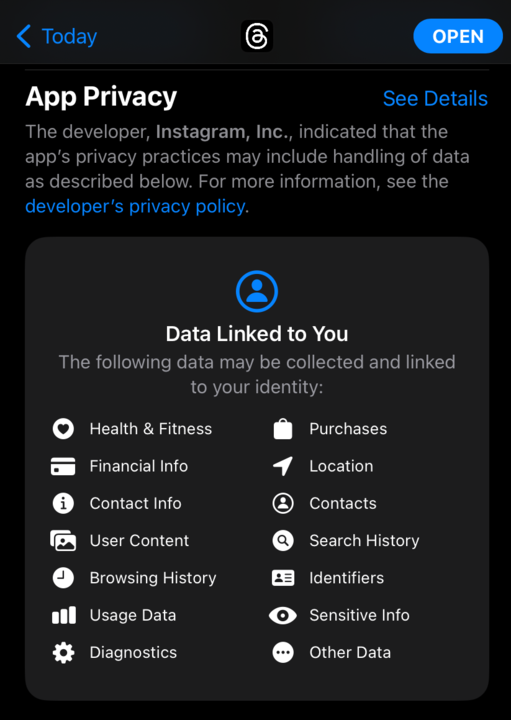
So #Meta's new #Threads app needs your health and fitness info. It also needs your browsing history and your location, and your purchases, and...well, it seems to need everything. If you want to get fully creeped out, here's the whole #privacy policy: https://t.co/zD3Znlqnu9.
Trivia: no two companies understand the CTO role (or VP, Principal, Staff, Lead, etc.) in the same way.
There’s a simple reason: no two companies are alike.
On top of that, FANG has added an invalid reference bc you probably don’t have thousands of devs.
#SetExpectations
@carlosazaustre@JoseAntPR No, no. Respeto 🫡
Os lo comentaba por si os interesa, han mucha oferta y funcionan de lujo. Y está siendo un hobby recordar viejos tiempos 👴🏻