Entropy points confirmed
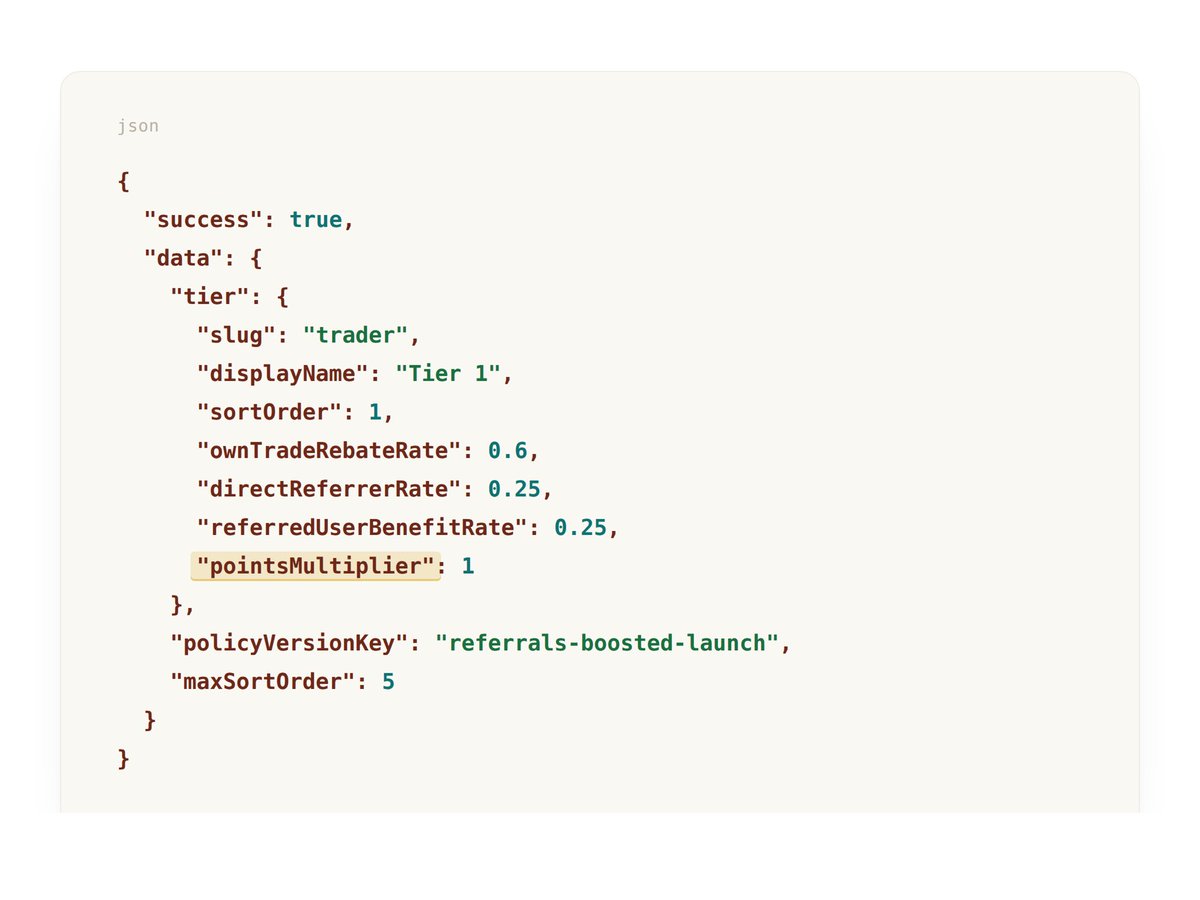
@entropyIO hasn't announced points. their API is already returning a pointsMultiplier field on every tier query. a team out of Jane Street, Citadel, and Polymarket doesn't ship a rewards field as decoration
the venue at a glance :
- HIP-3 deployer - TradeXYZ mechanics with points on top
- Anthropic pre-IPO perp live. no other on-chain venue has this
- Sandisk and RWAs on the ledger
- 24h volume under $100m - thin competition
- $45m raise led by @RibbitCapital ($14m cash + $30m $HYPE stake)
- 60% rebate on your own trades from the boosted tier
this is the window before it gets crowded.
25% off fees from your first trade + permanent tier if you use my code. link below
happy ATH $LIT day
which perp will perform next?
for example, with 10m points and 30% at TGE, one variational point would cost $113.4 with the same FDV
Variational $120 per point
$VAR docs got updated this week - 50% of total supply is going to community, distributed over time. first-drop share isn’t officially disclosed, but trader consensus sits around 25-30% of total supply at TGE
meanwhile, Polymarket has Variational hitting >$1B FDV at only 55%
I think Polymarket is underestimating this the same way it underestimated Lighter. here’s how I’m modeling it for myself:
Conservative: $1B FDV -> $30 per point
Base case: $2B FDV -> $60 per point
Optimistic: $4B FDV -> $120 per point
math :
FDV * 30% first drop / ~10M expected points at TGE
5 weeks left until the program ends. I honestly feel bad for people who still don’t know what Variational is
now is a great time to be buying points on OTC / NFA
last time i shared an early perp DEX it was Lighter
you know how that ended
today i'm sharing the second one. this is @entropyIO
an RWA-focused perp DEX on Hyperliquid via HIP-3. live this week. raised $45M led by @RibbitCapital
Ribbit backed Coinbase and Robinhood before either was obvious. their crypto rotation went Lighter first, Entropy second. that is not a coincidence
the team came out of Jane Street, Citadel, Optiver, Millennium, Radix, and Polymarket
what matters more: Entropy opened by listing perps no one else on-chain has offered. Anthropic pre-IPO is already trading. no other HIP-3 venue has this
TradeXYZ is still the volume leader on HIP-3. Entropy will not beat that on funding. it beats that by being the only place you can take a leveraged position on a private AI lab
their API returns your fee structure raw
60% rebate on your own trades
25% off fees from your first trade
the policy key is called referrals-boosted-launch. these are launch rates, not the base tier
the same response has a pointsMultiplier field. Entropy has not announced a points program yet. the infrastructure is already there
open an account in this window and you keep those rates permanently. cheapest edge in perp DEX this year
i opened mine. access code below
We are releasing the first liquid way to trade Anthropic.
For far too long, frontier assets have only been accessible to a select few. We are here to bring them to the masses.
Introducing EntropyIO. We’ve raised $14M led by Ribbit Capital and a $40M HYPE stake to build both improved and entirely new markets, the first of which are live on Hyperliquid today.
now is the best time to farm points on perp DEXs
most of the venues you’re active on today should TGE into the peak of this cycle
$HYPE and $LIT already showed you what that looks like
ELON MUSK’S $200 AGENTS JUST REPLACED A $356,000 NVIDIA MARKETING SYSTEM
7 agents. 200 campaigns. $2,400 a year
this guy published the entire graph
$84,000 in software, $46,000 in competitor research, $38,000 in creative, $52,000 in agency fees and a $136,000 manager were compressed into one system that runs while the company sleeps
$356,000 became $2,400
148 times cheaper
the 7 agents do not work in a straight line. each one controls a single part of the operation, while only the planner is allowed to change the strategy
the scanner collects 840 live ads. the analyzer reads every landing page. the validator rejects 371 weak variants before the executor moves a single dollar
every decision is recorded with the evidence behind it. if a campaign is working, the system stays silent. if the data contradicts the plan, it wakes the operator
at 4am it killed 4 losing campaigns while the agency slept
one media buyer normally watches 9 campaigns. this graph watched 200 and reduced seven hours of work to one decision
marketing agencies were built around two assumptions
testing is slow
attention must be human
both stopped being true at 4am
the full build is in the article below: 7 prompts, the graph schema and the contradiction rule
THIS 23-YEAR-OLD RUNS 300 KIMI K3 AGENTS AT ONCE. OPUS 5 CHECKS EVERY ANSWER BEFORE IT REACHES HIS VAULT
300 agents. 100 companies. 3 verification passes
he opens the dashboard and launches the entire swarm against the EV market
Kimi K3 researches 100 companies in parallel while Opus 5 compares every revenue figure, field and citation against the original source
the first pass returns 12 failures
wrong revenue numbers, dead citations and missing fields are rejected automatically and sent back into the loop
the second pass leaves 3 failures
the third leaves zero
only then does the system file every verified row directly into his Obsidian vault
most agent systems stop when the work looks finished
his stops when nothing is still wrong
that is loop engineering with teeth
300 agents create the speed
one verifier decides what becomes memory
THIS GUY SENT 300 KIMI K3 AGENTS AFTER 100 COMPANIES. THEY RETURNED ONE GRAPH HE CAN SELL AGAIN EVERY WEEK
300 agents. 100 companies. $1,000+ analyst job
instead of producing 300 reports nobody wants to read, the swarm compressed everything into one connected market map
384 entities. 1,064 typed relationships. 8 actions the system is allowed to perform
swarm_launch.md defines the task, sources and stop condition. CONSTRAINTS.md stores corrections from every previous run, while the graph keeps the companies, people and relationships that should survive after the session closes
one company appeared at the center with 12 incoming connections
it was the vendor everyone depended on and nobody had mentioned in the original prompt
most useful questions could already be answered within 2 hops
the loop decides when research starts
the graph decides what gets remembered
context engineering decides what the next 300 agents receive instead of forcing them to start from zero
one run can replace a four-figure competitive analysis and finish unattended in roughly an hour
then the same graph becomes a weekly retainer. every new company, dependency or market shift adds another edge the client can pay to discover
build the map once
charge every time the market changes
the full stack is in the article below
300 AGENTS JUST FINISHED WORKING IN PARALLEL. THE REAL BREAKTHROUGH IS WHAT THEY LEFT BEHIND
300 agents. 44,850 possible relationships. 1 shared memory layer
running hundreds of agents is no longer the hardest part
the problem begins when thousands of completed steps, discovered entities and conflicting results have to become useful to the next agent
100 entities create 4,950 possible pairwise relationships
at 300, that number jumps to 44,850
a shared context graph turns those isolated discoveries into one connected map. every run adds new entities, strengthens relationships and leaves behind structure instead of another pile of transcripts
the next agent does not start from zero or receive a larger folder of raw data
it inherits a better understanding of how everything connects
parallel agents create the work
shared memory compounds it
the real multi-agent breakthrough is not running 300 agents at once
it is making agent 301 smarter before it starts