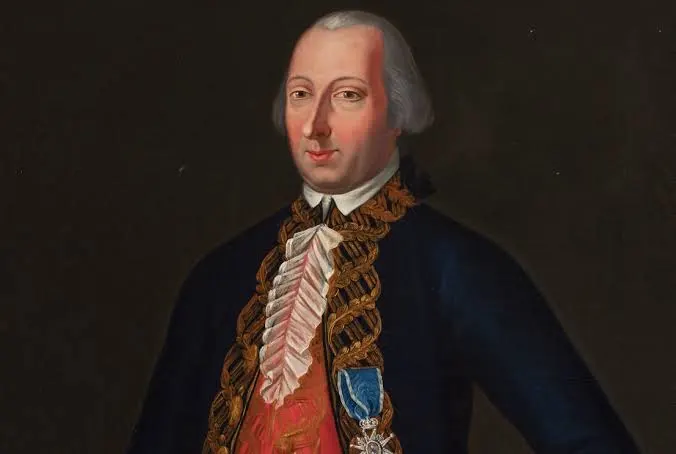
245 years ago today, a 35-year-old Spanish nobleman fired a single artillery shell that redrew the map of North America, broke British power in the Gulf of Mexico, and arguably saved the American Revolution. His name was Bernardo de Gálvez. He's not in your textbook. He should be.
When Spain entered the war against Britain in June 1779, the American cause was bleeding out. Washington's army was unpaid and shrinking. The Continental dollar was worth pennies. The British had taken Savannah and were preparing to take Charleston. France was helping, but France alone couldn't bankrupt the British Empire.
Spain could. And in New Orleans sat the man who would prove it.
Bernardo de Gálvez y Madrid was 33 years old, the governor of Spanish Louisiana, a battle-scarred career officer who had been wounded fighting Apaches in northern Mexico and Algerians in North Africa. The day he learned Spain had declared war, he didn't wait for orders from Madrid. He raised an army of Spanish regulars, Louisiana Creoles, free Black militia from New Orleans, Acadian refugees, German settlers, and Choctaw scouts, and he went on the attack.
In three months he took Manchac, Baton Rouge, and Natchez. The next year he took Mobile. The British presence on the Gulf shrank to one last fortress. Pensacola, the capital of British West Florida, defended by Major General John Campbell with 1,500 redcoats, the 3rd Waldeck Regiment of German mercenaries, loyalist battalions from Maryland and Pennsylvania, and a powerful alliance of Creek and Choctaw warriors led by the brilliant mixed-race chief Alexander McGillivray.
Gálvez arrived off Pensacola in March 1781 with 7,000 men and a fleet. The Spanish naval commander, Admiral Calbo de Irazábal, refused to enter Pensacola Bay. The entrance was narrow, raked by British guns at Fort Barrancas Coloradas, and treacherous with sandbars. So Gálvez did something insane. He boarded his own little brig, the Galveztown, hoisted his personal pennant, and sailed her into the bay alone, in full view of the British batteries, daring the Royal Navy to sink him. The British fired and missed. The Spanish fleet, shamed, followed him in. For this he was awarded the right to put the words "Yo Solo," meaning "I alone," on his coat of arms by the King of Spain.
The siege ground on for two months. Gálvez was shot in the abdomen and the finger directing artillery and refused to leave the field. The British defenses at the Queen's Redoubt, also called the Crescent, held against everything thrown at them. And then, on the morning of May 8, 1781, a Spanish howitzer crew lofted a shell over the parapet. It dropped, by pure luck or perfect skill, directly into the open powder magazine.
The explosion killed roughly 100 defenders in a single instant. Waldeck grenadiers, British regulars, loyalists, all gone. The blast tore the redoubt's wall open like paper. Spanish grenadiers and Louisiana militia poured through the breach within minutes and turned the captured British guns on the inner works. Campbell knew it was over.
The next morning, May 9, white flags went up. By May 10 the entire province of West Florida belonged to Spain. Over 1,100 British troops marched out as prisoners of war.
The strategic consequences were catastrophic for Britain. The Gulf Coast was lost. The Mississippi was a Spanish river from source to sea. Britain could no longer reinforce its southern armies by sea from the Caribbean, and the Royal Navy's Caribbean squadron had to be redeployed. Five months later, Cornwallis surrendered at Yorktown, in a siege funded in part by 500,000 silver pesos that Gálvez and the people of Havana raised in a matter of days to pay French Admiral de Grasse's fleet to come north.
Without that money, no French fleet. Without the French fleet, no Yorktown. Without Yorktown, no independence on those terms.
Gálvez was made Count of Gálvez and Viscount of Galveztown. The bay he charted in Texas still bears his name, Galveston. His portrait hangs in the United States Capitol by act of Congress. In 2014, he was made an honorary citizen of the United States, an honor given to only eight people in American history, including Lafayette, Churchill, and Mother Teresa.
He died of yellow fever in Mexico City at 40 years old, three years after the war ended.
Most Americans have never heard his name.
He won the Civil War, broke the Klan, went bankrupt at 62, got terminal throat cancer, and wrote one of the greatest books in American literature in the final year of his life. He finished it 5 days before he died.
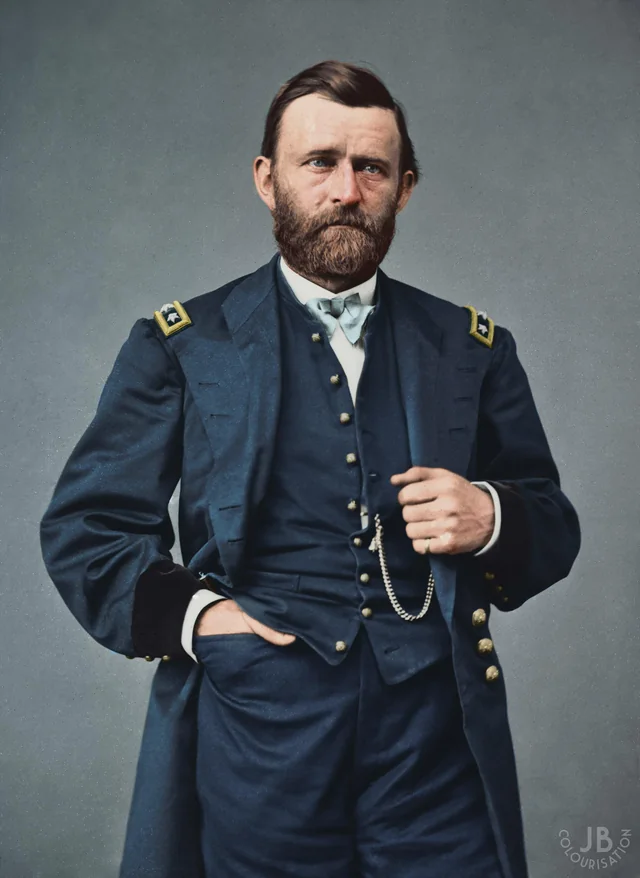
Ulysses S. Grant was born 204 years ago today.
His name wasn't even Ulysses S. Grant. He was born Hiram Ulysses Grant in Point Pleasant, Ohio on April 27, 1822. The congressman who nominated him to West Point wrote down the wrong name. Grant kept it. The "S." stands for nothing.
He hated his father's tannery and loved horses. Graduated 21st of 39 at West Point. Fought in the Mexican-American War, then came home convinced it was an unjust war designed to expand slavery. He later said he believed the Civil War was divine punishment for it.
He married Julia Dent in 1848, into a slave-owning Missouri family. His abolitionist father refused to attend the wedding. In 1859, broke and desperate, Grant freed the one enslaved man he'd briefly owned instead of selling him. He could have gotten a year's wages.
In the Civil War he became what no other Union general was: relentless. Vicksburg (July 4, 1863) split the Confederacy in half. Lincoln then gave him every Union army. His Appomattox surrender terms: officers kept sidearms, men kept horses for spring planting, no one prosecuted.
As president (1869 to 1877) he did something no president would do again until LBJ: used federal troops to crush the Ku Klux Klan. He suspended habeas corpus in 9 South Carolina counties, prosecuted Klansmen before predominantly Black juries, and broke the first Klan.
His presidency was also rocked by scandal: Black Friday 1869. Crédit Mobilier. The Whiskey Ring. Belknap. Grant himself never took a dime. He was just disastrously loyal to corrupt friends. The pattern damaged his reputation for a century.
After the White House, he toured the world for 2 years. Dined with Queen Victoria. Met the emperor of Japan. Then in 1884, a Wall Street partner named Ferdinand Ward ran what we'd now call a Ponzi scheme. Grant was wiped out. 62 years old. Penniless.
Weeks later he was diagnosed with terminal throat cancer. Mark Twain offered to publish his memoirs. Grant wrote in agony, sometimes 50 pages a day, racing the disease to leave Julia an inheritance. He finished the manuscript July 18, 1885. He died July 23.
The book made Julia $450,000, about $14M today. It's now considered one of the finest memoirs in the English language. For decades historians ranked Grant a failure. Since 2000 he's jumped 13 spots in the C-SPAN survey, the biggest rise of any president.
Happy birthday, General 🇺🇸