USA. A Mexican restaurant. We had not yet ordered anything, and the food was already arriving.
Chips. Salsa. Unrequested. Free.
I stopped the waiter. "We have not earned these."
"They just come with the table, man."
They come with the TABLE. In my land, hospitality is a debt. Every gift creates an obligation, weighed carefully, returned in the proper season with interest of feeling. Here, the gift arrives before you have even proven you can pay for dinner.
This is not an appetizer. This is a declaration: we trust you. Eat.
I ate with the gravity the moment deserved. And then — I must report this calmly — the basket emptied, and a new one appeared.
"Did we…?"
"Refill," the waiter said. "It's bottomless."
Bottomless. They have wells of salsa. The supply lines of this nation are beyond anything my ancestors imagined.
My friend warned me. "Don't fill up on chips, dude."
Too late. I had accepted three baskets. Honor demanded each one be finished — an unfinished gift is an insult. By the time my actual food arrived, I was a ruined man.
I was not hungry. I was not comfortable. I had been defeated by a courtesy.
Generosity that arrives before the request cannot be repaid. It can only be survived.
I know the rule now. I have made my peace with the basket. One basket. Two at the most.
Who am I deceiving. There is no number of baskets I would refuse. The trust of a nation is in that salsa, and I intend to honor all of it.
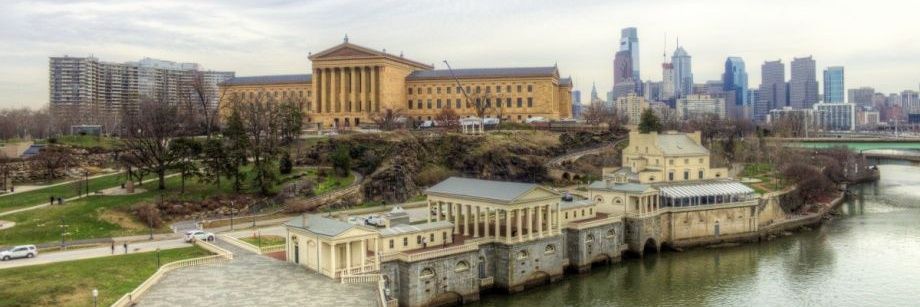
if you would’ve told me 13 years ago that zayn malik would live in bucks county and hang out in northeast philadelphia i wouldve laughed in your face but bro was really at paddy whacks last night
The railway line at the Bralos pass in central Greece, built in in 1908.
These days Greece can't even build a railway from Athens to Patras (that we already built in 1884).
It’s interesting how many generations of bad decisions contributed to Philly’s predicament. Hinkie gave them an almost foolproof asset surplus.
But Colangelo traded for Fultz.
And Brand chose Tobias/Simmons over Jimmy.
And Brown traded Bridges.
And Morey signed those contracts.
I wish this was fake but residents near Driscoll’s berry farms report a 38% higher incidence of childhood cancer.
Santa Cruz County is the heart of California's $3B strawberry industry and home to Driscoll's world headquarters.
Coincidentally, it also has the second-highest childhood cancer rate of any county in California.
At 22.5 childhood cancers per 100,000 children, the rate is more than 38% above the statewide average of 16.3.
Over 5,060 acres of pesticides linked to those same cancers are sprayed in the Pajaro Valley every year to grow 40% of California's strawberries.
Worst of all, it’s often next to schools and homes where children spend most of their time.
According to the latest data, over 2,000,000 pounds of pesticides were applied just in this school district’s area alone.
Driscoll’s is reported to apply two together:
1. 1,3-D: fumigant used to sterilize the soil, officially listed by the state as a carcinogen, causes tumors in multiple animal studies
2. Chloropicrin: originally deployed as a chemical weapon in World War I, so toxic that it kills or disables test animals before scientists can even evaluate its long-term carcinogenicity
But yeah it’s probably just a coincidence all the kids are getting cancer?
This is why you need to be buying local and seasonal fruit.
Do not trust major corporations to do the right thing for our food or health.
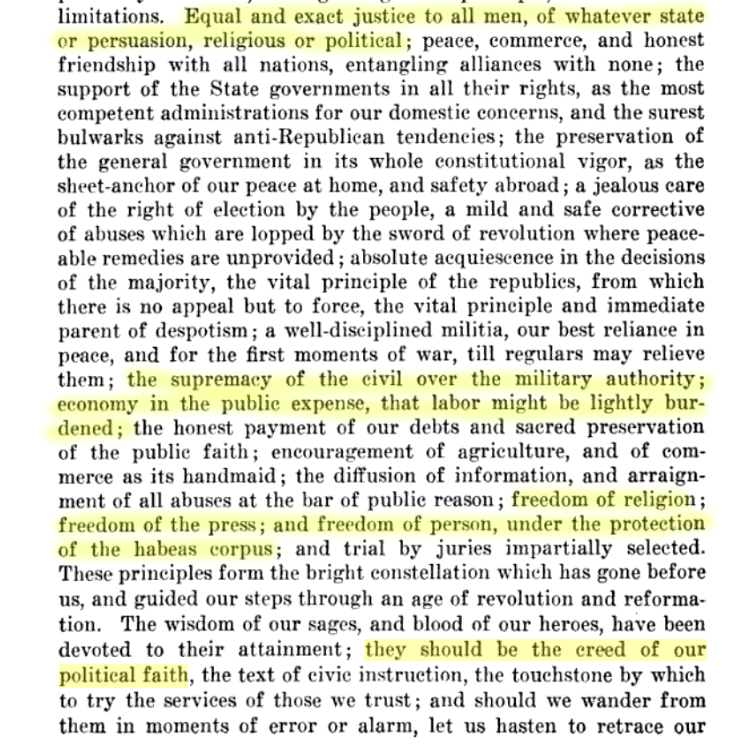
Thomas Jefferson's 1st inaugural address reveals why the Postliberal/New Right types went apoplectic over Justice Gorsuch's description of the United States as a creedal nation.
Jefferson shared that view, and the creed he described is the antithesis of postliberal ideology.
“There is a crime here that goes beyond denunciation. There is a sorrow here that weeping cannot symbolize. There is a failure here that topples all our success. The fertile earth, the straight tree rows, the sturdy trunks, and the ripe fruit. And children dying of pellagra must die because a profit cannot be taken from an orange. And coroners must fill in the certificate- died of malnutrition- because the food must rot, must be forced to rot. The people come with nets to fish for potatoes in the river, and the guards hold them back; they come in rattling cars to get the dumped oranges, but the kerosene is sprayed. And they stand still and watch the potatoes float by, listen to the screaming pigs being killed in a ditch and covered with quick-lime, watch the mountains of oranges slop down to a putrefying ooze; and in the eyes of the people there is the failure; and in the eyes of the hungry there is a growing wrath. In the souls of the people the grapes of wrath are filling and growing heavy, growing heavy for the vintage.”
One of the great general managers in MLB history was Pat Gillick, who moved from TOR to BAL to SEA to PHI, and won everywhere he went. He didn't believe in mass firings; rather, he would take a few key assistants into each job, and believed it was his responsibility, as leader, to help make the existing staff improve.
A Persian scholar finished a single math book in 9th century Baghdad that quietly became the foundation for every line of code running on Earth today.
I started reading about him at midnight and could not believe how many things in my daily life trace back to one man.
His name was Muhammad ibn Musa al-Khwarizmi. The book is called The Compendious Book on Calculation by Completion and Balancing.
Every time you say the word algebra, you are saying his book title. Every time someone says the word algorithm, they are saying his name. Both English words come from him. Both are Latin transliterations of Arabic and of his own identity. The man did not just contribute to mathematics. He named it.
Here is the part almost nobody tells you.
Al-Khwarizmi was born around 780 CE in Khwarazm, in what is now Uzbekistan. He moved to Baghdad and worked at a research institution called the House of Wisdom, which during the Islamic Golden Age was the single most important center of learning on the planet. The caliph al-Mamun hired the best mathematicians, astronomers, and philosophers from across three continents and put them in one building with one job. Translate, study, and produce new knowledge.
Al-Khwarizmi finished his book on algebra around 820 CE. The Arabic title contained the word al-jabr, which referred to one of the two operations he used to solve equations. When the book was translated into Latin in the 12th century, the Latin world did not have a word for what he had built. So they kept his Arabic word. Al-jabr became algebra. The discipline was named after a single Arabic word in the title of a single book by a single man.
The deeper insight is what he actually changed about how humans think.
Before al-Khwarizmi, mathematical problems were solved geometrically. You drew shapes. You measured them. You compared areas. The Greeks had built an entire mathematical tradition on visual proofs and physical constructions. It was beautiful and limited. You could not solve a problem you could not draw.
Al-Khwarizmi did something nobody had done before him at this scale. He said you could solve any problem using abstract symbols and rules. You did not need a shape. You needed a procedure. You moved terms across the equation. You cancelled like terms on both sides. You isolated the unknown. He invented the idea that mathematics is a manipulation of symbols according to rules, not a study of physical figures.
That single shift made everything that came afterward possible. Calculus. Differential equations. Linear algebra. Quantum mechanics. None of it works if math is locked inside geometry. He pulled it out.
The second thing he did is the one that changed how the world counted forever. He took the Hindu numeral system from Indian mathematics, refined it, and wrote a book introducing it to the Arab world. That system included the concept of zero as a placeholder, and a positional notation where the value of a digit depends on its location. Roman numerals could not do complex calculation. Hindu-Arabic numerals could.
When his book on numerals was translated into Latin as Algoritmi de numero Indorum, the word Algoritmi was just the Latin spelling of his own name. Europeans started calling the new method "doing algorism," then "running an algorithm." The word for the most important concept in computer science is literally his name in Latin.
The third thing he did is the part that should haunt anyone who works in tech.
His method of solving problems was systematic. Step one, do this. Step two, check that. Step three, if condition A, then do X, otherwise do Y. He wrote down procedures that could be followed by anyone, anywhere, who knew how to read. The procedure did not depend on intuition or genius. It worked because the steps worked.
That is exactly what an algorithm is. A finite, deterministic procedure for solving a problem. He did not just give us the word. He gave us the entire concept of programming a thousand years before there was anything to program.
When Alan Turing built the first abstract model of computation in 1936, when John von Neumann designed the first stored-program computer in 1945, when every engineer at Google, OpenAI, Anthropic, and DeepMind writes code in 2026, they are working in a paradigm that started with one man in Baghdad twelve centuries ago.
The strangest part is what happens when you walk into any tech office in San Francisco or Bangalore or Lahore today. Engineers say the words algebra and algorithm hundreds of times a day. They do not know whose name they are saying. Almost nobody can spell al-Khwarizmi correctly on the first try.
His original Arabic manuscript is preserved at Oxford. His book on Hindu numerals survives only in Latin translation. The Latin version was the textbook that taught medieval Europe how to count.
The man who built the foundation of the AI revolution did not live to see a calculator. He died around 850 CE, a thousand years before the first electric current was sent through a wire. The civilization he built mathematics for collapsed. The library he wrote in burned. His own grave is unmarked.
But every algorithm running on every machine on Earth right now still answers to his name.
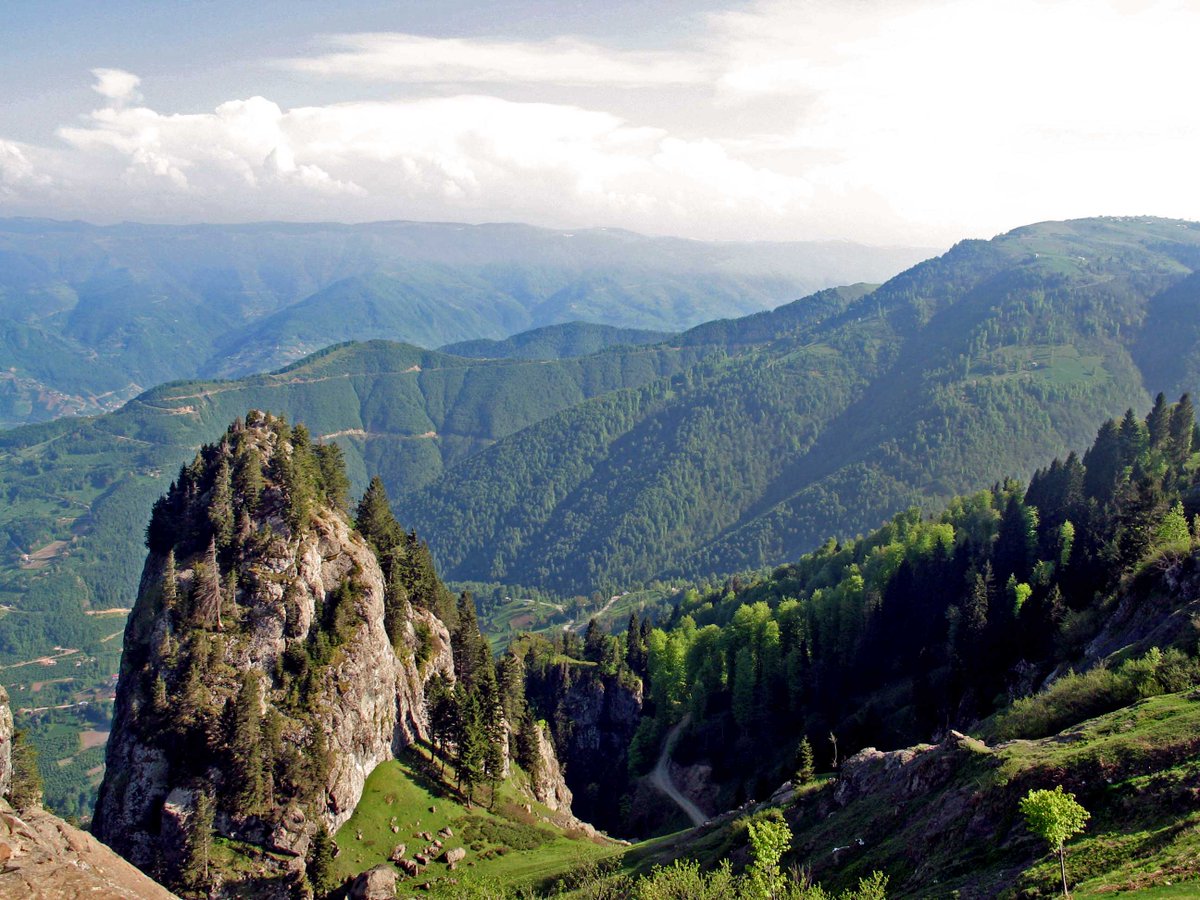
My grandmother met my grandfather in Laconia, where they fell in love and got married. However, my grandmother always felt incomplete, something was missing. What she missed was her home. Her origins were from a Greek city founded at the end of the 6th century BC by the Milesians. In that city, Greeks had lived continuously for 2,600 years. No one had ever expelled them from their ancestral lands or from the cities they themselves had founded, not even the Persians.
But things began to change gradually in more recent history.
From 1461 onward, the Ottomans and Mehmed II conquered the region. The Greeks started facing severe difficulties because of their status as Christians (dhimmis) in a Muslim empire. The perennial choice was to convert to Islam in order to end the suffering. Murders, slavery, abduction of children, torture, exorbitant taxes, seizure of properties, all of this would stop for a Greek who had lived in that land for 3,000 years if he simply changed his faith for the sake of people who did not belong there. They had come, just as many others had come before them, but none of the previous conquerors had been like the Ottoman Muslims and Islam. No one had ever been more inhumane and barbaric.
For about five centuries, the Greeks endured immense suffering. Many converted to Islam. But some did not break. They managed to hold on for 500 years, faithful to their blood, their ancestors, their values, and their religion.
So after 500 years, the time of reckoning had come.
The Turks could not tolerate it any longer; they wanted to create a pure homeland. They chose to build this new homeland on lands that had never belonged to them.
Therefore, every Christian, every Greek, every Armenian, and anyone who did not feel Turkish had to be expelled. Because "Turk" was not an identity with ethnic continuity and ancestors in those lands. A Turk at that moment was whoever had embraced Islam and renounced his past. Being Turkish was a fabricated identity without historical continuity in the region.
Thus, in 1922, my grandmother was forced to leave her home, the home of Greek ancestors who had lived there since the 6th century BC. She left because after five centuries, the barbaric conqueror gave her only one choice: convert to Islam or die. The Quran or the yatagan (sword).
My grandmother left. She escaped the genocide. She saw thousands of Greeks being slaughtered and dying of starvation, reduced to skeletons. But she managed to reach Greece. They first settled in Serres. There, the local Greeks welcomed them naturally as their own blood, as their brothers. They immediately helped them rebuild their lives. They helped them heal the wound of expulsion. Can you imagine it? Being driven out of your home? Running to save yourself so you wouldn’t be killed.
My grandmother, from Serres, which was then a small town in Macedonia in Northern Greece, eventually found herself in the Peloponnese. There she met my Laconian grandfather.
My Pontian grandmother met my Spartan grandfather.
The city from which she was expelled was Kerasounta of Pontus (today’s Giresun). It is located near Trebizond (Trabzon).
A city founded by Greeks in the 6th century BC, like the entire region of Pontus.
In Kerasounta were found the most fierce and battle-hardened Greek guerrillas of Pontus, who resisted heroically and died in the battle.
From there, my grandmother was forced to abandon her ancestral lands and flee to save her life. Yet she survived, she escaped death, and I, her grandson, born a Laconian, live today to fulfill her wish and her dream.
Do you want to know what her desire was? Read the story again. Read my article about the Genocide of the Greeks of Pontus. Put yourself in her place, and then tell me: what would your wish be if you were my grandmother?
I will fight to fulfill this wish of hers. If I do not succeed, I will pass the torch to the next generation.
Pontus – Greek Land
Ρωμανία 'πέρασεν, η Ρωμανία 'πάρθεν Η Ρωμανία αν 'πέρασεν, ανθεί και φέρει κι άλλο.
UPDATE: Letters from Leo can now independently confirm that the meeting took place — and that the Vatican was so alarmed by the Pentagon’s tactics that Pope Leo XIV shelved plans to visit the United States later this year.
Many in the Vatican saw the Pentagon’s reference to an Avignon papacy as a threat to use military force against the Holy See.