@elliotreports @nexta_tv China still lacks Good Samaritan laws. Making things worse, in an infamous lawsuit in 2006, a judge held a Good Samaritan liable despite witness testimony, ruling: 'If you weren't responsible, why would you help?' Both discourage helping strangers.
A person with Parkinson's disease can't walk because of severe freezing but put him on a bike and he is fine. Great case by Snijders and @basbloem Love the explanation: 'This striking kinesia paradoxica may be explained by the bicycle's rotating pedals, which may act as an external pacing cue. Alternatively, the motor-control mechanisms involved in gait as compared with other activities engaging the legs, such as cycling, could be affected differentially in Parkinson's disease. Cycling may offer a useful approach for exercise training in patients with Parkinson's who are “grounded” by severe freezing of gait.' https://t.co/fq5oe2oodu https://t.co/fq3jiDgUBC
@pereabuc Interesting. Maybe some of them just used small enough flip angles for a short d1 (and wide SW)? The off-resonance peaks can be theoretically calibrated by the excitation profile.
A beautiful NMR titration figure, congratulations on the great work! I'm thrilled to see the affinity was determined by TREND. Thank you! cc @vandosteve
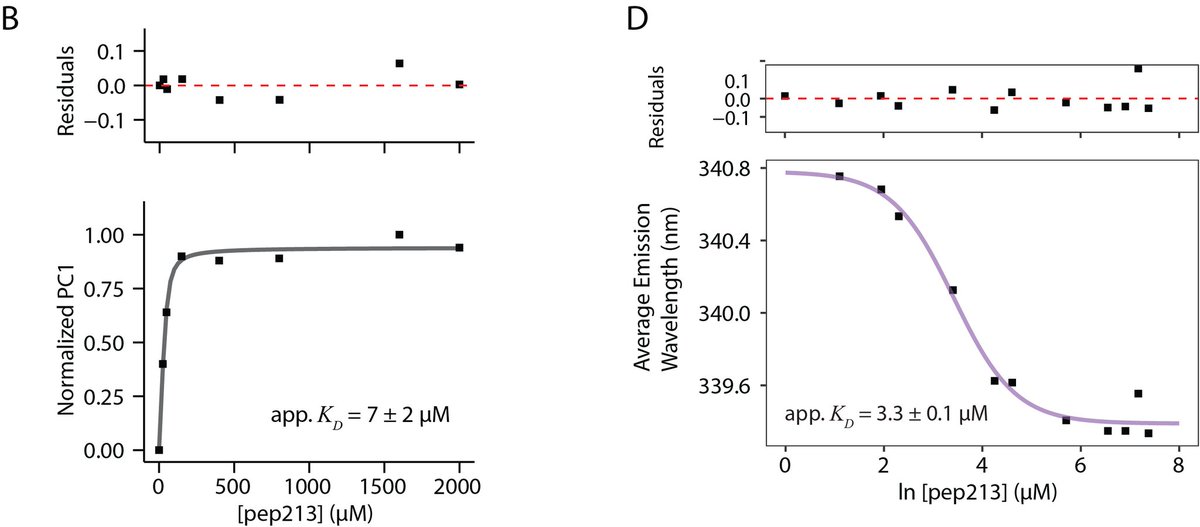
We used biophysical techniques to interrogate the peptide-Fis1 interaction. Using 2D HSQC NMR and intrinsic tryptophan fluorescence we determined binding affinities and protein-peptide specificity 7/8