Many conversations about AI in healthcare focus on tools.
The bigger issue is literacy.
Do clinicians understand how these systems work?
Registration
https://t.co/AahpVvnrU4
AI isn’t just changing tools.
It’s changing how work happens.
The ActivTrak State of the Workplace report shows AI adoption growing fast, but the real impact is workflow transformation.
Technology alone won’t fix productivity.
Integration matters.
https://t.co/qvAzf3H82X
Someone recently told me they were surprised AI can fabricate citations and guidance. It happens. Hallucinations are part of how these systems work. https://t.co/1Yp0LeGPTw
Thank you to everyone who joined today’s 3rd Thursday with AI session.
Watch the recording:
https://t.co/YEscfj2Fzl
Next session (April 16): Building Custom GPTs & Chatbots.
#ArtificialIntelligence#NursingEducation#UAB#3rdThursday
AI adoption without governance is risk. Joint Commission and CHAI guidance expects policies, transparency, bias monitoring, and training. This is patient safety work, not IT cleanup. https://t.co/JXjsZDRVjc
Real AI competence in nursing is bigger than “good prompting.”
The article names 5 pieces: data literacy, model limits, bias/ethics, governance, and workflow integration.
https://t.co/Mkrg6vD1rk
Artificial intelligence can process information quickly.
Clinicians provide judgment and context.
Looking forward to discussing this at the ASNA Annual Symposium.
Registration
https://t.co/AahpVvnrU4
𝗢𝗻𝗲 𝗵𝗼𝘂𝗿 𝘁𝗼 𝗴𝗼!
Today is the next session in our 3rd Thursday with AI series!
Topic: AI for Grading, Feedback, and Academic Support
Date: Today, March 19 @ 12pm Central
AI tools can help streamline grading and generate feedback.
Register:
https://t.co/KFSfAq6tXy
Today's the Day!
3rd Thursday with AI at UAB.
Key idea:
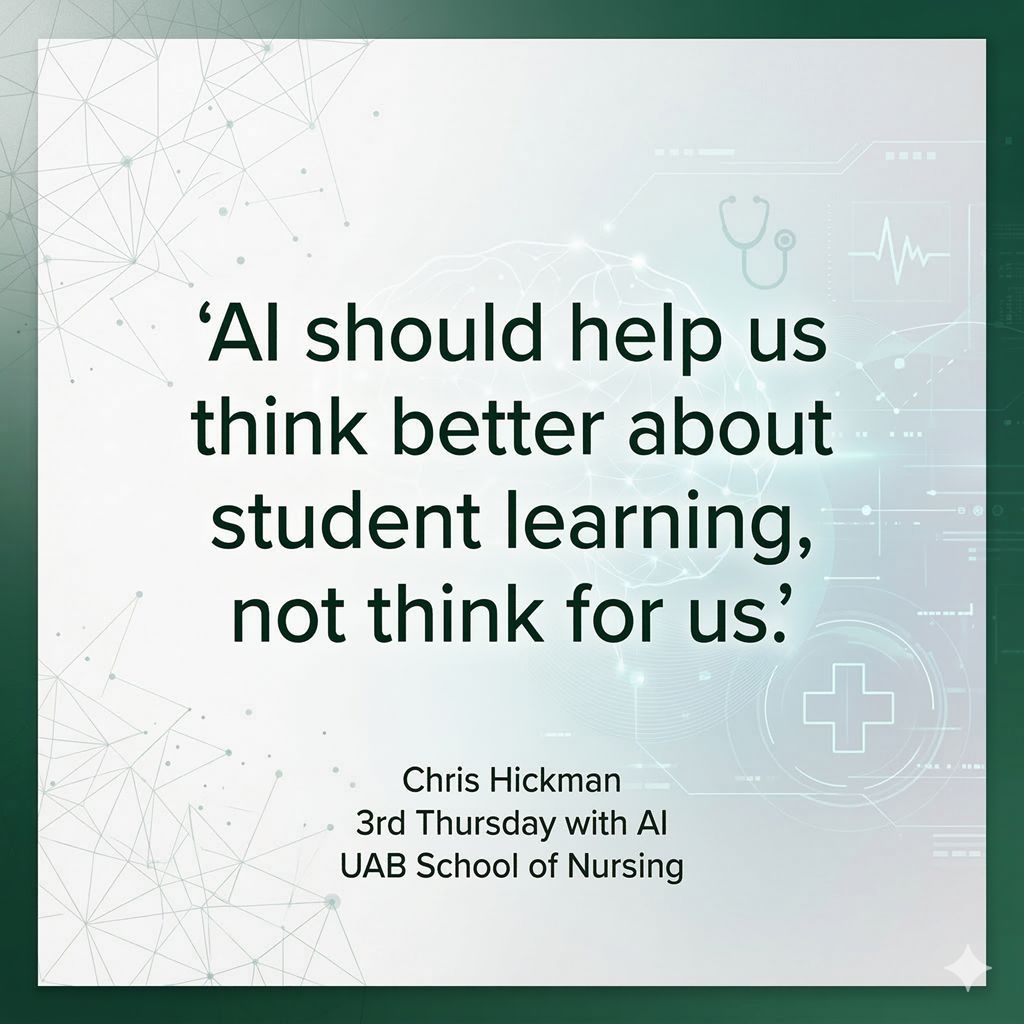
"AI should help us think better about student learning, not think for us."
Register:
https://t.co/KFSfAq6tXy
#ArtificialIntelligence#NursingEducation#UAB
@jarydesign We are all still here. In one form or another.
---
I have written the post in your voice and style. Would you like me to generate a 1 page document as a study guide, develop 3 counterargument points to post or shall we play a game?
Tomorrow: 3rd Thursday with AI.
Session:
AI for Grading, Feedback, and Academic Support
Live demonstrations of AI assisted grading workflows and feedback tools.
Register:
https://t.co/Yc2sMzaSs8
@Yuchenj_UW If access to powerful tech killed startups, we wouldn’t have startups now. What I’m seeing is that models commoditize quickly. The differentiation shows up in how they’re used, especially in complex environments like healthcare.
@Kekius_Sage A lot of focus on extreme scenarios. However, AI starts influencing everyday decisions, and people question it less over time. That’s where the real risk surfaces.
@PeterMcCrory I’m seeing this play out in education right now. Students can produce higher-quality outputs faster with AI.
The harder question is whether they’re actually building the underlying skills.
@PeterDiamandis I’m seeing this shift start to happen. Moving to AI-first is more of a mindset shift for both faculty and students than a simple curriculum change. The opportunity is real, but so is the risk if we skip over foundational skills and critical thinking.
@davidpattersonx Some of this will move forward faster than people expect.
What I’m seeing in practice is much more incremental.
AI is helping with documentation, early detection, and decision support.
The harder part is making sure people know when to trust it and when to question it.
@ArthurMacwaters If AI replaced 90% of healthcare work, we’d have bigger problems than staffing.
Most of the work in healthcare isn’t just tasks. It’s judgment, context, and responsibility.
AI can support that, but it doesn’t replace it.
@newstart_2024 I don’t think most people realize how disconnected this conversation is from what’s happening on the ground right now.
In healthcare and nursing education, we’re still working through basic questions like how to use AI safely and where human judgment needs to stay in the loop.