@General_Somto This is why Nigeria shld stop pretending to be a democracy. Imagine this woman's stupidity. Her reason is other people did 8 years so Tinubu should do 8 years.Nigeria full of illiterates, poverty capital of the world and the most out of school kids has no business with democracy
On this day in 1987, Burkina Faso’s🇧🇫 Marxist revolutionary Thomas Sankara was killed in a coup backed by NATO intelligence services. Here are his achievements in his short 4 years in power:
- Vaccinated 2.5 million children against meningitis, yellow fever and measles in a matter of weeks.
– Initiated a nation-wide literacy campaign, increasing the literacy rate from 13% in 1983 to 73% in 1987.
– Planted over 10 million trees to prevent desertification
– Built roads and a railway to tie the nation together, without foreign aid
– Appointed women to high governmental positions, encouraged them to work, recruited them into the military, and granted pregnancy leave during education.
– Outlawed female genital mutilation, forced marriages and polygamy in support of women’s rights
– Redistributed land from the feudal landlords and gave it directly to the peasants. Wheat production rose in three years from 1700 kg per hectare to 3800 kg per hectare, making the country food self-sufficient.
- Increased education spending: Government education expenditure rose by 42% between 1983 and 1987.
- Increased healthcare spending: Public health expenditure rose by 27% between 1983 and 1987, according to research by economist Emmanuel Harsch and other scholars.
- Expanded rural healthcare: By January 1986, more than 7,460 primary health posts had reportedly been established across Burkina Faso, approximately one per village.
- Expanded access to drinking water: The revolutionary government constructed 600 wells and 1,100 boreholes in 1986, alongside investment in small dams and irrigation.
- Accelerated road construction: Burkina Faso reportedly built an average of 106 km of paved roads annually, compared with an average of 59 km annually during the preceding 23 years, an increase of approximately 80%.
- Increased cereal production: Annual cereal production rose from approximately 1.12 million tonnes in 1983 to 1.64 million tonnes in 1987, an increase of roughly 46%.
He was assassinated in a coup led by Blaise Compaoré, a man who Sankara considered a brother before their relationship deteriorated. Compaoré betrayed the revolution, and reversed the country’s revolutionary direction, putting the chains of foreign neocolonial dependence back on Burkina Faso.
With the arrival of Captain Ibrahim Traore to power, Burkina Faso once again has changed course back onto the revolutionary path.
“You cannot build a road on the coast from Lagos to Calabar. I mean, you can’t even go through Bayelsa. Bayelsa is swamp. Even Yenagoa, the capital, is swamp. You’ll probably have to build about 100 or 200 bridges to go through those swamps.”
——Donald Duke
@jon_d_doe I can't believe people are still asking if this is true in 2026. David Wood has been talking about this for over a decade. Where do people think ISIS and Taliban get their ideologies from. Actually this guy makes the most sense. The source of the radicalisation is Islam.
✡️ 🇮🇱 – Un écrivain juif antisioniste, Benjamin Moser, explique à Piers Morgan ce que les sionistes ont toujours recherché : la suprématie juive au Moyen-Orient et le fait que le projet sioniste plonge ses racines civilisationnelles dans le christianisme.
Seven years ago the ban was meant to end Huawei.
Last month it shipped a chip the sanctions were designed to make impossible, then today Qualcomm licensed the patents behind it.
In May 2019 Washington put Huawei on the Entity List and Google pulled Android within days, then by September 2020 TSMC had stopped making Kirin altogether. Richard Yu told a conference in China that year might be the last generation of Huawei’s high-end chips, while allies were also being leaned on to rip the gear out of their networks.
The charge was spying, a backdoor and a listening post disguised as a router.
The evidence never appeared. An 18-month review ordered by the White House and reported by Reuters in October 2012 questioned nearly 1,000 telecom equipment buyers and found no clear evidence of spying. One individual expressed it clearly, stating they would have found it if it existed. The congressional chairman who claimed customers had watched routers send valuable data to China was quietly corrected, because the company was Leap Wireless and its own investigation found infected computers and no stolen data.
Nothing since then has changed that. The trial that opened in Brooklyn on the 9th September runs on Iran sanctions, bank fraud, racketeering and trade secrets covering Cisco source code, a T-Mobile testing robot and an old Motorola file, with no espionage count anywhere on it. After seven years of bans the original accusation is still not on the charge sheet.
Huawei was already the world’s largest maker of telecoms equipment and, in the second quarter of 2020, briefly the largest phone maker on earth, the first company outside Samsung and Apple to top the table in nine years. The cut-off was meant to stop it there, but it did the exact opposite.
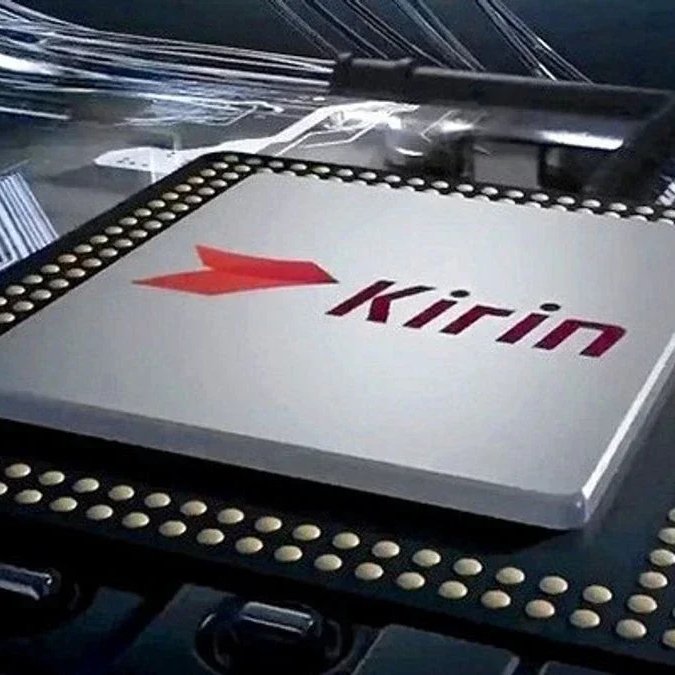
Without Android it built HarmonyOS and without TSMC it turned to SMIC and DUV multi-patterning. When the Mate 60 Pro appeared during a visit by the US commerce secretary in 2023, teardowns found a SMIC 7nm Kirin 9000s built without EUV, so Washington opened a probe. The Commerce Department’s own statement revealed the honest truth: the restrictions in place since 2019 “have knocked Huawei down and forced it to reinvent itself”.
The machines came next. Chinese immersion DUV scanners are in production-line validation at domestic fabs, where Huawei’s own investment arm has put money into the domestic light source and the projection optics. When that story arrived in July, ASML lost about 44 billion dollars of market value in a single day.
The architecture changed after that. On the 7th of September 2026, in Guangzhou, the Mate XT 2 shipped on the Kirin 9050 Pro, the first mass-produced phone chip built on Huawei’s Tau scaling law and LogicFolding. Instead of waiting for a smaller transistor (following Moore’s Law) it stacks logic and shortens the wire. Density goes from about 155 million to 238 million transistors per square millimetre, which is a step the older geometric treadmill needed three years to make. Multi-core performance is up 52% with the whole device 42% ahead of the previous Mate XT.
The honest part is that this is still a 7nm-class chip printed on DUV with Bernstein putting it roughly 30% behind Apple’s newest, so the gap has gone from four years to three rather than to nothing.
Four weeks after Guangzhou the Mate 90 series shipped.
Then Monday happened. Huawei and Qualcomm announced a multi-year cross-licence covering 5G, computing, AI and networking, with Qualcomm also buying a set of Huawei’s US patents in computing, AI and networking. Bloomberg reported that the agreement reaches near- and co-packaged optics as well as the patents underpinning LogicFolding, which means the American company that used to sell Huawei its phone chips is now licensing the architecture Huawei built to navigate around the ban.
Huawei first paid Qualcomm for patents in 2001 and the money ran one way for a quarter of a century. In 2020 Huawei handed Qualcomm 1.8 billion dollars in back royalties. Nikkei reported that once this agreement takes effect, Qualcomm becomes a net payer to Huawei for the first time ever. Huawei expects the total value of its patent licensing agreements to pass 6.9 billion dollars when the deal closes.
It needs US regulatory approval before that happens, so Washington still holds a vote on whether the company it blacklisted can collect royalties from San Diego.
Moore’s law was a manufacturing treadmill owned by whoever held the next ASML machine, while Tau is the workaround, performance by design rather than by permission. Washington spent seven years trying to keep China one node behind. Huawei answered by changing the ruler.
Living here in China, the shift seems usual nowadays. HarmonyOS is on 85 million devices, tri-folds sit on restaurant tables and the chip roadmap no longer asks Cupertino or Eindhoven for the next step.
A ban with no public proof of spying built a rival that no longer needs your operating system, your foundry or your scaling law, one that now licenses the patents behind its own chip architecture to San Diego.
Who exactly got contained?
“This Is Not About VeryDarkMan, But About Christianity, Ministers Of The Gospel, And The Kind Of Gospel That Has Been Preached In Nigeria.” ~ Pastor Abel Damina Shares His One-Cent Take On The VDM And Apostle Arome Osayi Saga 👀
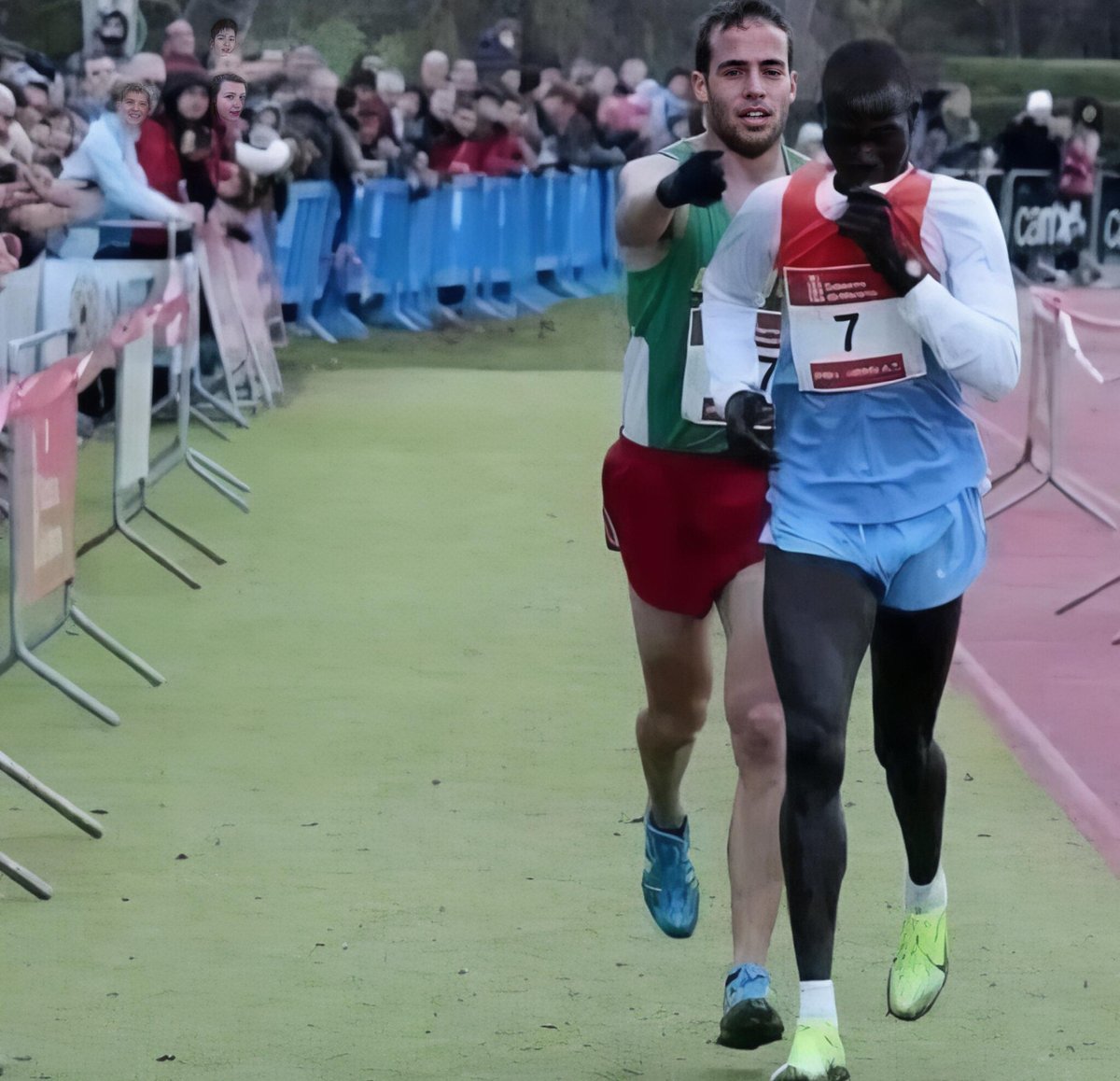
🚨WOW: The legendary moment Spanish runner Iván Fernández Anaya refused to steal a victory from Kenyan Olympic medalist Abel Mutai!
During the 2012 Burlada Cross-Country race in Spain, Mutai was leading the pack when he mistakenly pulled up just meters before the actual finish line, believing he had already crossed.
Following right behind him, Spanish athlete Iván Fernández realized Mutai was confused due to the language barrier and race setup.
Instead of sprinting past him to steal the first-place gold, Fernández slowed down, pointed Mutai toward the true finish line, and physically guided his rival across first!
When reporters repeatedly questioned why he gave up a guaranteed win, Fernández gave a masterclass in honor and integrity:
"I didn't let him win, he was going to win. The race was his... What would be the merit of my victory? What would be the honor of that medal? What would my mother think?"
A powerful lesson for humanity that true character, honor, and values matter far more than winning at all costs!👏🏾
@jabaroky@BaT_MaN_23@grok Lol! You must be a joker. Islam did not exist until more than 600 years after Jesus birth. If we're going by age it doesn't even qualify. Zoroastrianism, Judaism, Christianity, Hinduism , Buddism are all older than Islam.
China: dictatorship of the proletariat > the 99.9% rule. USA: corrupt democracy of the oligarchs > the 0.01%.
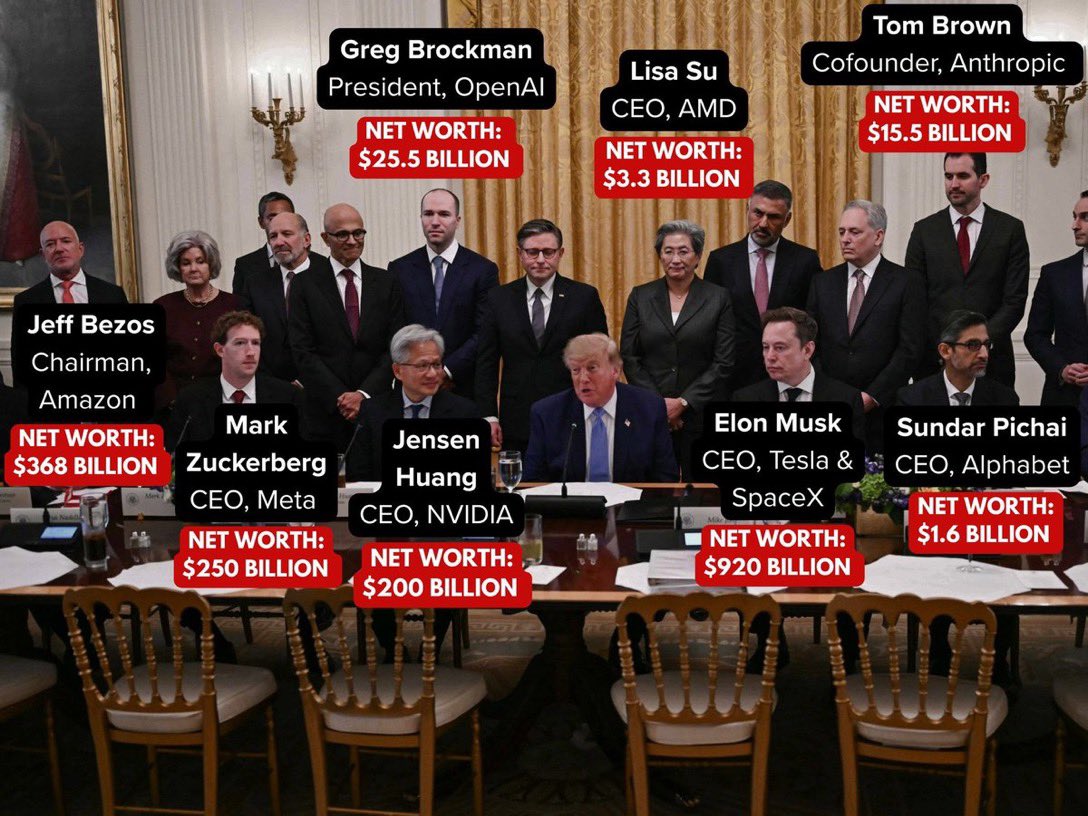
Look at the photo. One table. The US president in the middle. Around him the people who actually run the American machine.
Jeff Bezos, Amazon, $368 billion. Mark Zuckerberg, Meta, $250 billion. Jensen Huang, Nvidia, $200 billion. Elon Musk, Tesla and SpaceX, $920 billion. Sundar Pichai, Alphabet, $1.6 billion. Greg Brockman, OpenAI, $25.5 billion. Lisa Su, AMD, $3.3 billion. Tom Brown, Anthropic, $15.5 billion.
That is not a US cabinet. That is the ownership class sitting down with the US state. Platforms, chips, AI, space, retail, the information pipe. Net worth on the name tags, because net worth is the real credential. Elections come and go. This table does not.
China still uses the old Marxist label. Dictatorship of the proletariat. Western media hears “dictatorship” and stops there. The rest of the sentence never gets read.
Look at what the Chinese rule actually does. Capital does not buy candidates. It does not own the newsrooms that set the frame. It does not write the laws through lobby shops, then sit on the boards that enforce them. The 0.01% can get rich. They cannot finance politics, capture the narrative, or turn the state into their instrument. That is the whole point of the label. In China, power stays with the many, not with the people who already have the money.
Call it what you want. On the ground China is a system where the 99.9% are not competing with billionaires for control of the ballot, the media, or the courts.
Now the USA.
The US calls itself a democracy. Fine. Whose?
The photo is the answer. Campaigns run on donor money. Media sits with a handful of owners. Think tanks, universities, regulators, even judges, move through the same revolving door. Policy follows the check, not the poll. When the 0.01% lose an election they do not lose the machine. Information, elites, law. All of it was already upstream of the vote. They just pull up a chair.
China bars the rich from buying the state. The USA lets them own it, seats them at the table, and still prints “democracy” on the brochure.
Words matter in this game. Dictatorship of the proletariat sounds ugly in English. Corrupt democracy of the oligarchs sounds respectable. Read the mechanism, not the slogan. The money in that US room is the mechanism.
On this day in 1949, out of the ashes of civil war, a war of annihilation by Japan, and domination by other foreign powers, communist revolutionary Mao Zedong officially declares the People’s Republic of China🇨🇳.
Life expectancy in 1949 was around 36, by 1972 it was around 61. Currently, it is 78.
China’s GDP grew from 67.9 billion yuan in 1952 to 364.5 billion yuan in 1978. In 2025, China’s GDP reached 140.2 trillion yuan.
Since 1978, China’s GDP has grown at an average rate of more than 9% a year.
Around 80% of Chinese were illiterate in 1949. Today, China’s adult literacy rate is above 95%.
Since 1978, China has lifted nearly 800 million people out of extreme poverty, accounting for more than 75% of the global reduction in extreme poverty during that period.
In 1981, around 840 million people in China lived below the World Bank’s international extreme poverty line. By 2022, the share living below the updated $3-a-day international poverty line was effectively zero.
China has accounted for nearly three-quarters of the global reduction in the number of people living in extreme poverty since 1978.
In 1949, China had around 2,200 kilometres of operational railway. By the end of 2025, the railway network had exceeded 165,000 kilometres.
In 1949, China had no high-speed railway. By the end of 2025, China had more than 50,000 kilometres of high-speed rail, more than two-thirds of the world’s total.
In 1949, China had around 81,000 kilometres of roads and no expressways. Today, it has more than 5.4 million kilometres of roads, including around 190,000 kilometres of expressways, the largest expressway network in the world.
China’s manufacturing sector has been the world’s largest for 16 consecutive years. Manufacturing accounted for more than 28% of global manufacturing value added during the 2020s.
China’s manufacturing value added rose from 26.5 trillion yuan in 2020 to 34.7 trillion yuan in 2025.
China’s industrial value added reached 41.7 trillion yuan in 2025, up from 31.1 trillion yuan in 2020.
China produced 16.52 million new-energy vehicles in 2025. That is more than 11 times the 1.46 million produced in 2020.
China has been the world’s largest producer and seller of new-energy vehicles for 11 consecutive years.
In 2025, China generated around 4 trillion kilowatt-hours of electricity from renewable energy, more than the total electricity consumption of the European Union’s 27 member states.
China added nearly 500 GW of renewable energy capacity in 2025 alone, accounting for more than 60% of global renewable capacity growth that year.
By the end of 2025, China had 4.84 million 5G base stations, more than five times the number it had in 2020.
China’s digital economy accounted for 33.1% of GDP in 2024.
China has built more than 3,500 basic-level, 8,200 advanced-level and 500 world-class smart factories, with 101 recognised “lighthouse factories”, the largest number of any country.
China has become the world’s largest economy measuring GDP at purchasing power parity. China’s GDP @ PPP is $44.3 trillion, while the United States’ GDP @ PPP is $32.4 trillion.
China’s share of global GDP reached approximately 16.9% in 2024, compared with a fraction of that level in the decades immediately following 1949.
China’s total goods trade reached 45.5 trillion yuan in 2025.
China has become the largest trading partner of more than 140 countries and regions.
The Belt & Road Initiative has expanded to more than 150 countries and 30 international organisations through cooperation agreements.
China’s grain production reached 1.43 trillion jin in 2025, with per-capita grain availability reaching around 509 kilograms, above the internationally recognised 400-kilogram food-security benchmark.
In 2025, China’s urban per-capita disposable income reached 56,502 yuan, compared with 26,955 yuan in 2013.
In rural areas, per-capita disposable income reached 24,456 yuan in 2025, compared with 8,896 yuan in 2013.
“Óle! Óle!” (“Thief! Thief!”). Lagos residents chant as President Bola Tinubu’s convoy arrives in Lagos following his return from France, after an extended period away from Nigeria amid ongoing economic hardship and public concerns.
Ingat momen ketika PM Israel berpidato di UN dan peserta sidang walk out?
Momen diatas diwujudkan menjadi sebuah video yang sangat indah dan menyentuh hati.
Video ini telah meraih lebih dari satu miliar penayangan di media sosial,
(produksi Televisi Press Iran)
♥️♥️🇵🇸
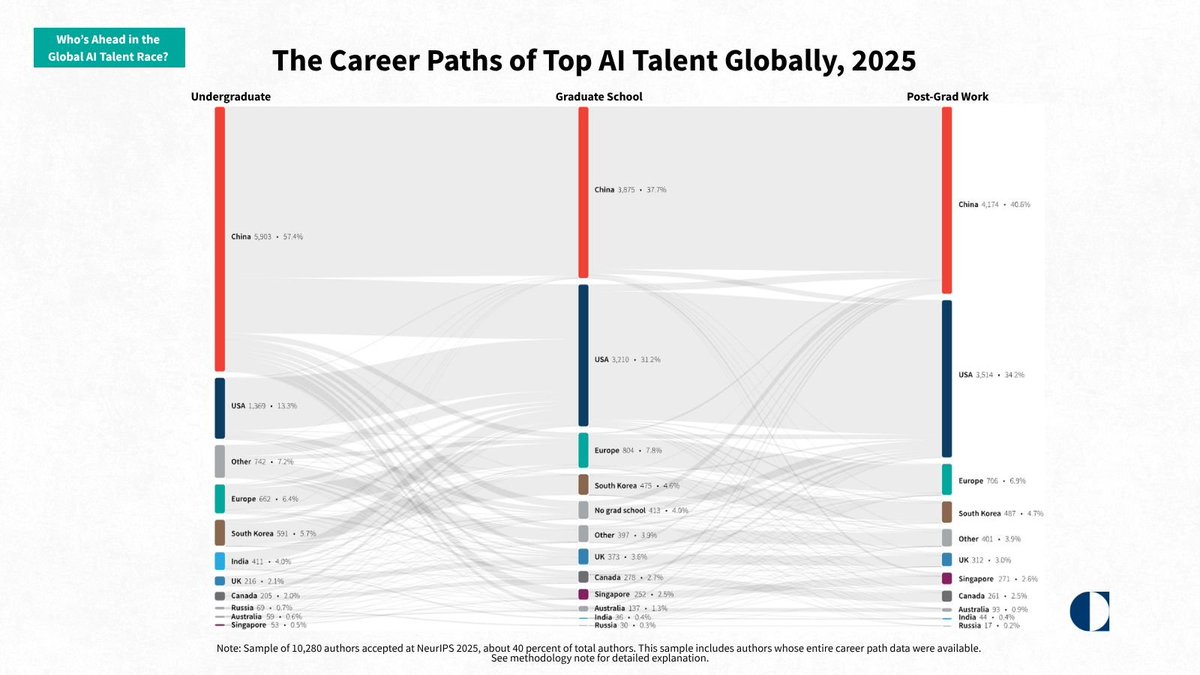
This is a fascinating graph which demonstrates the extreme dependence the US has on Chinese talent for AI.
At the undergrad level, the US only natively produces 13% of global AI talent vs 57% for China: it's only after immigration - mostly from China - that the US's share of top AI talent in the workplace climbs to 34%, and that China's reduces to 41%.
Which means that the AI "race" - to the extent there is one - is, in a very real way, really a race between Chinese who stayed in China and Chinese who moved to the US. Or, put another way, it's "made in China" vs "made by Chinese."
Remember that next time you read an article around the "China is stealing American technology" narrative.