seen a lot of people not understand this.
so let’s explain.
let’s say a land in Lekki is selling for ₦10m today and you think it’ll be worth ₦20m next year but you don’t have ₦10m right now.
so you meet the landowner and say “I’ll pay you ₦900k today just to reserve my right to buy this land at ₦11m anytime within the next year.”
the owner agrees.
two things can happen:
1. land goes to ₦20m → you exercise your right, buy at ₦11m, immediately sell at ₦20m.
profit of ₦9m. all from a ₦900k deposit.
2. land stays at ₦10m or falls → your reservation expires worthless. You lose the ₦900k.
the landowner keeps it and moves on.
the person who just bought the land outright?
they spent ₦10m. Land went to ₦20m, they made ₦10m profit.
good.
but you made ₦9m with only ₦900k.
thats the power.
but if land crashes to ₦5m, they still have land worth ₦5m.
you have nothing. your ₦900k is gone.
simple rules:
- only do this when you’re very sure the price will jump
- don’t use money you can’t afford to lose
- don’t wait till the last minute to cash out
That’s LEAPS.
A reservation bet on a stock’s future price.
Everyone looks at the FGN Savings Bond as one of those regular investments; but what if I told you that you can actually create a system that pays you salary every month without having to work using this same bond? Well, that’s what I have created for you for your future retirement or if you just want to catch cruise with a “careless” monthly income to spray around. And depending on how much you can invest, it could be as high as N1m or even N5m per month!
Let’s talk generally, so I don’t end up talking about myself.
1. Everyone is looking for problem-solvers. I have access to several billionaires, so I know even at that level, they crave problem-solvers.
2. Never ever ask people for help. Reserve that for people that are really close to you. Do everything within your powers, no matter how pressing, to avoid asking people for money/help. It’s even a cheap way to access them. This is where many miss it. They lead with their problems. They end up like most people.
3. Be excellent with conversations. Learn to engage people in a way that’d leave them feeling seen and heard. Too many times, people just want to talk about themselves. Don’t be that person.
4. Avoid ‘Happy New Month’ and other such messages. Avoid ‘I just said I should greet you’. There must be a purpose to every action. At a certain level, except they are really close to you, people don’t have time for stuff like that.
5. Be a person of value. Make yourself someone others want to meet.
It’s a new year so if you’re trying to take your finances seriously or a beginner to investing, this thread is for you. Bookmark and repost.
You can ask questions too. 💕
One of the most bizarre things I observed at Shell was how someone would spectacularly fail at a $$$ project, and instead of being demoted or fired, the opposite happens. They get transferred to manage another high-visibility project or even get a promotion!
It took me a long time to understand this but when I did, it changed everything for me.
You see, performance is measured in most companies on two prongs: the what and the how. The “what” is the actual result: did you or did you not strike oil after drilling that well? The “how” is the behavior you displayed during the entire process.
I was too focused on the actual results but I later found out that leaders rate behaviors higher. Hence, a project might fail in that it did not meet its stated objectives and yet the project manager might come out a winner because of how he carried himself through it all.
So what are the behaviors highly cherished by the higher ups?
First is daily updates. Forget weekly reports. Tell your boss and other key stakeholders about how the project is going at least once a day. When I say “tell”, I mean “tell.” Don’t rely solely on an email or a tool. Find a way to get in their face daily even if just for a min or two to verbally articulate the status of things. The pros at this put a standing 5-10 min meeting on their calendars and they come prepared to discuss the highlights and issues that need addressing. Which leads me to the second point.
Second, involve your superiors in solving the problem. Don’t form James Bond or Jackie Chan, trying to do it all alone. Any issue that will lead to a delay or cost overrun or any other wahala should be brought up asap to be discussed. Much easier to do if you talk with them daily. It is hard for them to blame you on the outcome of a project they have been integral to.
Third, conduct a “lessons learned” session where you perform an autopsy on the dead project. Share these lessons far and wide. You will be hailed as a sage. Suddenly you are now the guy helping the company become better by spreading wisdom gained from the school of hard knocks. This act alone has landed many people their promotion.
Bottom line: you can secure victory from defeat. The high flyers in your company do it all the time. If the project succeeds, they win. If the project fails, they win.
Be like them.
The things that excite me always come as a surprise to me.
I haven't been more excited in a while.
All over a car diagnostics scanner.
We always have cars that need diagnosis, our old scanner was basic.
If you are new to investing, do not start by chasing random stocks. Start by understanding sectors and owning quality companies inside them. This is how I am positioning for 2026.
1. Banking Fortress Stocks (Recapitalization Winners)
The March 31, 2026 recapitalization deadline is one of the biggest events in the market.
• Zenith Bank (ZENITHBANK): A strong dividend bank with an estimated yield of about 12 percent. It is already close to meeting the new capital requirements.
• GTCO (GTCO): One of the safest banks in the market. It has a strong history of efficiency and consistent returns to shareholders.
2. Energy Powerhouses (Growth and Dividends)
Energy is one of the most exciting sectors due to deregulation and major acquisitions.
• Aradel Holdings (ARADEL): One of the fastest growing energy companies on the NGX. After listing in late 2024, earnings grew by over 170 percent in 2025. This is a pure growth play in energy.
• Seplat Energy (SEPLAT): After acquiring Mobile Producing Nigeria, production increased significantly. A recent special dividend also makes it attractive for income investors.
3. Defensive Growth (Essential Products)
In an inflationary environment, companies that sell necessities perform better.
• Fidson Healthcare (FIDSON): Pharmaceuticals remain resilient. As local drug production grows, Fidson stands out for steady revenue growth.
• Presco (PRESCO): A leading palm oil producer with rising earnings and a strong dividend track record. Agriculture remains a solid hedge against economic uncertainty.
4. The Wildcard
• Dangote Refinery IPO: If this listing happens in 2026, it could reshape the entire market and instantly become the largest stock on the exchange.
We all agreed that this year, none of us are living hand to mouth again right?
Let me put you ON where to INVEST and WHAT to invest in, with tested & trusted platforms you can use across Nigeria, Canada, the UK, the USA, and Ghana so your wealth ACTUALLY grows.
*NOT AN AD*
I don’t understand why more people don’t use Google Gemini for stock research.
Not for tips.
Not for predictions.
But for thinking clearly before risking money.
Here are 10 detailed prompts I actually use 👇
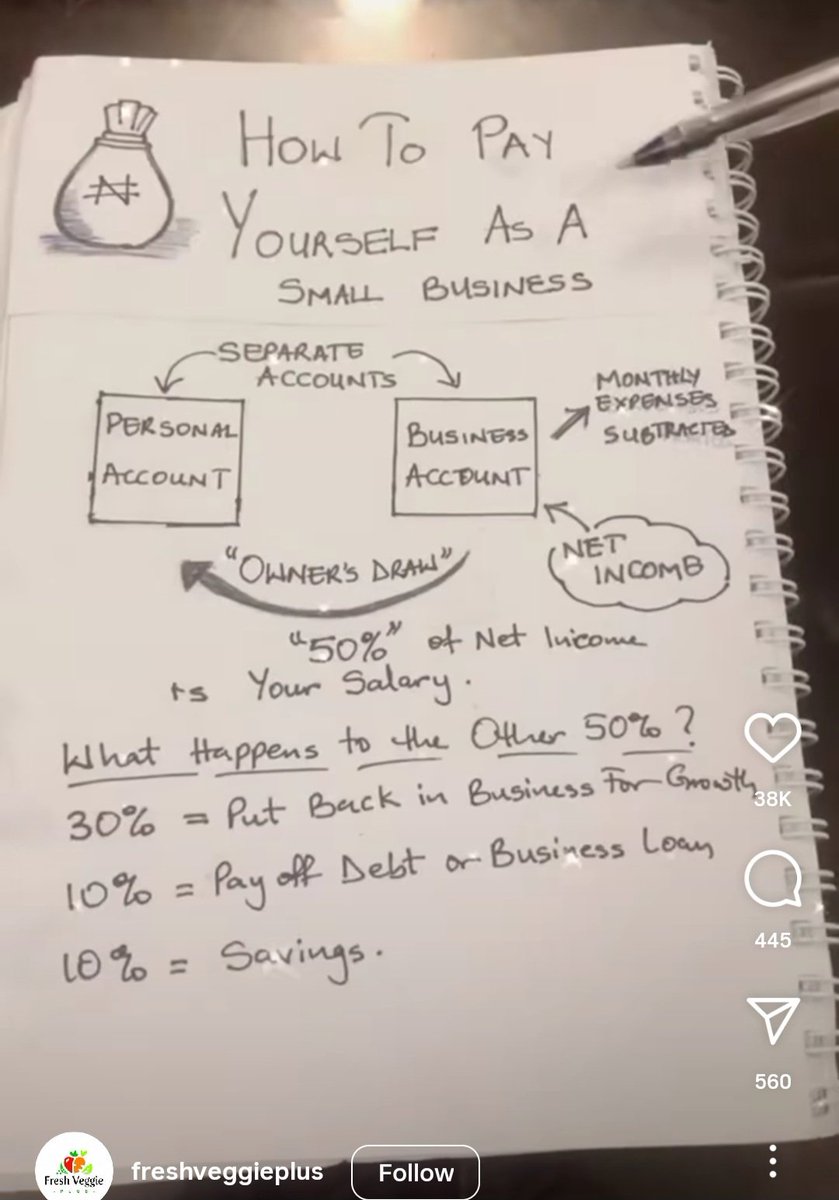
HOW TO PAY YOURSELF AS A SMALL BUSINESS OWNER
I came across this online, and since I’ve tried it myself, I can confidently recommend it to any small business owner (SBO) struggling with cash flow.
One major mistake most SBOs make is running business transactions through their personal accounts. This rookie mistake often leads to overspending and poor financial control. To avoid this, you must have two separate accounts: one for your business and one for personal use.
All business expenses should be paid strictly from the business account. This makes it easier to monitor expenses and accurately determine your profit margin at the end of a given period.
I also recommend using a simple Excel template to record and track your revenue and expenses daily. This way, you can easily assess the financial health of your business at a glance.
At the end of the month, after deducting all expenses, such as staff salaries, raw materials, supplies, staff motivation, transportation, marketing, taxes, miscellaneous costs, etc., from your revenue, whatever remains is your income.
This is where many SBOs become lazy and undisciplined. They start spending the income recklessly because they believe they can always make the money back and don’t answer to anyone. After all, it’s “their money.”
You can not have this mindset if you plan to grow and expand your business.
Instead, do this:
1. Pay yourself 50% of the income as an employee
There is you, and there is your business. Treat your business as a separate entity. When closing your books for the month, pay yourself a salary just as you pay your staff. Transfer this 50% into your personal account. This should cover your personal savings, expenses, and enjoyment.
2. Reinvest 30% of the income back into the business
This does not have to be spent immediately if there’s nothing urgent to purchase. You can set it aside until it’s enough to acquire new equipment or fund business growth. Just ensure the money is strictly reserved for the business.
3. Use 10% to pay off debt or business loans
If your business is debt-free, you can add this percentage to your business savings.
4. Save 10% in an interest-yielding platform
This savings is for your business, not your personal savings. Over time, it helps build financial stability and future expansion capacity.
I hope this helps someone out there. Financial discipline is especially challenging when you run a business that brings in daily income, but it’s also what separates sustainable businesses from struggling ones.
Day 29- This is a summary of how to start investing in the stock market as a beginner.
This is like a summary of everything I have been teaching in the last 28 days.
The safest way to travel is by plane. Do you know why?
Because they crash.
A few months ago, I learned a concept called Black Box Thinking which is a system that defines how entire industries respond to failure.
In aviation, when a plane crashes, they don't just look for who to blame.
They find a device called a Black Box, retrieve the data, and then ask what went wrong with the system.
And there is a reason for this.
To explain this, there is a famous story of a crash involving an Asian airline years ago.
When investigators listened to the recording from the black box, they found the engine didn't just fail on its own, the junior pilot actually noticed a mistake.
But because of a cultural hierarchy in Asia that demanded absolute respect for elders, he didn't question his senior pilot.
Instead, he hinted and spoke softly and the plane crashed.
That tragedy changed aviation safety forever.
It moved the focus from "Who made the mistake?" to "Why did the system allow this mistake?"
As we stand on the 29th of December, looking back at 2025, I want you to adopt this strategy of Black Box Thinking.
Most of us look at our failures this year and feel shame.
We hide the crash, and blame the economy, government, or something that does not exist.
But Black Box thinking demands a harder question: "How did I contribute to this problem?"
Did I stay silent when I should have spoken up?
Did I rely on motivation instead of a system?
Did I ignore the data because of my ego?
Don't bury your failures of 2025.
Open the box and analyze it.
Because that is the only way to fly safer in 2026.