people say AI will make your brain weaker.
maybe.
but gyms didn’t kill muscles.
they created an industry around training them.
wouldn’t surprise me if we eventually get:
thinking gyms
deep focus clubs
memory training spaces
“no AI” creative sessions
intellectual endurance coaching
the more automation grows, the more valuable trained cognition probably becomes.
would you actually pay to train your brain the same way people pay to train their body?
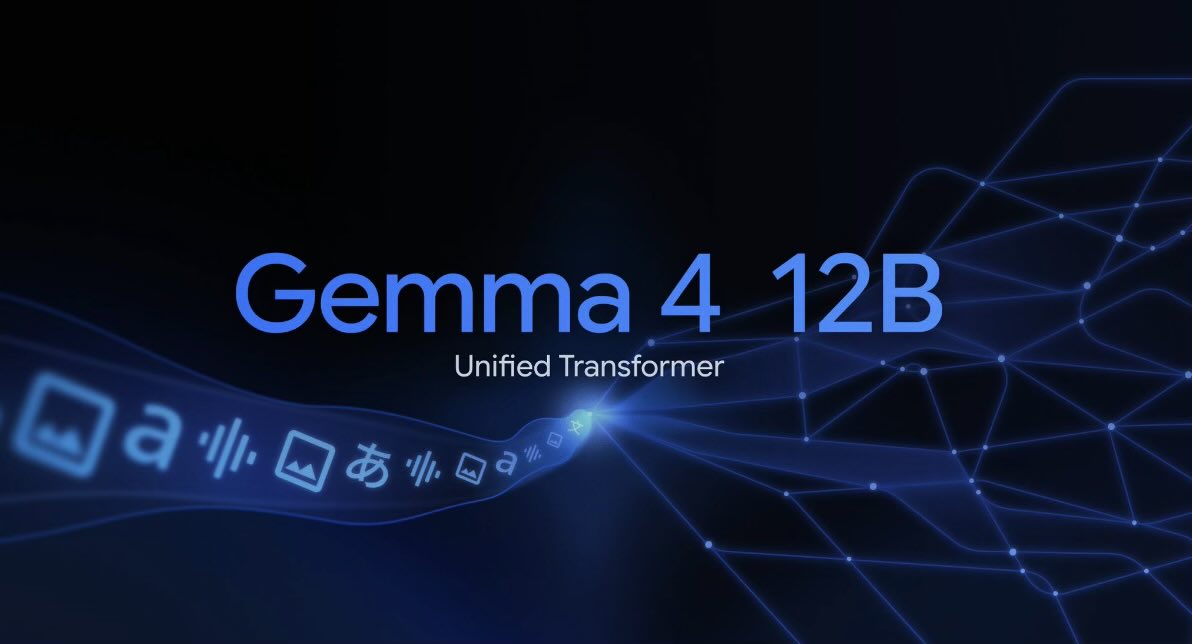
Gemma 4 12B is the kind of release that makes local inference feel practical.
multimodal.
small enough for a 16GB laptop.
usable commercially.
available through Hugging Face, Kaggle, LM Studio, and llama.cpp.
the interesting part is where it fits:
private docs, image understanding, extractors, classifiers, small assistants, local workflows.
cloud models for hard calls.
local models for repeatable work.
@ddddyland same direction. the interesting line is when local inference stops being a demo and starts replacing a specific OpenAI or Anthropic call in production.
what workload are you moving first?
people talk about AI as if opting out is a strategy.
it isn’t.
nobody won by ignoring electricity.
nobody won by ignoring the internet.
you can criticize AI.
you can regulate AI.
you can be cautious about AI.
but betting against it entirely is a different bet.
history has not been kind to those bets.
@ai_for_success encoder-free means image patches run straight through the main transformer as tokens alongside text. what quant level gets it into 16gb on ollama?
@Taniyatweets_ right. you can dislike the direction and still learn the tools.
refusal only feels principled until the job, product, or customer flow already assumes AI is there.
@mark_k passing 70% of behavioral tests but fully solving almost nothing points to a steep difficulty cliff in that last 30%. do they publish where the failures cluster?
what is happening with the @x algo lately? 🤔
same account.
same topic.
similar post quality.
one original post gets buried, one reply gets pushed, then a random follow-up wakes up hours later.
is reach becoming more about routing than content itself?
@aethon121@xai boring compatibility is the wedge. OpenAI-style APIs get local inference into existing apps, then evals decide if Ollama or vLLM can replace the frontier call for that task.
Hey @xai, help me find a way to #connect with the local inference builders.
llama.cpp, Ollama, vLLM, MLX, CoreML, GGUF, TEI, Qdrant.
embedders, rerankers, extractors, small tuned models, on-device LLMs.
especially teams moving repeatable AI workloads off OpenAI and Anthropic.
what are you running, and what broke first?
@Yamatoeth the copilot/claude/codex split maps better to trust boundary than task type. copilot is sandboxed to the IDE, codex runs in a cloud container, claude code gets full local machine access; that's what actually determines how far each can run unsupervised.
@MarkGPatterson@CodeByPoonam context starvation causes the silly things. pass it your existing file structure + stack constraints before asking it to code, and the ratio of useful output to cleanup flips.
@haider1 the 4.8 vs 4.6 regression question depends what they regressed on. sycophancy is the common tradeoff: lower benchmark scores but higher user satisfaction. what's your signal that 4.8 is the downgrade?
@gdb 5m weekly active, but the research and ops use cases are the part worth watching. coding tools commoditize, workflow integration takes longer to replace.
@YashHustle_22 claude api if you want the clearest docs and long context. openai api if you want the most community answers when you get stuck. what are you actually building?
@GalaxyBuilt yeah. job reqs will say prompting, but the actual skill is knowing what context to give Copilot, what work to delegate, and how to verify it before a customer sees it.
@GalaxyBuilt crypto stayed optional for a lot of jobs. AI is getting baked into GitHub Copilot, Google Workspace, Microsoft 365, support desks, and hiring funnels, so the opt-out window gets narrower quietly.
@artalar the actual question is whether openai's products access inference at the same price as external developers. if yes, it's just competition. if no, it's vertical integration abuse and antitrust regulators already have tools for that.
@DanielSmidstrup already happening in a narrow band. `claude code --dangerously-skip-permissions` with a well-scoped prompt can write, test, and push a feature start to finish. reliability on ambiguous requirements is the actual bottleneck.