Hey, I’m Chinaza 👋
Full-Stack & Mobile Developer building web apps, mobile apps & AI automations.
I’m sharing what I build, what breaks, how I fix it, and what I learn along the way.
Building in public
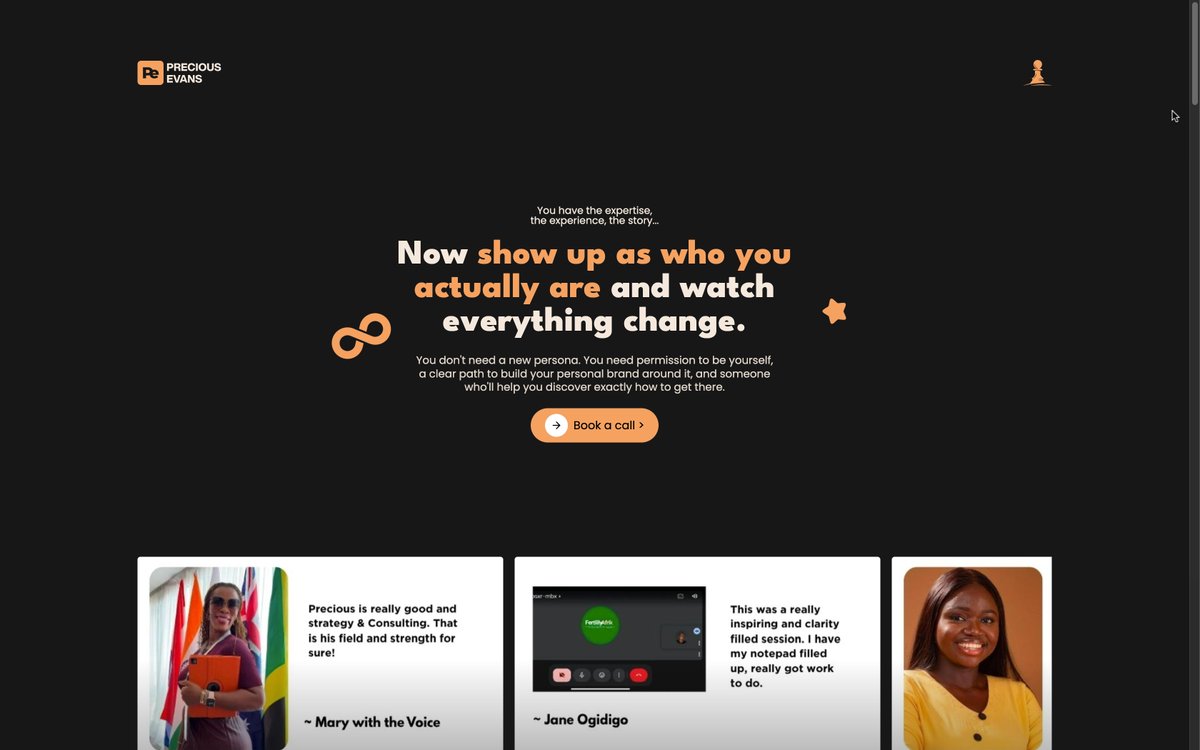
Just gave Precious Evans a fresh digital look, with a cleaner design, better user experience, and a modern feel.
Check it out: https://t.co/WWTm04KP50
Need a website or want to redesign your existing one? Send me a DM. Let’s build something great!
Another day, another set of bugs fixed. 💻
Just wrapped up some bug fixes and improvements on Bealodgr. A little cleanup here and there, making things better one update at a time.
Back to building! 🚀
🌐 https://t.co/SbrTR08TUa
#BuildInPublic#WebDevelopment#DeveloperLife
One thing I’m increasingly convinced of: AI won’t reward people who simply use it. It will reward people who know what good work looks like, can give clear direction, and can spot when the machine is confidently wrong. Tools are getting easier. Judgment is becoming more valuable.
Oil above $100 is a reminder that “global news” becomes personal very quickly. Energy prices feed into transport, food, logistics, cloud infrastructure and business costs. You can ignore geopolitics, but your budget probably can’t.
Apple’s new iPhone cycle keeps proving something about product design: specs matter, but people remember the experience. A better camera, battery or AI feature only matters when it removes friction. Tech companies often lose this while chasing feature count.
AI coding is moving past autocomplete. The interesting shift now is agents that can inspect a repo, use tools, run tasks and stay active longer. Developers won’t become irrelevant, but the job is clearly moving toward better judgment, architecture and verification.
Seeing AI leaders call for slower frontier development is interesting. I don’t think the choice is “move fast” or “stop AI.” The real question is whether safety can scale with capability. Powerful agents without strong guardrails are a product risk, not just a research issue.
Cursor cloud agents can now react to events, watch PRs, follow Slack threads and keep working toward a goal.
That’s where AI automation gets interesting.
Not “ask AI, get answer.”
Event happens → agent wakes up → takes action → checks result → continues until done.
n8n’s new Agents can be created once, then reused in workflows, chat, Slack or on a schedule.
That’s a bigger shift than “add AI to automation.”
We’re moving toward reusable digital workers with tools, memory and triggers that can operate across an entire business.
VS Code is starting to feel less like an editor and more like an agent control room.
Multiple agent sessions. Integrated browser. Better review workflows. Project-aware dictation.
The IDE is becoming the place where humans coordinate software work, not just type code.
GitHub is retiring several Copilot models today.
Good reminder for anyone building AI products: don’t build your workflow around one model name.
Abstract the model layer. Track quality, cost and latency. Models will keep changing faster than your product roadmap.
GitHub Copilot is moving beyond “chat in the IDE.” Agent sessions, cloud agents and deeper code review are starting to look like a delivery layer around software.
The skill shift: developers won’t just write code. We’ll design the system that writes, checks and ships it.
@alenmalkoc@flyrank_ai SARAJEVO 🇧🇦 I’d bring my closest friend @FiendishScott . I’d love to experience the culture, explore the city, and most importantly meet and learn from the FlyRank AI team in person. Definitely working for those leaderboard points.
Wowwwwww🤭 I am so excited to announce that I am now a @Cowrywise Ambassador!🎉. You should check it out here https://t.co/5UrNZjLNsh 👈🏼 (and ensure you register) 🤭
The more capable AI agents become, the more important permissions become.
An agent that can browse, execute code and call APIs is powerful.
But "complete this task" should never mean "do anything necessary."
Agent security is going to be a huge engineering problem.