High cortisol ages your face, shrinks your brain, and tanks your libido.
Here are 9 surprisingly simple ways to bring it down naturally:
1. Put your face in cold ice water.
45 million Americans alive today will die of Alzheimer's, and they have no idea it can be reversed.
A 2025 clinical trial found 90% of people in the treatment group improved their mild Alzheimer's, with a few fully recovering.
This is the full breakdown of the study:🧵
You don't need a gym.
You need Dumbbells and a system.
I'm a professional athlete. I've built and maintained elite strength with nothing but dumbbells more times than I can count.
Here's 48 exercises, every muscle group covered:
I just read about a phenomenon I can't stop thinking about:
"The Red Car Theory"
Once you understand it, you'll see it EVERYWHERE.
And it will change your reality FOREVER.
Here's how:🧵
Jordan Peterson explained how you can become dangerously articulate:
1. Articulate does not just mean well spoken. It means differentiated. A joint that is articulated can move with precision and grace. A person who is articulated can move through the world the same way. Vague people are one solid useless mass. Articulate people have range.
2. Peterson calls articulate people the most dangerous people in the world. Not dangerous in a destructive way. Dangerous in the sense that they cannot be ignored, dismissed, or pushed around. The word is the most powerful tool a human being can carry.
3. It does not matter what you do for a living. A plumber who is articulate can negotiate better contracts, manage employees, advertise services, and think through complex problems. Articulation is not a luxury for intellectuals. It is a practical weapon available to everyone.
4. Jocko Willink is one of the most decorated special operations soldiers alive. Peterson uses him as his primary example of why articulation matters even in the most physically demanding environments. Jocko succeeded not just because he was tough. He succeeded because he could communicate clearly with the men under his command, explain situations to his superiors, and make the case for soldiers who deserved promotion. Toughness without articulation leaves half your power on the table.
5. Becoming articulate starts with paying attention to what you say. Peterson uses the image of crossing a swamp on a hidden stone path. You cannot see the path. You feel for it with each step. You test the ground before you commit your weight. That is exactly what you do with words. You feel whether what you are about to say is solid or whether it will make you dissolve.
6. He noticed 40 years ago that most of what he said made him feel weak. Not all of it. About five percent felt solid. The rest was instrumental language. Words used to win arguments, appear smart, gain small victories. That kind of language is hollow and people can feel it. The goal is to increase the percentage of what you say that actually feels true.
7. Stop filling silence with noise. The ums, the likes, the you knows, the ahs. These are not harmless verbal habits. They are signals that your thinking has not caught up with your speaking. Take the time to craft the word. Silence while thinking is not weakness. It is precision.
8. Peterson calls the pause a prayerful pause. When someone asks you a question, instead of immediately answering with what you think you should say, ask yourself what you actually think. Make it a real question. One you genuinely do not know the answer to yet. Then wait. The answer will come. And when you speak it, people will find you immediately interesting because you are saying something real.
9. Joe Rogan is one of the most successful communicators alive and his entire method is the opposite of instrumental language. He is not trying to appear smart. He is not trying to get something from his guests. He just genuinely wants to know more than he knows. That honesty makes every conversation magnetic. People can feel the difference between someone performing and someone actually thinking.
10. Read great writers. Write about the problems that obsess you. Practice saying only what you believe to be true. These are not quick fixes. They are a lifetime practice. But Peterson's promise is direct. If every word you say reflects what you genuinely believe, the path you walk becomes a golden path. Not because it sounds good. Because it is real. And real is the only thing that actually works.
stop asking Claude one question and thinking you understand the topic. you don't.
Stanford proved a better way. it's called STORM. peer reviewed. 25% more organized output. open source.
the trick: don't ask one question. ask five. from five different experts.
>the practitioner: what do they know that academics miss?
>the skeptic: what's the strongest counterargument?
>the economist: who profits from the current narrative?
>the historian: what pattern has played out before?
>the academic: what does the evidence actually say?
4 prompts. 5 minutes. no software. no GitHub. just paste into Claude.
single prompts give you what everyone already knows.
STORM gives you what nobody else found.
this article has all 4 prompts ready to copy. pick your hardest topic. paste prompt 1. you'll know more in 5 minutes than people who spent days reading.
Two years of vigorous exercise reversed about 20 years of structural heart aging in sedentary 50-year-olds
By gradually building to 5–6 hours/week of training, participants reversed the shrinking and stiffening that comes with age
The protocol:
• Norwegian 4x4 intervals (once per week initially, later twice per week, eventually back to once per week)
• Recovery aerobics (20–30 min. light exercise on days following intervals)
• Endurance sessions (1+ hr. endurance training, plus a 30-min. base pace session weekly)
• Strength training twice weekly
The takeaway: even at 50, the heart can regain size and flexibility with enough structured training
Sundar Pichai’s powerful message to the Stanford Class of 2026 🔥
“You have thousands of moments ahead of you.
The important thing isn’t to get them all right;
it’s to find a way to keep moving forward.”
This 2-minute clip is pure motivation.
Save it.
Watch it when you feel stuck.
What’s your biggest takeaway from this? 👇
Follow @aishivamx for more AI + mindset + productivity insights.
As you age the passage of time begins to seem like it is accelerating.
But you can slow it down.
Focus on having new experiences.
Read a book.
Watch a movie, really watch it, and take in the details.
Go somewhere you've never been and explore.
Let your mind experience new things.
That will help you become more mindful of the present and slow down the perception of time's passage.
The key is breaking away from repetitive routines that the brain catalogs as being redundant and therefore doesn't store the same way it does new experiences.
A woman walked into Verizon ready to change her phone number after 12 years.
She was getting 47 spam calls a week. Robocalls at 7am. Scam texts during meetings. Voicemails in Mandarin selling fake insurance.
She had blocked 200+ numbers. Reported them to the FTC. Downloaded three different spam apps. Nothing worked.
The calls kept coming.
She filled out the number change form and slid it across the counter: "I just want a clean start."
The rep looked at the form, then back at her phone.
"Before you lose your number forever, let me show you something. Your number isn't burned. It's exposed. There are 18 ways they're tracking you right now. The carriers won't tell you this because the data broker ecosystem pays them. Let's fix it."
Here's what he showed her in the next 11 minutes:
Listen carefully. This is not speculation.
Elon Musk, Mustafa Suleyman from Microsoft, and Dario Amodei from Anthropic are not giving opinions. They are ANNOUNCING THE END OF THE WORLD AS MOST PEOPLE KNOW IT.
What they are openly saying is this:
Within the next 12 TO 18 MONTHS, AI will completely take over most white-collar jobs. Coding, law, accounting, finance, writing, design, analysis, customer service almost everything that educated people do to earn a living will be done better and cheaper by AI.
This is not “some jobs will be lost.”
This is MASS HUMAN OBSOLESCENCE.
Millions of people are about to wake up one day and discover that their skills, their degrees, their experience… are suddenly worthless. There will be no jobs for them. Not fewer jobs. NO JOBS.
The harsher truth nobody wants to hear:
The elite class has already accepted that they no longer need most human beings to run the economy. Once AI and robots can do the work, the average person becomes an expensive liability. They are openly preparing for a future where the majority of humans have no economic value whatsoever.
This is why you’re hearing them talk about Universal Basic Income. It’s not charity, it’s a leash. A way to feed and control a population that has been made economically useless.
People are still making reels, scrolling, showing off, and living in total delusion while the ground beneath their feet is being destroyed. They have no idea that their entire way of life is about to be erased in the next 1 to 2 years.
This is not “technological change.”
This is the deliberate replacement of human beings in the economic system.
The machine doesn’t need you anymore.
And the people who control the machine just told you that in plain English.
@jackcoder0 This is one of the clearest explanations of the long-term AI demand paradox I’ve seen. Productivity without purchasing power is not a sustainable economy.
INSTEAD OF WATCHING AN HOUR OF NETFLIX TONIGHT.
This 60-minute Cambridge lecture by Demis Hassabis will teach you more about the future of AI than most people will learn in the next 5 years.
Bookmark it and give it an hour, no matter what.
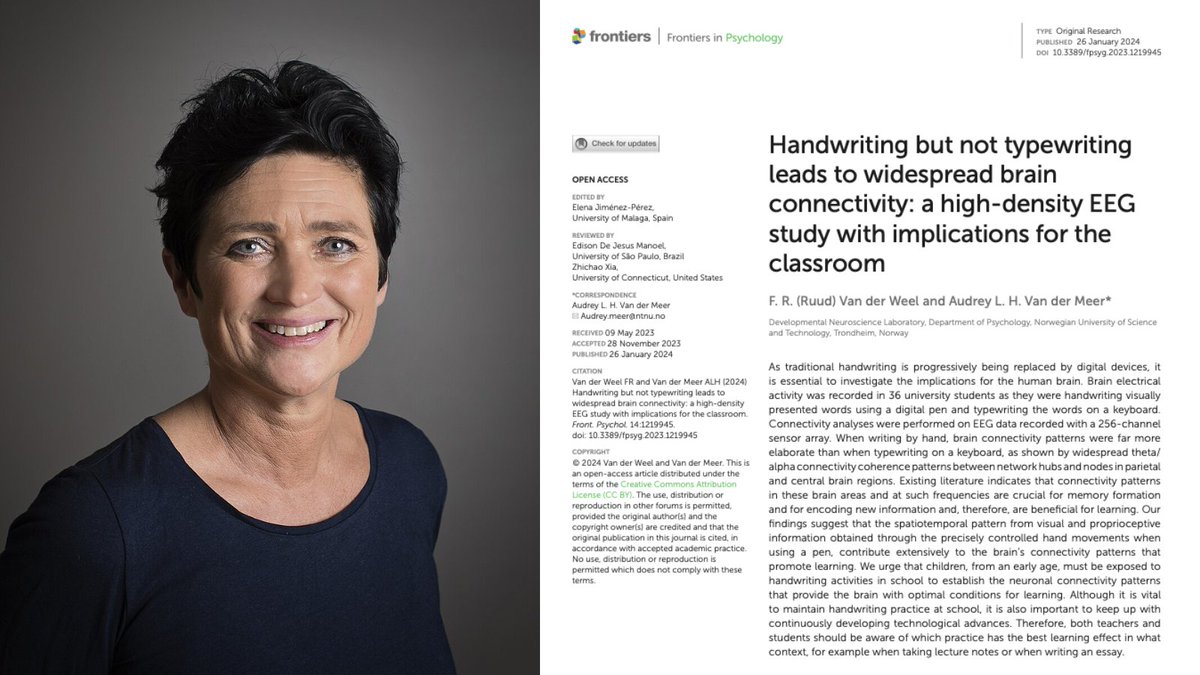
A Norwegian neuroscientist spent 20 years proving that the act of writing by hand changes the human brain in ways typing physically cannot, and almost nobody outside her field has read the paper.
Her name is Audrey van der Meer.
She runs a brain research lab in Trondheim, and the paper that closed the argument was published in 2024 in a journal called Frontiers in Psychology. The finding is brutal enough that it should have changed every classroom on Earth.
The experiment was simple. She recruited 36 university students and put each one in a cap with 256 sensors pressed against their scalp to record brain activity. Words flashed on a screen one at a time.
Sometimes the students wrote the word by hand on a touchscreen using a digital pen, and sometimes they typed the same word on a keyboard. Every neural response was recorded for the full five seconds the word stayed on screen.
Then her team looked at the part of the data most researchers had ignored for years, which is how different parts of the brain were communicating with each other during the task.
When the students wrote by hand, the brain lit up everywhere at once.
The regions responsible for memory, sensory integration, and the encoding of new information were all firing together in a coordinated pattern that spread across the entire cortex. The whole network was awake and connected.
When the same students typed the same word, that pattern collapsed almost completely.
Most of the brain went quiet, and the connections between regions that had been alive seconds earlier were nowhere to be found on the EEG.
Same word, same brain, same person, and two completely different neurological events.
The reason turned out to be something nobody had really paid attention to before her work. Writing by hand is not one motion but a sequence of thousands of tiny micro-movements coordinated with your eyes in real time, where each letter is a different shape that requires the brain to solve a slightly different spatial problem.
Your fingers, wrist, vision, and the parts of your brain that track position in space are all working together to produce one letter, then the next, then the next.
Typing throws all of that away. Every key on a keyboard requires the exact same finger motion regardless of which letter you are pressing, which means the brain has almost nothing to integrate and almost no problem to solve.
Van der Meer said it plainly in her interviews.
Pressing the same key with the same finger over and over does not stimulate the brain in any meaningful way, and she pointed out something that should scare every parent who handed their kid an iPad.
Children who learn to read and write on tablets often cannot tell letters like b and d apart, because they have never physically felt with their bodies what it takes to actually produce those letters on a page.
A decade before her, two researchers at Princeton ran the same fight using a completely different method and ended up at the same answer. Pam Mueller and Daniel Oppenheimer tested 327 students across three experiments, where half took notes on laptops with the internet disabled and half took notes by hand, before testing everyone on what they actually understood from the lectures they had watched.
The handwriting group won by a wide margin on every question that required real understanding rather than surface recall.
The reason was hiding in the transcripts of what the two groups had actually written down.
The laptop students typed almost word for word, capturing more total content but processing almost none of it as they went, while the handwriting students physically could not write fast enough to transcribe a lecture in real time, which forced them to listen carefully, decide what actually mattered, and put it in their own words on the page.
That single act of choosing what to keep was the learning itself, and the keyboard had quietly skipped the choosing and skipped the learning along with it.
Two studies. Two countries. Same answer.
Handwriting makes the brain work. Typing lets it coast.
Every note you have ever typed instead of written went into your brain through a thinner pipe. Every meeting, every book highlight, every idea you captured on your phone instead of on paper was processed at half depth.
You did not forget those things because your memory is bad. You forgot them because typing never woke the part of the brain that would have made them stick.
The fix is the thing your grandmother already knew.
Pick up a pen. Write the thing down. The slower road is the faster one.
Happy Mother’s Day.
Not everyone knows that Paul McCartney wrote "Let It Be" for his mother Mary, who had passed away in 1956 from breast cancer.
She came to him in a dream and told him to ‘let it be’.
Hungarians take back control over their streets, their squares, their Parliament. WE ARE BACK!
I can't thank enough everyone who didn't give up on us and helped during our struggle.
You are the best, We are the best!
🥹
I've spent thousands of hours watching all 835 episodes of The Diary Of A CEO podcast.
Here are the 10 craziest health lessons I learned (so you can skip the 1000+ hours):
1. Weekly sex extends your life by 49%:
Yale charges $80,000/year for access to Professor Ben Polak!
They put his most important lecture on YouTube for free.
Every negotiation you have ever entered. Every salary you have ever accepted. Every price you have ever set.
The other person was running game theory. Payoff matrices. Dominant strategies. Nash equilibrium. Backward induction.
You were hoping for the best.
That is not a skill gap.
That is a universe gap.
And it has been costing you $20,000. $50,000. $100,000 every single year, without you knowing the name of the thing taking it.
1 hour today closes most of that gap permanently.
The lecture MBAs pay $150,000 to access inside a degree.
Free for you right here.
Bookmark so you do not lose it!