Seeking Solutions to uncontrolled consumption by a few, poverty for many. Circular economy, waste, air pollution, climate change. Women and children key to us.
D for DATA!
Reliable air pollution data helps us understand how polluted the air is, where the pollution comes from, and how levels change over time. It also helps us track whether clean air measures are actually working.
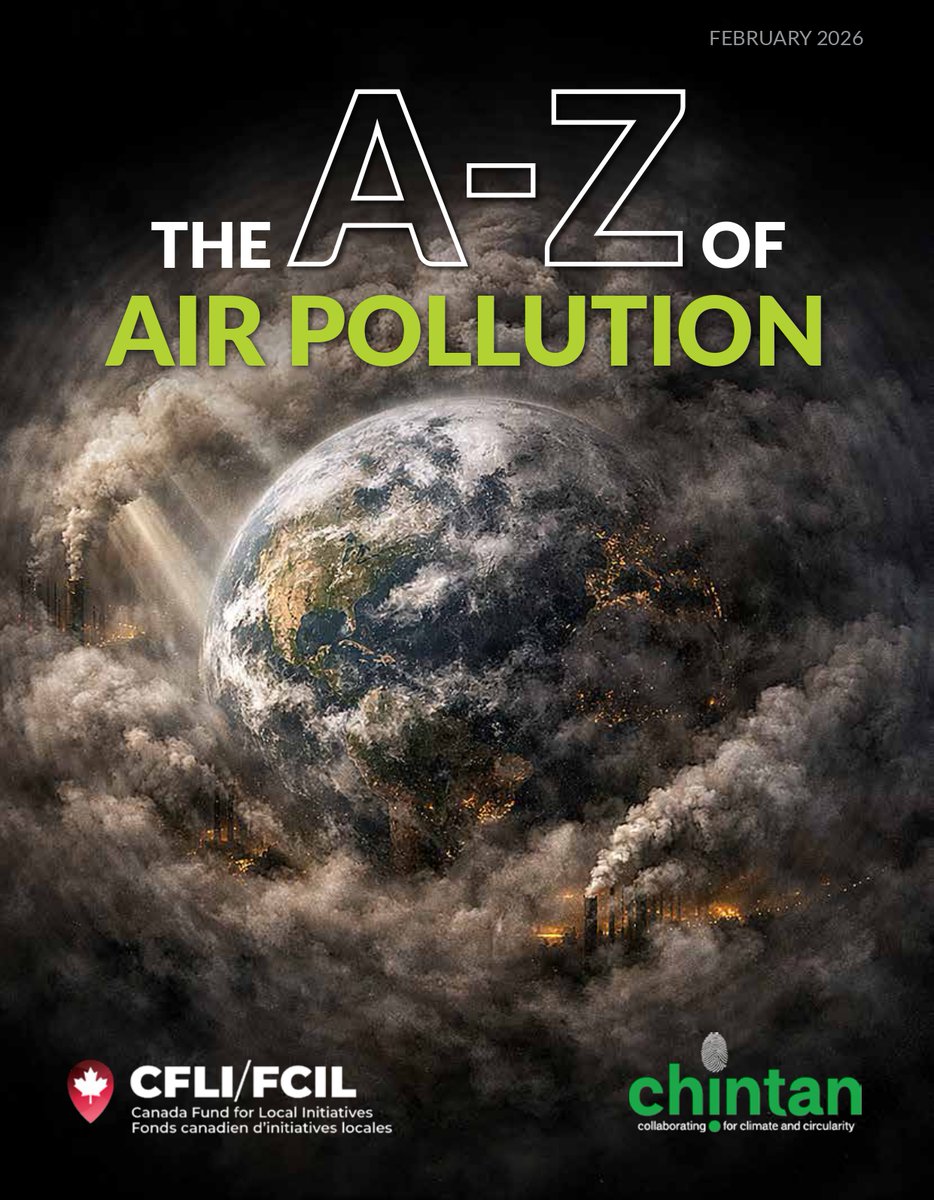
In the fourth instalment of Chintan’s A–Z of Air Pollution, we explore how air quality is monitored, why reliable data matters, and how we can use it to identify pollution hotspots and demand action for cleaner air.
Read the A–Z of Air Pollution to understand the sources, impacts, and solutions to air pollution. Download Here: https://t.co/uWpOPEOoqZ
@Bharati09
#AirPollution #AirQuality #AirQualityData #PollutionMonitoring #AirPollutionAwareness #AQI #PM25 #PM10 #CleanAir
Not every stubble needs to end in smoke.
Once known for frequent stubble-burning incidents, Shahjahanpur, Uttar Pradesh, is showing how practical solutions, farmer engagement and the right support can turn crop residue into an opportunity.
From reducing farm fires to creating value from agricultural waste, our October 2026 issue explores how a district is moving from smoke to solutions.
This issue also features an insightful conversation on moving beyond AQI to better understand health risks, research on how clean air can help reverse lung damage in children, and a look at emerging environmental concerns in Kashmir’s orchards.
Read the October 2026 issue of ON AIR, India's only bilingual webzine on issues related to Air Quality. Download Here: https://t.co/OVf7OQIbus
Cover Story: @ramji3789@Bharati09 | @JamwalNidhi
#ONAIR #CleanAir #AirPollution #StubbleBurning #CropResidueManagement #SustainableAgriculture #SolutionsForCleanAir
C for CARBON!
Carbon-related pollutants like carbon dioxide, carbon monoxide, and black carbon affect the air we breathe and contribute to climate change.
In the third instalment of Chintan’s A–Z of Air Pollution, we explore the “Bad Cs”, their sources, their impact on our health and the environment, and how reducing carbon emissions can help us move towards cleaner air.
Read the A–Z of Air Pollution to understand the sources, impacts, and solutions to air pollution. Download Here: https://t.co/uWpOPEOoqZ
@Bharati09
#AirPollution #AirQuality #CarbonEmissions #CarbonDioxide #CarbonMonoxide #BlackCarbon #PM25 #ClimateChange #CleanAir #ClimateAction
B for BIOMASS!
From cooking fires to burning crop residue, biomass burning contributes to the air pollution we breathe.
In the second instalment of Chintan’s A–Z of Air Pollution, we explore its impact on PM2.5, why women and children face greater exposure, and how we can reduce the smoke.
Read the A–Z of Air Pollution to understand the sources, impacts, and solutions to air pollution. Download Here: https://t.co/uWpOPEOoqZ
@Bharati09
#Biomass #BiomassBurning #AirPollution #PM25 #CleanAir #IndoorAirPollution #CropResidueBurning #PublicHealth #WomenAndAirPollution #AirQuality
Why did Shahjahpur in #UttarPradesh reduce stubble fires by 67% from 2021.
By the collaboration between the farmers and the DM and other officials. And together, they helped the farmers make money and find a market for the stubble.
That’s what #OnAir - @ChintanIndia bilingual webzine devoted to air quality revealed this month, thanks to @ramji3789
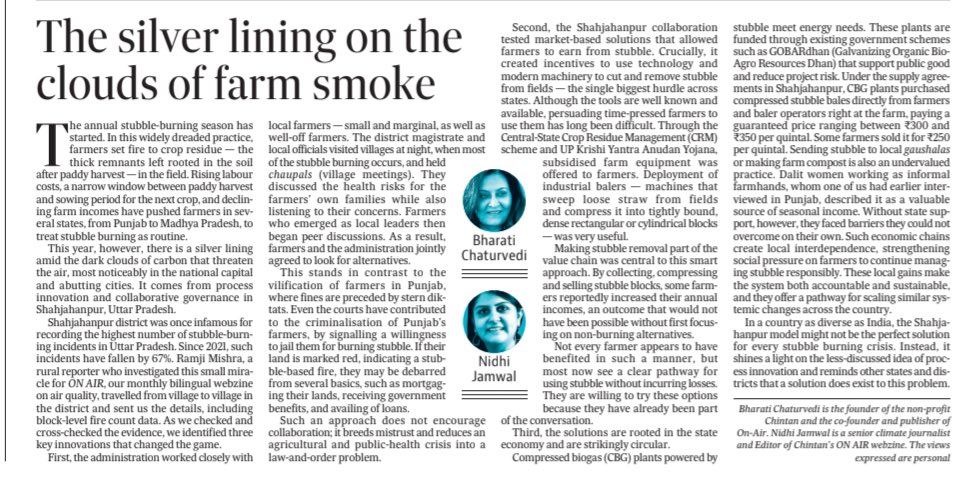
What was the innovation at play? Read this oped in @htTweets by @JamwalNidhi and myself as we further reveal the inner working of process innovation.
@CAQM_Official@moafjm
A for AIR POLLUTION!
Pollution has too many stories—and sometimes, too many words to understand.
So, what if we had a simpler way to make sense of it?
Chintan’s A–Z of Air Pollution is our attempt to decode the world of pollution, one alphabet at a time. Each letter takes us to a different term, pollutant, source, idea or solution that helps us understand the air we breathe—and what shapes it.
We begin with A — Air Pollution.
What does air pollution actually mean? Why does the size of a particle matter? How does pollution travel across shared airsheds? And what can we do about it?
This is just the beginning.
A to Z. One alphabet. One story at a time.
Follow along.
@Bharati09
#AtoZofAirPollution #AirPollution #CleanAir #AirQuality #PublicHealth
Every harvest season, the same story returns to North India: fields are cleared, smoke rises, and farmers are blamed for burning the stubble.
But in Shahjahanpur, Uttar Pradesh, something changed.
The district had once been among the state’s biggest hotspots for farm fires. In Powayan, farmers had just a few days between harvesting paddy and sowing wheat. When time was short and clearing residue was expensive, setting fire to it was often the easiest way out.
So the administration tried something different.
Instead of looking only for the farmer who was burning, officials started looking at why the fires were happening.
Satellite data showed that many fires were being lit between 6 pm and 11 pm. Officials followed that pattern into the villages — holding meetings and even late-night chaupals to hear from farmers.
And then came the less dramatic, but more important part: making it easier not to burn.
Machinery and subsidies. Balers to collect the residue. Stubble for gaushalas and cattle feed. Composting and in-situ management.
The result? Farm fires in Shahjahanpur fell by 67%.
That doesn’t mean the problem has disappeared. But it does challenge a familiar assumption: perhaps stopping stubble burning isn't only about stopping a farmer from lighting a match.
Sometimes, it is about making sure there is a practical alternative before they do.
Our October cover story looks at what Shahjahanpur’s experience can — and cannot — tell us about tackling farm fires.
Read the October 2026 issue of ON AIR here:
https://t.co/MLK6sPfqvb
Credit for bytes: @ramji3789@Bharati09 | @JamwalNidhi
#StubbleBurning #FarmFires #AirPollution #CropResidue #AirQuality #Shahjahanpur #UttarPradesh
Shahjahanpur’s smoke story is changing.
Once Uttar Pradesh’s worst stubble-burning offender, Shahjahanpur has brought its farm-fire incidents down from 423 in 2021 to 139 in 2025 — a 67% decline.
But the bigger story is how it happened.
Our October 2026 cover story, “When the Smoke Clears,” travels into Shahjahanpur to look at the combination of night-time chaupals, direct engagement with farmers, machinery subsidies, gaushala networks and new markets for crop residue that helped change the economics of burning.
The October 2026 issue of ON AIR goes beyond the usual blame game to look at solutions emerging from the ground — from turning agricultural waste into valuable products to understanding the health and science behind air pollution.
Read the October 2026 issue of ON AIR. Download Here: https://t.co/MLK6sPfqvb
@Bharati09 | @JamwalNidhi
#ONAIR #Shahjahanpur #StubbleBurning #FarmFires #AirPollution #CleanAir #CropResidue #AirQuality #Pollution #Parali
Come October and the annual cycle of media reports on stubble burning & air pollution kicks off.
ON AIR decided to break that cycle.
We travelled far & wide and delved deeper to find solutions to stubble burning—on farm & off farm. Read our latest issue for exclusive stories.
Shahjahanpur was once Uttar Pradesh’s stubble-burning hotspot. Then the farm fires fell by 67%.
What changed?
Our October 2026 cover story, “When the Smoke Clears,” by @ramji3789 goes to Shahjahanpur to find out how a district once ranked first in Uttar Pradesh for stubble-burning incidents began turning the problem around. Farm-fire incidents fell from 423 in 2021 to 139 in 2025—a 67% decline.
But this is not simply a story about enforcement. It is about what happens when a pollution problem is approached through conversation, machinery, markets and incentives.
From late-night chaupals where officials met farmers in their villages, to subsidised crop-residue machinery, cattle-fodder networks and the sale of baled stubble to Compressed Biogas plants, Shahjahanpur’s experience offers a closer look at the economics and practical realities behind stubble burning.
And the October issue takes that question beyond the fields.
We look at Indian enterprises turning crop residue into plant-based leather, biodegradable tableware and other high-value products, bringing a circular-economy lens to one of India’s most familiar seasonal pollution problems.
In Doctor’s Desk, @doctorsoumya looks at the health consequences of polluted air and why measuring pollution through its impact on human health could change how we understand the crisis.
Read the cover story and more in the October 2026 issue of ON AIR, India’s first bilingual webzine on issues related to air quality. Download Here: https://t.co/MLK6sPfqvb
@Bharati09 | @JamwalNidhi
#ONAir #AirQuality #AirPollution #StubbleBurning #CropResidue #FarmFires #Shahjahanpur #UttarPradesh #CleanAir
The journey from discard to recovery now has a new dedicated starting point.
At Sankalp Bhavan, New Delhi, a new RRR (Reduce, Reuse & Recycle) Centre in the NDMC area was inaugurated by Shri Manohar Lal Khattar, Union Minister, Ministry of Housing and Urban Affairs, Government of India.
Chintan has partnered with the RRR Centre at Sankalp Bhavan for waste collection, helping channel materials collected at the Centre towards responsible recovery, reuse and recycling.
This partnership is part of a larger effort with @tweetndmc, with RRR Centres across 8 locations and our RRR on Wheels initiative, taking reuse and recycling closer to communities across the city.
From Sankalp Bhavan to neighbourhoods across NDMC, we’re building more pathways for materials to stay in circulation.
@Bharati09
#RRR #ReduceReuseRecycle #WasteManagement #CircularEconomy #NDMC #Circularity
Farm fires have registered a sharp increase in Madhya Pradesh & Uttar Pradesh in the last 2-3 years.
BUT one district in UP has done something amazing to drastically reduce stubble burning. We’ll tell you its story in ON AIR’s October issue tomorrow.
@ChintanIndia@Bharati09
On 24 September 2026, we were pleased to welcome Mr. Akhlaque Khan, CSR Manager, SBI General Insurance, to our SBIF Conserw – Waste No More project in Ayodhya.
During his visit, Mr. Khan saw our work up close — from door-to-door waste segregation and community awareness to the processing of dry and wet waste.
He also spent time with our field team and waste workers, whose everyday efforts are at the heart of this work. Their contribution is helping make Ayodhya’s wards cleaner while keeping more waste in the recovery and recycling loop.
We’re grateful to @SBI_FOUNDATION and @sbigeneral for their continued partnership in strengthening sustainable waste management systems and supporting dignified livelihoods for waste workers.
Building a cleaner city is not just about managing waste — it’s about building systems that work for people and the planet.
@Bharati09
#WasteManagement #WasteSegregation #CircularEconomy #SustainableAyodhya #CleanAyodhya #WasteWorkers
We installed an exhaust fan. The next day, it was gone.
Not because it had stopped working. Not because the family didn’t need it.
A neighbouring family had taken it.
For us, this became more than an unexpected incident. It showed just how difficult it can be to decide who needs help first when everyone is living with the heat.
The fan had been installed in a home with almost no ventilation, where there was a pregnant woman, a young child and an elderly woman. The intervention was based on vulnerability and need—not simply on who asked for it.
So we went back, sat down with the families, and explained why this particular home had been prioritised.
Sometimes, heat resilience is not just about putting solutions in place. It is about having conversations, building trust, and making sure that the people most vulnerable to extreme heat receive the solutions first.
@Bharati09@avpn_asia@Seedstechnical
#HeatResilience #HeatAndHealth #ClimateAdaptation #CommunityAction #UrbanHeat #ClimateAction
The Roof Could Be Your First Defence Against Heat
During high temperatures, the roof can become one of the biggest pathways for heat to enter our homes. But simple, affordable interventions can help change that.
White or reflective roofs can keep much of the sun’s heat from entering the home. Adding insulation, creating shade, introducing rooftop greenery and improving ventilation can provide another layer of protection.
Dr @anshu_seeds, co-founder of SEEDS, explains that when several of these measures are combined, indoor temperatures can come down by 10–12°C.
For vulnerable and low-income households in Dakshinpuri, where homes can be particularly exposed to extreme heat, these measures can offer more than just a cooler room—they can make everyday living safer and more comfortable.
Sometimes, tackling extreme heat starts from the roof.
@Bharati09@avpn_asia@Seedstechnical
#CoolRoofs #HeatResilience #ExtremeHeat #ClimateAdaptation #UrbanHeat #HeatAction #Dakshinpuri #CoolHomes #ClimateAction