"Joyce preceded to work out in detail the laws of the media which we have gradually learned to formulate as follows: that an intense impact, some shock or crisis, produces a moment of fission or abstraction of some part or function of the body and embeds it in a new material outside the body. This amounts to a new posture or situation of the old body which engenders a chain reaction both in the senses and in the environment." #McLuhan
@amicusadastra But also...
Books created dinner parties
and fostered a spatial bias where one goes out to be alone and inside (at home) to be together.
@drewlock Ha! I think yer roll smooth is better by far.
But, to me at least, there's also merit in the grind when there's no other way, or coming back having escaped from a position of imminent doom. These are also features of wrestling with the real.
A little before the founding of the Explorations group, HMM can be seen wrestling with TSE’s question of whom one is to talk to. HMM claims that two to three hours a day of extremely vigorous conversation is a minimum requirement for the mere continued existence of the male being. Without it, he claims, a man might lapse into action, usually into something that imitates the world of know-how: golf, bridge, poker, etc.
1987. The big three lose their monopoly ushering in the VHS home-video boom, channel surfing, rapid-fire media consumption and a synthwave aesthetic fueled by 3D computer graphics.
1997. The apogee of TV. The cartoon’s high-contrast triad of colours, is pushed to the extreme by the Sony PlayStation, the 3D revolution and the console wars. McDonald’s builds playspaces. In the background, the Siemens S10: the world’s first phone with a colour screen is released. McDonald’s enters its second generation of design as Cable splinters the audience, and the broadcast networks lose their absolute grip.
2007. The touchscreen turning point. The iPhone launches, and the App Store follows in 2008. McDonald’s goes third-gen with McCafé styling.
2026. Personal screens have taken over in the wake of 4G, then 5G, ultra-fast mobile data. McDonald’s is well into its 4th gen design: net-zero, minimalist. Charcoal grey, black, wood panelling, clean lines, and the self-ordering kiosk. All the colors of 1987, and every other period in human history, are ‘in’ the ‘phone.’
You could also run it through the changing patterns of recreational drug use in North America.
1987. Cocaine and plant drugs: a small set everyone recognised, coming from a few places. The parallel with the small set of shared screens is obvious. The image is photographic; there is a real referent.
1997. Club drugs and heroin. Ecstasy promotes immersion as the VJ’s projections mutate and dissolve a collective image.
2007. Meth and painkillers, in the home and the suburbs. The everyday numb arrives by prescription and/or by platform: reality TV, social media 1.0, cheap digital cameras in phones.
2026. Synthetic opioids and NPS (new psychoactive substances). Designer tweaks at the molecular level, like a meme. Fentanyl needs no plant as referent, and an AI image needs no camera. Algorithmically targeted images are so potent that the dose can’t be seen on any common screen. The public commons of images is gone.
@duncanreyburn 🤔Hmm ... the LIVE performance has never been so vibrant and jam packed with significance (in ways beyond simply being derived from a collective experience of a replay/recording) ! The practices of playing music (ideally together) are, it seems, similarly charged.
53 years ago, McLuhan was on the war path: "As I have explained in TAKE TODAY, all structures in the world, including the church in these human aspects, are being torn apart by the decentralising power of instant information. The Toronto School of Theology knows no more about this than Rockefeller. Why should I sit by and watch it happen here? Why should I respect the somnambulistic maundering of University committee and councils who are totally unaware of being robotised by new technology? Must we use our rational faculties merely to implement the dictates of the stock response? In a word, why should I sit by any longer as if unaware of the foolishness and incompetence of Bill Davis and John Evans and many of those under them who take them seriously?" - MM 73'
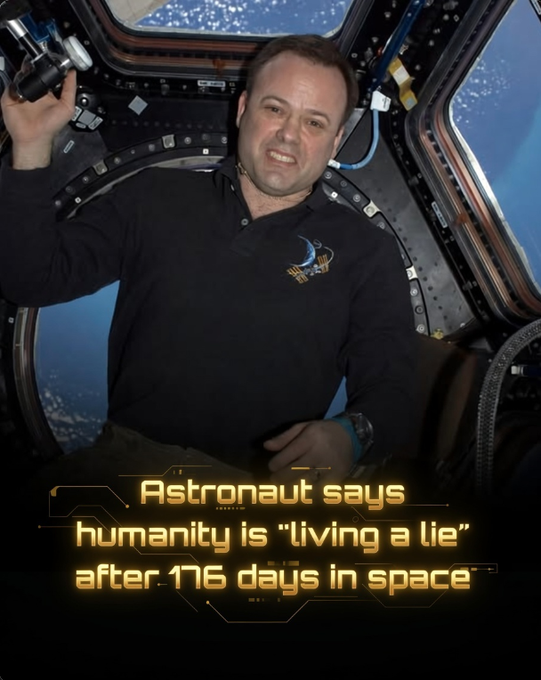
Former astronaut Ron Garan returned from space convinced that humanity is “living an enormous lie.”
During his 178-day mission aboard the International Space Station in 2011, spending nearly six months in orbit and covering over 71 million miles, Garan experienced the transformative “Overview Effect.” From 250 miles above Earth, the planet appeared as a single, delicate blue marble suspended in the void, with no visible borders, nations, or divisions. Political lines vanished; instead, he saw a fragile, interconnected biosphere wrapped in an astonishingly thin atmosphere, the sole protective layer sustaining all life against the deadly vacuum of space.
This perspective shattered his prior worldview. He observed an iridescent, teeming world of life but no trace of the global economy that humans prioritize. Garan realized the “enormous lie” we perpetuate: the illusion that we are separate from one another, from nature, and from the planet itself. Our systems treat the Earth’s life-support mechanisms, air, water, ecosystems, as mere subsidiaries of the economy, when the orbital view reveals the opposite truth: the planet comes first, then society, then economy.
In his words, this realization highlighted how crises like climate change, deforestation, and biodiversity loss stem from this fundamental misperception of separation. Garan argues that embracing this unified, fragile reality, seeing ourselves as crew members on “Spaceship Earth”, is essential for collective survival and effective global stewardship. The view from space didn’t just change his outlook; it underscored an urgent call for humanity to realign priorities with the undeniable interconnectedness of our shared home.