@TrollTouchline Arsenal wasted the clock with slowly handing the ball to 3 different players BEFORE the corner kick. Arsenal squandered their own opportunity.
+ no team wins with 22% possession.
lol
Hey @nytimes your Connections have gotten insufferable. Why do I keep giving you another chance? Buy your puzzles editor some resources or fire your A.I. or whatever. Oof.
My 18 yr-old (while eating carnitas): “It’s gonna be sad when I’m older and food doesn’t just appear.”
He leaves for West Point BEAST (basic training) in 35 days.
#stuffmykidssay
Players in NBA History to record 500+ PTS, 100+ REB & 100+ AST in the first 18 career Playoff games:
• Cade Cunningham
• Ja Maront
• Luka Doncic
• LeBron James
• Michael Jordan
Cade Cunningham in win-or-go home games in his young career:
31.2 PPG
7.2 APG
6.0 RPG
2.0 STL
1.0 BLK
40.0% 3PT
+10 average +/-
The only player in NBA history to average 30+ PPG on 40.0% from three in elimination games (min. 5 GP)
If you use TikTok, you should read this once.
In October 2024, a court clerk in Kentucky uploaded the lawsuit against TikTok with the confidential sections still visible. NPR downloaded it before anyone caught the mistake. By the time the court resealed it, the internet had a copy.
What was inside was TikTok's own engineers, in their own words, describing what their app does to a human brain.
Not a critic's brain. Yours.
Here is what they wrote down.
— TikTok ran the math on how long it takes to develop "compulsive use" of the app. The number is 260 videos. With 8-second videos played in rapid-fire succession, that works out to roughly 35 minutes. The company's internal documents call this the compulsive-use threshold.
— TikTok's own research describes what compulsive use causes: "diminished analytical ability, impaired memory, contextual reasoning, conversational depth, empathy, and heightened anxiety." That is not a quote from a critic. That is TikTok's own language, in its own internal documents.
— A team inside the company called "TikTank" wrote in an internal report that compulsive use on the platform was "rampant."
— After 30 minutes of continuous use in one sitting, the company's own documents state that users are placed into "filter bubbles" — algorithmic loops the user did not choose and cannot easily escape.
Then there is the screen-time tool — the one TikTok publicly markets as proof it cares.
— TikTok ran an experiment on the 60-minute screen-time prompt. Daily teen usage dropped from 108.5 minutes to 107. A reduction of 1.5 minutes.
— Internally, the screen-time tool was not measured by whether it reduced screen time. Its top success metric, in writing, was "improving public trust in the TikTok platform via media coverage."
— A project manager wrote in internal chat: "Our goal is not to reduce the time spent." Another employee added that the goal was "to contribute to daily active users and retention."
— A TikTok executive approved the screen-time feature only on the condition that its impact on the company's "core metrics" was minimal. The lawsuit alleges the company planned to "revisit the design" if the tool ever reduced usage by more than 10%.
The "Are you still scrolling?" break videos? An executive admitted in an internal meeting they were "useful talking points" for lawmakers, but "not altogether effective."
Then there is the algorithm itself.
— An internal report flagged that the For You feed was showing what the company called "a high volume of not attractive subjects." TikTok then retooled the algorithm to suppress those users. Kentucky authorities wrote: "By changing the TikTok algorithm to show fewer 'not attractive subjects' in the For You feed, [TikTok] took active steps to promote a narrow beauty norm even though it could negatively impact their Young Users."
That sentence is the entire pitch of the platform, said out loud.
— Internally, TikTok also acknowledged that its publicly reported content moderation metrics were "mostly misleading," because they only measured the content the company successfully moderated — never the content it missed.
Now read those bullet points again as one continuous case.
The company knows the addiction threshold. The company measured it. The company ranked engagement over mental health in writing. The company built a screen-time tool whose internal success metric was PR. The company suppressed people it deemed unattractive to keep you scrolling. The company called its own moderation numbers misleading.
None of this is a leaked rumor. None of this is a journalist's interpretation. This is a court filing. The documents are TikTok's. The words are TikTok's. The math is TikTok's.
The 14 state attorneys general who signed onto this lawsuit aren't fringe activists. They're a bipartisan coalition.
Sources at the bottom: NPR, CNN, AP, Mashable, OPB, The Independent. All citing the same accidentally-unsealed Kentucky filing from October 11, 2024.
The next time the company tells you it cares about your wellbeing — the screen-time prompts, the break videos, the safety features, the careful PR statements — remember that its own engineers wrote down, in court-admissible language, that the safeguards were never meant to work.
The app is not broken.
It is performing exactly as designed.
You were the spec.
Search is full of ads and wrong answers. Every other email is an ad. Prime Video charges you and shows ads. Paramount? Ads. Peacock? YouTube? Hulu? Ads followed by more ads. Netflix full of ads. Meta and X, every other thing is an ad. Pinterest is nothing but ads. AI is in everything. AI finishes sentences incorrectly and won’t stop. AI reads your email and search history to target you with more ads. Every time you open an app or visit a site there’s an update making it worse. In a hurry? First, click here to agree to terms you don’t have time to read and must accept. You need an account to do that. Change your temporary password. Enter your 2FA code. Check your email and enter that code. Now use a passkey. Your password is too simple to remember. Change it. No, not like that. Now log on. Enter your 2FA code. Check your email for a code… Welcome back! We’ve updated our terms of service and privacy policy (you have none). Subscribe to the site. Subscribe to Netflix. Subscribe to toilet paper. Subscribe to these groceries. Pay a membership fee for the right to subscribe then tip your driver who delivers the subscriptions your membership lets you subscribe to. Time to work? We’ve got to update your laptop and will slow down everything you do until you agree to update. But first, click here to agree. Update installed — your laptop’s broken now. It doesn’t matter, since your boss just replaced you with AI. Go to your phone to complain on social media. Wait, your phone needs an update so we can add more AI. Click here. Oh sorry, your phone can’t handle this update. Now it’s useless. Go get the newest phone. Here’s a text from a friend, an email, a voice mail they left three days ago but you didn’t see until now because of sync problems with the cloud. It’s their GoFundMe. Their MLM. Their Patreon. Never mind, you didn’t respond to their text within 9 minutes and now you’re no longer friends. They blocked you. Make new friends. Download this app to find people in your area. In your neighborhood. On your street. Two doors down from you. Do you know this person yet, we think you’d get along. You need an account to use this app. That username is taken. Enter a password. Not that one, you used it on another site. You need to be connected to WiFi to download the app. Allow the app to connect to other devices on your network. Allow the app to access your contacts, know your precise location, store your credit card details. Oops, sorry, we got hacked now all that info is available on the web. There’s a class action suit. You can join. It’ll take a decade to get your $3.73 share of the ten billion settlement. We’ll send it via PayPal or deposit it to your bank, just tell us those details. Oh no, another hack. That info is circulating now, too. Here’s a spam call, a spam email, a spam text. Why are you angry? Why are you talking about getting rid of your phone? Why don’t you like AI, it lets us make all of this easier? Do you know how ridiculous that sounds? This is progress. You’ll be left behind. Do you want to be left behind? Do you???
Imagine a 19-year-old scrolling TikTok. She watches a creator list five "signs you have undiagnosed anxiety." She recognizes three in herself. By the end of the week, she's describing herself as anxious to her friends. A month later, she's avoiding situations she used to handle fine.
What went wrong?
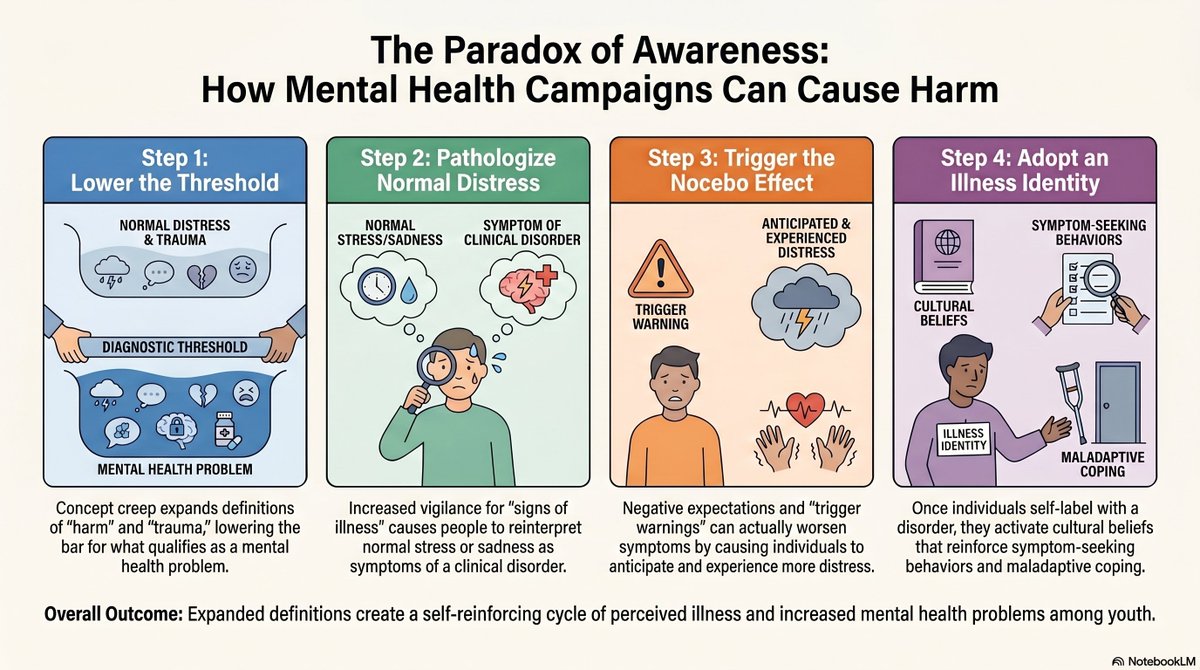
In a new paper by my PhD student Dasha Sandra, titled "Why mental health awareness can harm: Converging explanations for a societal problem", we argue that well-meaning mental health awareness can backfire, and we identify how. Four separate literatures (concept creep, nocebo effects, prevalence inflation, and illness self-labeling) have been circling the same problem from different angles. We show they converge on three mechanisms:
1.Awareness lowers the threshold for what counts as a disorder.
2. It trains people to scan their inner lives for symptoms and reinterpret normal distress as pathology.
3. Once someone adopts an illness identity, they behave in ways that confirm and deepen it.
The evidence is wide. Learning that loneliness is harmful makes solitude feel worse. Learning that stress is harmful worsens well-being and performance. Awareness videos about fake conditions like "wind turbine syndrome" produce real headaches. Trigger warnings raise anticipatory anxiety without reducing distress.
This does not mean awareness should stop. It means awareness can have unintended consequences, including manufacturing the suffering it tries to prevent. Inoculating people against these mechanisms works, and we already have evidence it does.
Link to paper: https://t.co/ucoGyhEuAj
This MRI study on young kids just exposed something terrifying:
They scanned the brains of 60 children aged 3–5 — including 5-year-old Rose — and found interactive screen time is causing measurable loss of white matter in their developing brains. Even just 2 hours a day is linked to impaired neural connectivity, language, and literacy development.
Professor Mike Nagel (neuroscientist and father) said his first reaction was simply: “Wow… I was not anticipating seeing anything like that.”
We’re physically changing children’s brains before they even start school — and the damage is visible on scans.
This one actually unsettled me. I’ve always suspected too much screen time was bad, but seeing real white matter loss in toddlers hits different.
Parents of little ones — has this kind of research changed how much screen time you allow?