I was asked to comment on the recently published Google/Verily work on predicting cardiac risk from retinal images. Nice work, nice article. Most impressed that @jjvincent actually has a decent crack at defining AUC in a news article.
https://t.co/WWMIkFQbAD
Missing data hinder replication of artificial intelligence papers. In 400 artificial intelligence papers presented at major conferences, only 6% included code, 30% included test data, & 54% included pseudocode.
https://t.co/iI0VwvGJnO
With the emergence of new hardware, what are the challenges for deep learning systems? We try to answer it in our TVM paper https://t.co/0QKQ3Jg1Kr to provide reusable optimization stack for DLSys on CPU/GPU, and accelerators. I will give an oral presentation about it at #SysML
Recommend this clear, short piece in @sciencemagazine "What can machine learning do? Workforce implications" https://t.co/6hpVLZNAKG @erikbryn @compcomcon @PartnershipAI
Great blog post from @DrHughHarvey on the barriers to using x-ray reports to build medical AI systems. If my last blog post was the "what", then this post addresses the "why" very well. https://t.co/3cvj12ayW0
We just open-sourced MUSE, our library to align embedding spaces in a supervised or unsupervised way, along with multilingual embeddings for 30 languages aligned in the same vector space, and 110 large-scale ground truth bilingual dictionaries: https://t.co/tCipxPJY2M
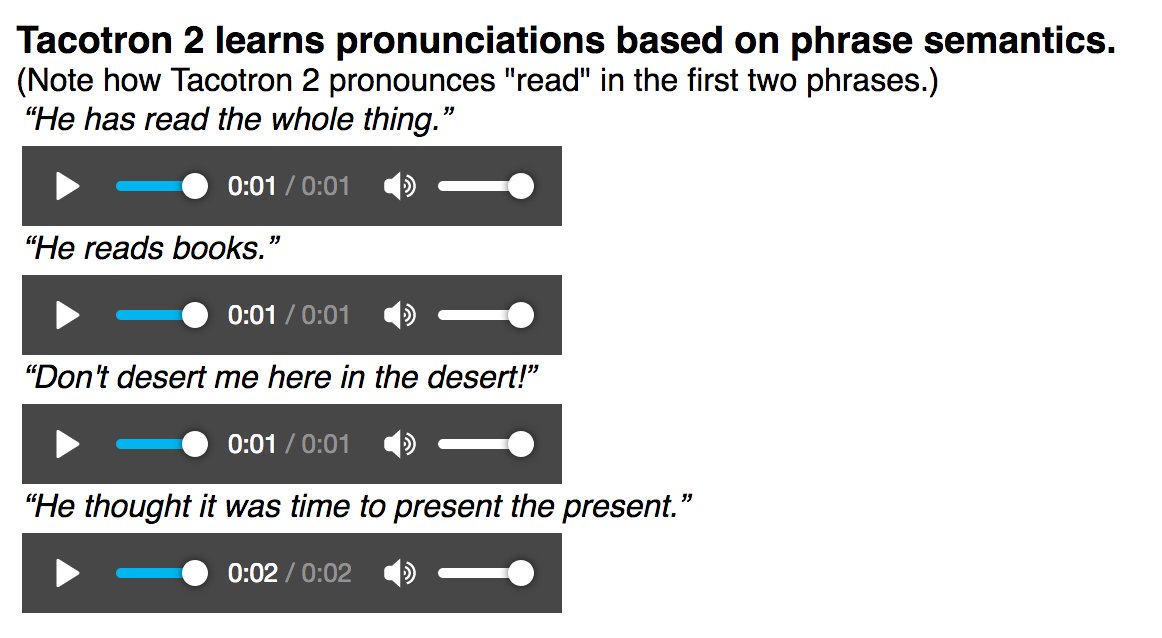
Wow! I can no longer distinguish between a computer generated voice and recording of a person. #TTS#generative#DeepLearning
Try the samples then the Turing test: https://t.co/8LNcaCGfLR
This is exceptional work. Really exceptional. (I need to reread to fully understand the last section stoll.)
This piece shows why we need to teach deep learning to domain experts. Only a radiologist could have written this. https://t.co/z9YmXpa3Xz