When Borrowing is Leprosy and cancerous.
Mr. President, borrowing is not only a leprosy, but a killer cancer when it is borrowed for consumption and not production as it is in Nigeria today.
Borrowing for consumption slowly eats away at the health, reputation, and autonomy of a nation. One of the major “leprosy” afflicting Nigeria today is not just debt, but debt without productivity. Debt that is not tied to measurable economic value. Debt that does not translate into jobs, growth, or improved living standards for the Nigerian people.
No serious economy borrows recklessly. Nations borrow with discipline, with purpose, and with a clear plan for repayment through productive investment.
Fiscal Responsibility Act 2007 provides that “Any government in the Federation or its agencies and corporations desirous of borrowing shall, specify the purpose for which the borrowing is intended and present a cost-benefit analysis, detailing the economic and social benefits of the purpose to which the intended borrowing is to be applied”
Cost-benefit analysis must show how the loan would be applied, how it will impact economic growth and improve the welfare of Nigerian citizens in measurable ways.
Most of the borrowings by this government do not satisfy the requirements of law or the requirements of economic common sense. The humongous borrowing so far does not show how the projects for the loans enhance the productive capacity of the nation and the welfare of Nigerian citizens.
These loans are also dangerous because they burden the capacity of the Nigerian state to improve the economy in the future, as we have one of the world’s highest debt servicing ratios. What matters is not debt-GDP as much as debt-debt servicing ratio because the latter constrains our capacity to finance the sectors that drive human development and economic growth.
If the money is wrongly spent as we do in Nigeria currently, it becomes double jeopardy because you are using current revenue to service debts that did not add to revenue or improve capacity for more production in the future.
A responsible government does not merely defend borrowing; it explains it, justifies it, and most importantly, ensures it works for the people.
A new Nigeria is POssible. -PO
Nigeria Is Bleeding From Within
It is deeply troubling to read recent World Bank reports indicating that, while Nigeria’s Federation Revenue surged to ₦84 trillion in just three years, a staggering 41% —amounting to ₦34.44 trillion —never reached the Federation Account. This sum exceeds the combined ₦34 trillion earmarked for capital projects in the 2024 and 2025 Appropriation Bills, a comparison that underscores the gravity of the situation and signals that something is fundamentally wrong.
This is not a mere oversight; it points to institutionalised corruption on a massive scale. In 1994, when the Okigbo Panel reported about $12.4 billion from the Gulf War oil windfall as unaccounted for, Nigerians were outraged and the nation shook with indignation. Today, an even more troubling situation appears to be unfolding, yet it is met with a disquietening silence.
We are trapped in a lethal paradox: Earning more as a nation, yet having less to invest in healthcare, education, and infrastructure. From 2025, systemic “deductions” have allowed agencies to capture more resources than entire states and even critical ministries.
These leakages explain why countries with fewer resources are out-performing us across key development indices. With such a broken system, how can we fix power, strengthen our schools, build resilient healthcare, or develop critical infrastructure?
Nigeria has no business being poor. We must stop these leakages through disciplined, transparent leadership driven by character. It is time to redirect our hijacked resources back to the people and move Nigeria into the league of developed nations.
With our collective resolve to change this corruption-infested system, a New Nigeria is POssible. -PO
We need to work as a united Nigeria for the sake of Nigeria. The country is so divided. The present government has ensured that we remain more divided. Our unity is important.
- Peter Obi, ADC chieftain.
#ADCConvention2026
Now a Disgraced Country Indeed
Today, as the world marks World Health Day, we must pause for honest reflection.
Nigeria, a nation of over 200 million people, continues to grapple with one of the weakest healthcare systems in the world. Our primary healthcare structure is almost comatose. We now record worse infant mortality outcomes than India, a country with a larger population, while health insurance coverage in Nigeria remains below 5%. These are not just statistics; they are a painful indictment of our priorities.
Recent disclosures by the Honourable Minister of Health show that out of the ₦218 billion appropriated for healthcare capital expenditure, only about ₦36 million has been released. This is deeply troubling.
At the same time, the Independent National Electoral Commission (INEC) has projected over ₦135 billion for legal expenditures.
Let us reflect on this.
The amount earmarked for election-related litigation is far higher than what has been made available for primary healthcare, the very foundation of a nation’s wellbeing. This is the same primary healthcare system expected to serve millions of Nigerians and support critical institutions such as:
1. University of Benin Teaching Hospital, Benin City
2. University of Calabar Teaching Hospital, Calabar
3. University of Abuja Teaching Hospital, Gwagwalada
4. University College Hospital, Ibadan
5. Obafemi Awolowo University Teaching Hospital, Ile-Ife
6. University of Ilorin Teaching Hospital, Ilorin
7. Irrua Specialist Teaching Hospital, Irrua
8. University of Nigeria Teaching Hospital, Ituku-Ozalla, Enugu
9. Jos University Teaching Hospital, Jos
10. Aminu Kano University Teaching Hospital, Kano
11. Lagos University Teaching Hospital, Lagos
12. University of Maiduguri Teaching Hospital, Maiduguri
13. Nnamdi Azikiwe Teaching Hospital, Nnewi
14. University of Port Harcourt Teaching Hospital, Port Harcourt
15. Usmanu Danfodiyo University Teaching Hospital, Sokoto
16. University of Uyo Teaching Hospital, Uyo
17. Ahmadu Bello University Teaching Hospital, Zaria
18. Federal Teaching Hospital, Abakaliki
19. Abubakar Tafawa Balewa University Teaching Hospital, Bauchi
20. Federal Medical Centre, Yola
These institutions represent hope for millions. Yet, they remain underfunded, overstretched, and burdened by systemic neglect.
A nation that prepares more for electoral disputes than for the health of its citizens is a nation that has lost its way.
We must begin to ask the difficult but necessary questions: What are our true priorities? What kind of nation are we building? And for whom?
Healthcare and education are not optional; they are the foundation of national development. Any country that neglects them undermines its own future.
Nigeria must urgently reorder its priorities. We must invest in the health and wellbeing of our people, strengthen our institutions, and build a system that works for all, not just a few.
A new Nigeria is POssible. -PO
Standing Up for Democracy
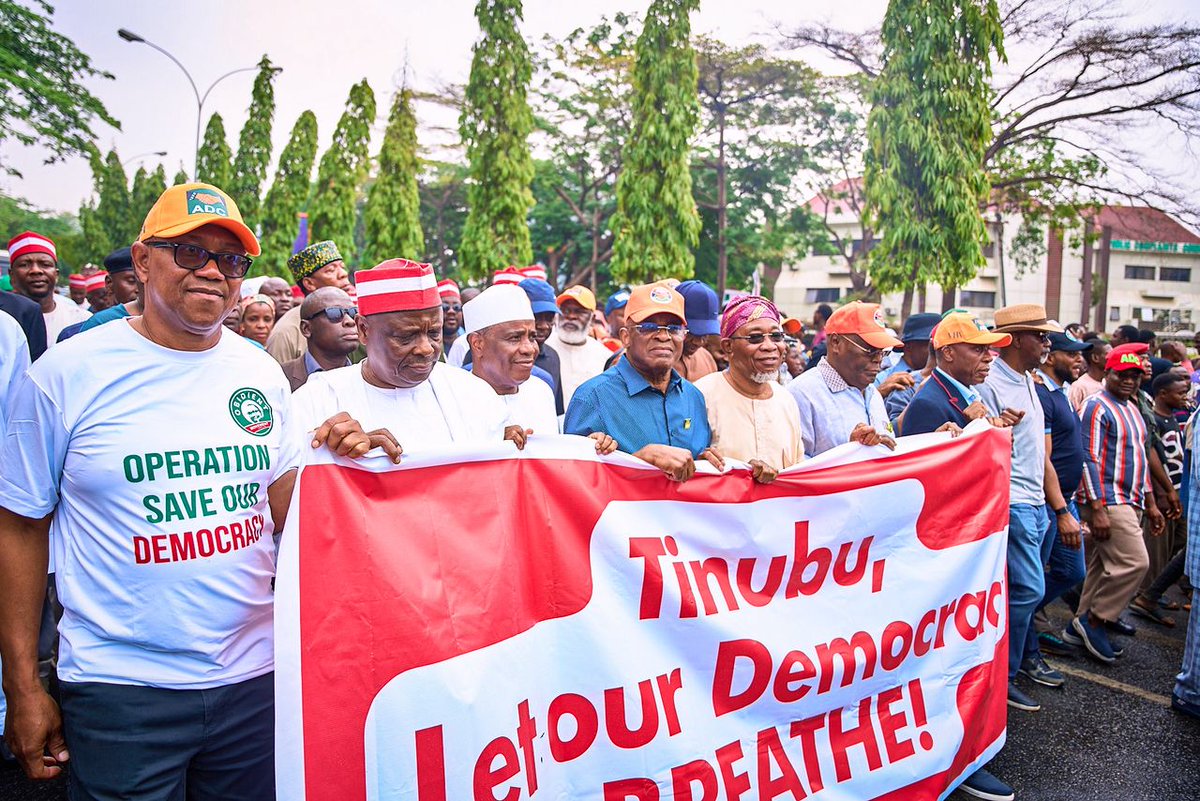
Today, I joined fellow Nigerians, leaders, and members of the African Democratic Congress (ADC) led by National Chairman Sen. David Mark to participate in a peaceful "Save Democracy" protest.
This event was not just an effort to protect our democracy; it was also a moment of reflection on how far we have fallen as a nation. We must resist the suffocation of our democracy by those who once claimed to have sacrificed to defend it, but are now doing everything possible to undermine it and silence opposition.
History will not be kind to those who traded the struggle for democracy for the comfort of power. We will not remain silent, we will not be intimidated, and we will not surrender the future of this nation. The will of the people must prevail—stronger, louder, and impossible to suppress.
A New Nigeria is POssible. -PO
We, members and leaders of the ADC, and other well-meaning Nigerians, lovers of democracy, are saying that our democracy must not be killed. We say NO to a one-party system and for that today we’re calling out Nigerians who believe in unity, peace, and security of our country to join us as we defend democracy in our land.
A New Nigeria is POssible. -PO
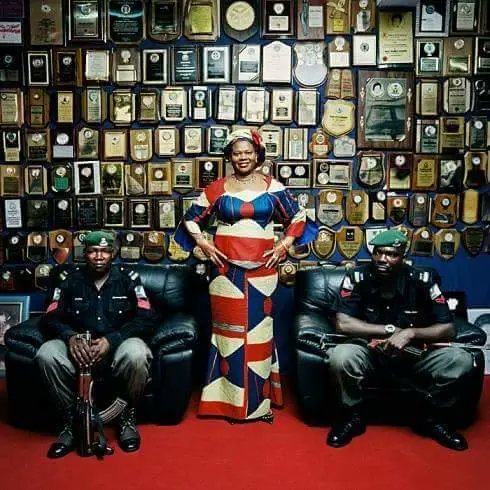
Today we remember the legend Dora Akunyili, who died in 2014, she lost her sister, who was given fake insulin for diabetes. This was 1988.
In 2001,she became the head of NAFDAC. By 2006, she had reduced the circulation of fake drugs in Nigeria from 80% to 17%.
Keep resting 🕊️