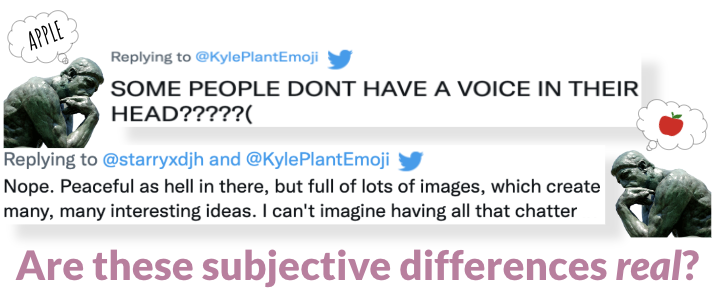
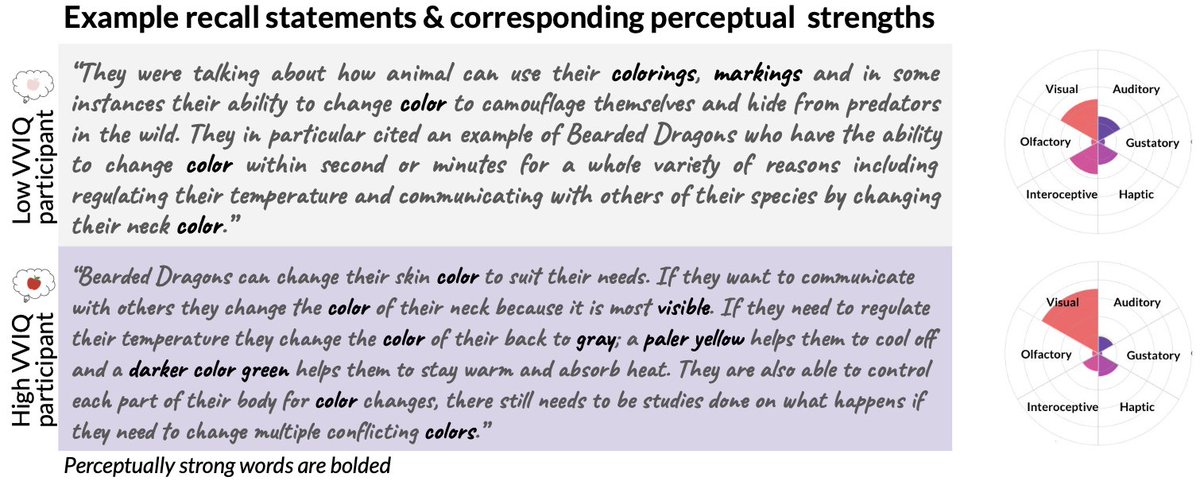
People differ in how they experience their thoughts (see @KylePlantEmoji’s tweet for an ethnographic excursion). Some people report seeing pictures in their ‘mind’s eye,’ others say they hear sentences in their ‘mind’s ear.’ Are these phenomenal differences real? Our @cogsci_soc #CogSci2023 paper w/ @kiyonoggin@CoulsonSeana explores whether subjective differences in how people think they think predict objective differences in people’s narrative recalls.
Paper: https://t.co/jTO5gOPExt
Apply by Dec 1 to the UCSD Cognitive Science PhD program: https://t.co/3VAyDzrW5v. We have an incredible community working on language + cognition + development - if that's up your alley, check us out! I'll also be considering applications to join my new lab opening in Fall 2024.
🚨 New Preprint 🚨 Does GPT-4 Pass the Turing Test?
Excited to share results from https://t.co/ptJtrpLg8O!
Preprint: https://t.co/c3X8Q4eTPQ
The best GPT-4 prompt succeeded on 41% of games, beating GPT-3.5 (17%) and ELIZA (27%) but falling short of humans (63%) and chance. 🧵
Can you tell the difference between a human and an AI? Really excited to share https://t.co/ptJtrpKIjg, a site where you can play the Turing Test with GPT-4. You get randomly matched with either a human or an AI, and you have 5 minutes to decide which it is.
Can you tell the difference between a human and an AI? Really excited to share https://t.co/ptJtrpKIjg, a site where you can play the Turing Test with GPT-4. You get randomly matched with either a human or an AI, and you have 5 minutes to decide which it is.
People differ in how they experience their thoughts (see @KylePlantEmoji’s tweet for an ethnographic excursion). Some people report seeing pictures in their ‘mind’s eye,’ others say they hear sentences in their ‘mind’s ear.’ Are these phenomenal differences real? Our @cogsci_soc #CogSci2023 paper w/ @kiyonoggin@CoulsonSeana explores whether subjective differences in how people think they think predict objective differences in people’s narrative recalls.
Paper: https://t.co/jTO5gOPExt
@glupyan@HettieRoebuck In this paper, we didn't discuss differences between the questionnaires in terms of the kinds of phenomenological experiences they might be indexing, but I definitely agree that we should expand on that in future work.
In sum, we found that subjective differences in how people experience their thoughts manifest in objective cognitive behavior. Heightened visual imagery vividness leads to increased use of perceptual language in narrative recall, while stronger verbal imagery is associated with reduced perceptual language usage. However, regardless of our imagery format, we are all equally good (or bad) at recalling naturalistic narratives.
paper: https://t.co/jTO5gOPExt
stimuli & data: https://t.co/UXOTzkzJgA