@interesting_aIl 1) Why did the guy overtake from the wrong side?
2) Why he seemed so pissed off?
What he did at the end was plain wrong but sometimes you can't just help if the car in front of you is driving slow on the fast lane and also not letting you overtake.
@NaddaSalim @Hammadr097 @ZulfiqarAhmed69 BTW this game is rated for 12+ age because of moderate violence. Just wondering if this is realy the game or if he did this as a part of a group with older kids as well. But regardless, a moment to ponder what is going on in the little brains of our kids?
We all Need Some one to Pick up the Phone on Holidays
I Want to Sell You Software
& Other Stories...
The year was 1981. Phone lines opened to the GE Answer Center information service. Open 24/7, the service fielded 500,000 call in its first year.
https://t.co/PjPqrHudVX
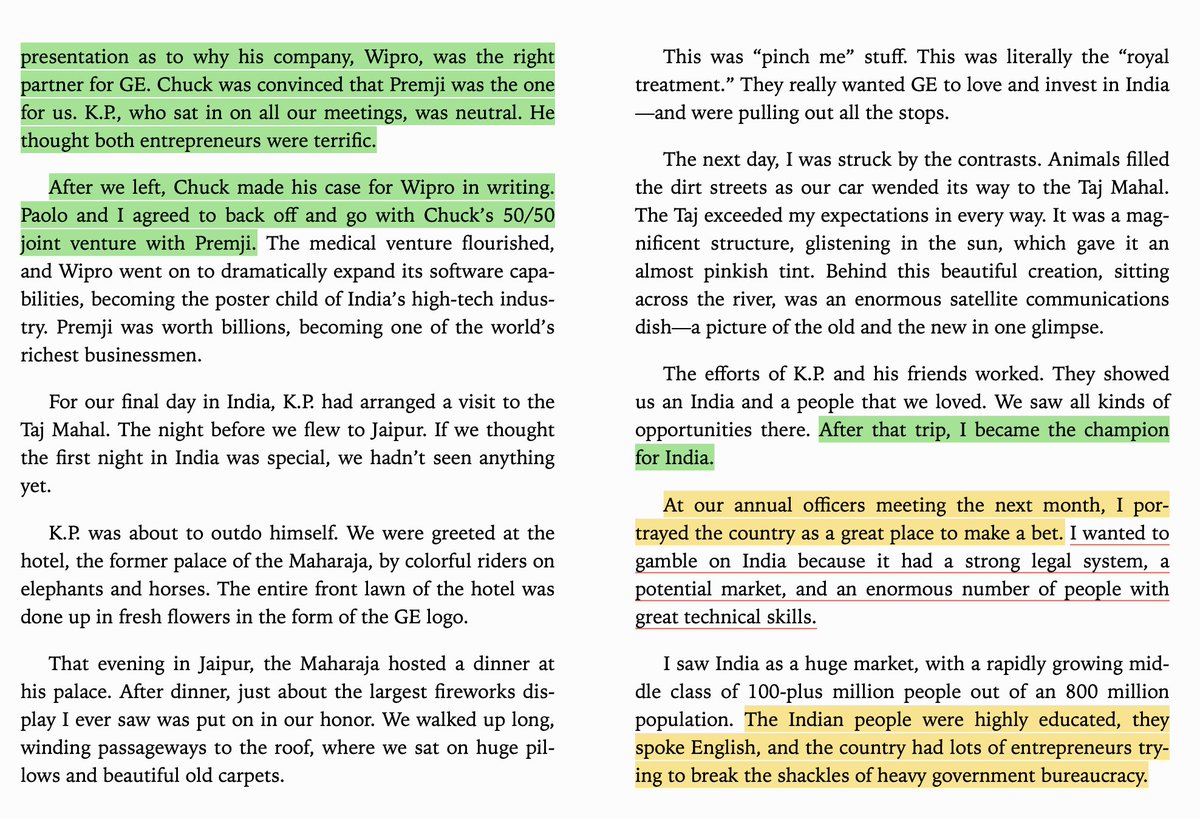
But some thing else happened, in 1998, Jack Welch the CEO GE went to India & he made a big bet that catapulted the Indian Software Industry into the stratosphere.
The Indian software industry has a huge debt of gratitude to Welch. He legitimized the idea that software development could be done offshore in India at a large scale
Sam Pitroda who was advisor to then Prime Minister Rajiv Gandhi, recollects in his blog https://t.co/09D56mWF84(excerpts below) that Welch was already a living legend at the time.
He says Welch wanted to meet Gandhi, but Gandhi was preoccupied and asked Pitroda to meet him. And Pitroda met him together with Jairam Ramesh and Montek Singh Ahluwalia. Welch came with six or seven of his executives. And they met at the Taj Mahal hotel in Delhi.
I arranged a breakfast meeting in a private dining room at the Taj Mahal hotel. I was a little wary of the cost of this get-together. The Taj was going to charge 8000–9000 rupees, which I thought would not look good on the prime minister’s account books. Rajiv was always under close scrutiny, and a fancy meal with foreigners at a five-star hotel, for official purposes, had the potential to generate negative publicity. To preclude this I called one of my public-sector CEO friends and told him, ‘Look, you’re going to get a bill for a Taj breakfast. Please, just pay it. Don’t even ask.’
Welch and his team arrived at eight and we were assembled to meet him. After the pleasantries and coffee we got down to business. Welch knew we were aware of what he wanted, so he asked, ‘Sam, what do you propose?’
My answer surprised him. ‘Jack, I want to sell you software.’
‘I’m not buying software,’ he said. ‘I want to sell you engines, that’s what we are here for.’
‘Jack, I’m not buying engines.’
‘Strange,’ he said. He had come all the way to India, expecting a very different conversation. ‘Then what do we do?’
‘I guess we have nothing to do,’ I said. ‘Let’s have breakfast.’
There was dead silence. The GE guys just sat there, perplexed. I could feel the waves of discomfort washing over my guys. They felt awkward. I was locking horns with Jack Welch, CEO of General Electric. This wasn’t the way to start a conversation. There wasn’t any need for confrontation.
After a long silence, Welch broke the spell. ‘Okay,’ he said, ‘tell me what you want to tell me about software.’
I had prepared a 35mm-slide presentation. India, the title read, Country of Snake Charmers, Sadhus and Software. The slides rolled on. People think of India as a land of mysticism. But we also make software. A slide showed a priest praying in front of a computer. We have a young population with advanced education and great ability. We have a large number of software engineers. GE can benefit from our software talent. India can develop software for GE.
Welch watched. He listened carefully. ‘What, specifically, do you want?’ he said.
‘Given a choice,’ I said, ‘I would want a 10-million-dollar software order from you.’
‘I’ll tell you what,’ he said. ‘I’ll send you eleven top people from my company; you convince them first. I’ll send them here in thirty days.’
Thirty days later eleven GE executives appeared in Delhi from their plastics, consumer goods, appliances and other divisions.
It so turned out that the GE executives were very pleased with the visit. At its conclusion, they announced that they would be giving us the 10-million-dollar order.
Today, these software companies have gone global. Together, they have over half-a-million employees and a market cap in the area of hundreds of billions of dollars.
Later, GE's Chief Information Officer (CIO) Gary Reiner, Wipro Chairman Azim Premji, and Wipro's President at the time, Ashok Soota, met in 1993. During this period, there was a request for a presentation related to the creation of the Global Development Centre (GDC) program. The GDC program began in the early 1990s, but it took several years for it to scale, and by 1996-97, some significant milestones, such as crossing the $100 million mark, were achieved.
Not all the bets by Jack for India happened as he states in his Book(excerpts attached) but the transformative bet on building software 1000s of miles away from home is still paying dividends & transformed the global IT industry.
Lesson 1
It takes a village to build a country as a software destination but some times all it takes is the conviction of one person to be the catalyst for change. K.P Sign persuaded Jack Welch, the then Chairman of GE, to visit India in 1989 and convinced GE’s Board to invest. When GE invested heavily in India, other multinationals around the world followed, triggering the flow of FDI into India. This led to India becoming a top outsourcing location and an international IT hub.
Lesson 2
Have the right people to have the right conversations at the right time. Sam Pitroda had the right conversations at the right time, because he knew what the right ask was. He worked on digital switch technology at GTE, Chicago, after completing his masters in electrical engineering. In 1974, he started a company, Wescom Switching, and later sold it to Rockwell. He became the head of telecom in Rockwell. Circa 1984, Sam Pitroda, by then the Indian technocrat par excellence based in the US, is invited to India by the young Prime Minister Rajiv Gandhi. His mission: to set up a Centre for Development of Telematics (C-DOT) and develop small exchanges for connecting villages and small towns.
Lesson 3
Have the right offer but don't rest on your laurels. What started as BPO, moved to KPO moved to R&D. Having the ability to build on momentum and growing it is a key skill. For industries to flourish, there has to be constant innovation for growth. Had the Indian companies just decided to stay in the BPO space and not explore the entire value chain, the outcomes today would be very different.
Lesson 4
Solve with intent but have the humility to know what you don't know. Some Indian companies did not even have offices at the time they were pitching to Jack but they decided to showcase what they were proud of, offices they built later. Lead with effort vs leading with optics, lead with solutions vs leading with problems.
Lesson 5
There are no short cuts to innovation or hard work. You have to build from the ground up. When you take the time to understanding the problem, the solutions manifest them selves, the rest is your drive to implement them. Photo ops and mutual admiration clubs, or committees don't solve problems, people solve problems. Do not wait for recognition instead recognize the problems & build solutions.
Lesson 6
You miss 100% of the shots you do not take. What is the worse than can happen? A NO? If you want to hear a lot of YES's, be prepared to hear a lot of NO's. Act on your intuition but always have a pragmatic ask. If you do not ask, there will never be a YES at the end.
The Most Valuable Company In the World.
GE is not even a fraction of its former self from being one of the most valuable companies in the world to nearly not being relevant. But it has taught me some of the most valuable lessons in my career.
My very first job as a Co-Op/Intern was at GE. As a 19/20 Year old transplanted from Pakistan to Purdue, then to Smyrna, GA was a deer in headlight moment. GE was powering every thing from refrigerators to jet engines but most of all It was powering the American Dream.
Its akin to your FAANG moment now.
But some perspective first.
The all-time high General Electric stock closing price was 256.11 on August 28, 2000.
In August 2000, the company had a market capitalization of $601 billion, and was the most valuable company in the world.
In 2020, GE ranked among the Fortune 500 as the 33rd largest firm in the United States by gross revenue. In 2011, GE ranked among the Fortune 20 as the 14th most profitable company, but later very severely underperformed the market (by about 75%) as its profitability collapsed. Today it ranks 53 on the same fortune list that it dominated for decades.
Two employees of GE – Irving Langmuir (1932) and Ivar Giaever (1973) – have been awarded the Nobel Prize.
The commercial below was playing at the recruitment booth at the university career fair. It inspired you, to bring good things to life.
Lesson 1
Great Leaders drive ambition, GE had Jack Welch(the jury is out on a host of his financial engineering plays as CEO) but what you cant take away from him, was the cult of leadership. The personification of the problem solver.
I remember at one Leadership Award session, he made an appearance and met the co-op students, he knew every ones name. GE had over 100k employees globally at that time, but being prepared for that 1 interaction made sure, every single one of those co-ops would return to GE if a full time offer was extended to them after graduation. Jack made it personal.
Lesson 2
The dream is the mission. Working towards a higher purpose was always the feeling at GE, you were always part of some thing meaningful. This happened because leadership framed the "outcomes" extremely well and then gave every one the path to chart their course.
Lesson 3
Mistakes happen, take ownership and be some one who comes up with solutions. GE rewarded the builder, solver, doer, executer mind set. Do now and apologize later, helped the ambitious and those who wanted to stand out from the crowd. There was an inherent level of acceptable risk taking allowed, so long as you took ownership of your actions.
Lesson 4
Train your best people. Few places in the business world were as iconic as GE’s learning center, commonly known as Crotonville. It was as much a symbol of a way to run corporations as it was a location. GE build its learning center in 1956 in the town of Ossining, N.Y., which at the time was better known as the home of Sing Sing prison, a maximum security location on the Hudson River where the execution of prisoners took place. The phrase being “sent up the river” meant being sentenced to Sing Sing. GE executives who were sent to the learning center used to say they were being sent up the river.Before MBA business schools had their luster, the Crotonville center offered that model. Only the highest-performing managers and potential executives went there. The experience was classroom training in the kind of tiered classrooms known as “pits” because they looked like a mini coliseum where gladiator battles took place—in this case, between students and instructors. It also became the place where the top talent interacted with the bosses.
Lesson 5
Things that are worth doing, are worth doing the best way possible. As soon as he took over, Jack insisted that GE had to be number one or number two in every business they were in, or else get out. By number one or number two, he meant GE to be the leanest, lowest cost, worldwide producer of quality goods and services. A relentless focus to be the best is a culture that does not allow people to coast. It can be argued that it is brutal but without drive you can not be the best. Without being the best, you cant articulate your outcomes.
Lesson 6
Every one is replaceable till they are not. It makes leaders fearless, every one wants to perform because the reward outweighs every thing else. The vitality model of former General Electric chairman and CEO Jack Welch has been described as a "20-70-10" system. The "top 20" percent of the workforce is most productive, and 70% (the "vital 70") work adequately. The other 10% ("bottom 10") are non producers and should be fired. Not the most politically correct system in the present times but it drove a sense of purpose to be the best amongst your peers and getting crucial feedback. No participation trophies.
According to Welch, "A" players had the following characteristics:
1)Filled with passion
2)Committed to "making things happen"
3)Open to ideas from anywhere
4)Blessed with much "runway" ahead of them
5)Possess charisma, the ability to energize themselves and others
6)Can make business productive and enjoyable at the same time
Exhibit the "four Es" of leadership:
1)Very high Energy levels
2)Can Energize others around common goals
3)The "Edge" to make difficult decisions
4)The ability to consistently Execute
The vital "B" players may not be visionary or the most driven, but are "vital" because they make up the majority of the group. On the other hand, the "C" players are non producers.
Granted Jack left a very visible mark across the enterprise, he had his flaws, like every one. But the key lesson to take from his tenure and my time spent there was the fact that "accountability with authority" makes people execute with intent for better outcomes.
Whilst some times things could be lost in bureaucracy of the large system, GE's culture was nimble for its size & there was always a "path" & "direction" for every one. It kept the bureaucracy in check.
I knew in weeks, months and years the trajectory my career would take from a CO-OP to the Leadership Program I joined post graduation. That level of clarity gives purpose to outcomes and lets you organize your thoughts.
The lessons we choose to keep & learn from, is our choice. There were obvious pitfalls to this kind of approach if not nuanced.
According to Jack Welch, companies that develop extraordinary products and services do more than gain market share — they represent the very foundation of society.
A remarkable absence of candor in the workplace represents one of the most significant obstacles to companies’ success, he said. “In a bureaucracy, people are afraid to speak out. This type of environment slows you down, and it doesn’t improve the workplace.”
Instead, Welch called for developing a corporate culture that encourages and rewards honest feedback. “You reinforce the behaviors that you reward,” he explained.
“If you reward candor, you’ll get it.”
@MnPCourier Salman Sb, please focus on your customer service as well. My package arrived in Karachi on Saturday. Despite two calls already been made, requesting to please get it delivered today or let me pickup I am just told that it can't be delivered today. Pathetic!
@MnPCourier Salman Sb, please focus on your customer service as well. My package arrived in Karachi on Saturday as per the tracking#. Despite two calls already been made, requesting to please get it delivered today or let me pickup I am just told that it can't be delivered today. Pathetic!
@MnPCourier Please focus on your customer service as well. My package, a bagpack order, arrived in Karachi on Saturday as per the tracking#. Despite two calls already made, requesting to please get it delivered today or let me pickup I am just told that it can't be delivered today. Pathetic!
@ImranRiazKhan You did not get it. Timing is of the essence here. This should be their priority, but why do they need to point it out now? The real message is; "We can not provide security for elections".
@elonmusk when a #twitter user is shown a #hashtag as "#trending" in a certain '#location', why does it bring up the #tweets from all over the #world? How hard it is to understand for the algo that user would be interested to see some location play in the results as well.