My company, Newfound Research, turned 15 today.
Coming up on this anniversary, I reflected quite a bit on my career. I’m not sure why, but this milestone feels larger than I would've expected.
So I decided to write something.
15 Ideas, Frameworks, and Lessons from 15 Years
"I like an escalator because an escalator can never break; it can only become stairs. There would never be an 'escalator temporarily out of order' sign, only 'escalator temporarily stairs. Sorry for the convenience.'"
@BradyR36@dollarsanddata I'm not sure passive flows would step out (e.g. 401k participants likely aren't going to move to actively managed TDFs), but I do think more active capital would be recruited from other asset classes.
Efficiency doesn't require a security to trade at the correct price; it simply says that mispricings aren't predictable.
I can almost certainly guarantee that the price of a share of Coca-Cola stock, which can fluctuate percentage points per day, is not accurate to the penny. But that doesn't mean I can tell you how it's wrong.
To answer your question, though: the mechanism in discussion here is the pervasiveness and magnitude of passive flow simply overwhelming the ability for active capital to reprice markets.
@hbkazemi33@dollarsanddata Yes; at the extreme, internal and external activism and buyouts would likely be the mechanism.
But those are much coarser and slower means of repricing.
I'm not talking about Mike's extrapolations, though. I'm simply pointing out that Nick's core argument above is flawed.
Regardless, yes, the material I've read about cross sectional (you'll note I keep using that phrase) pricing impacts is compelling.
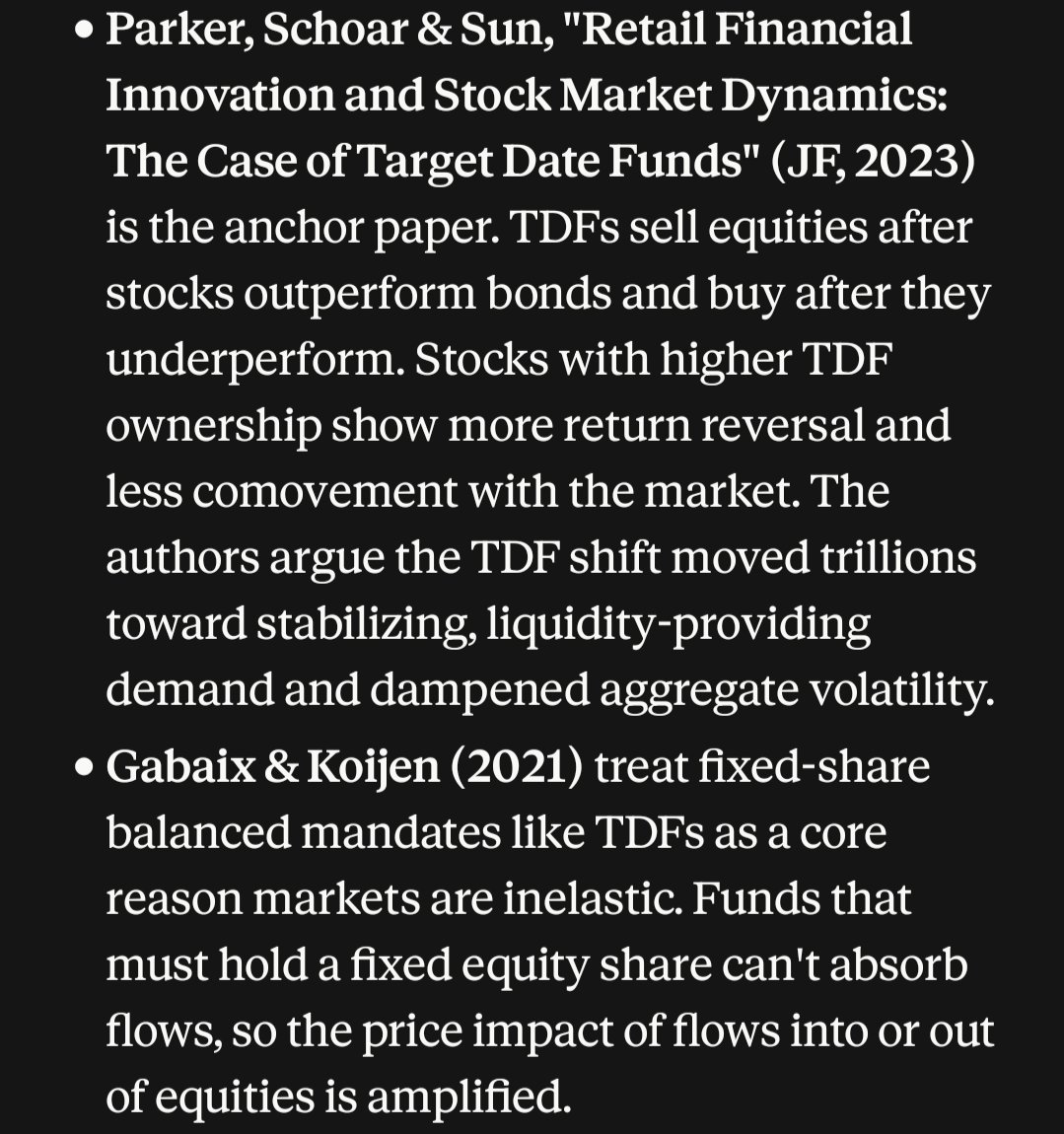
E.g. https://t.co/amLRaZYAsI
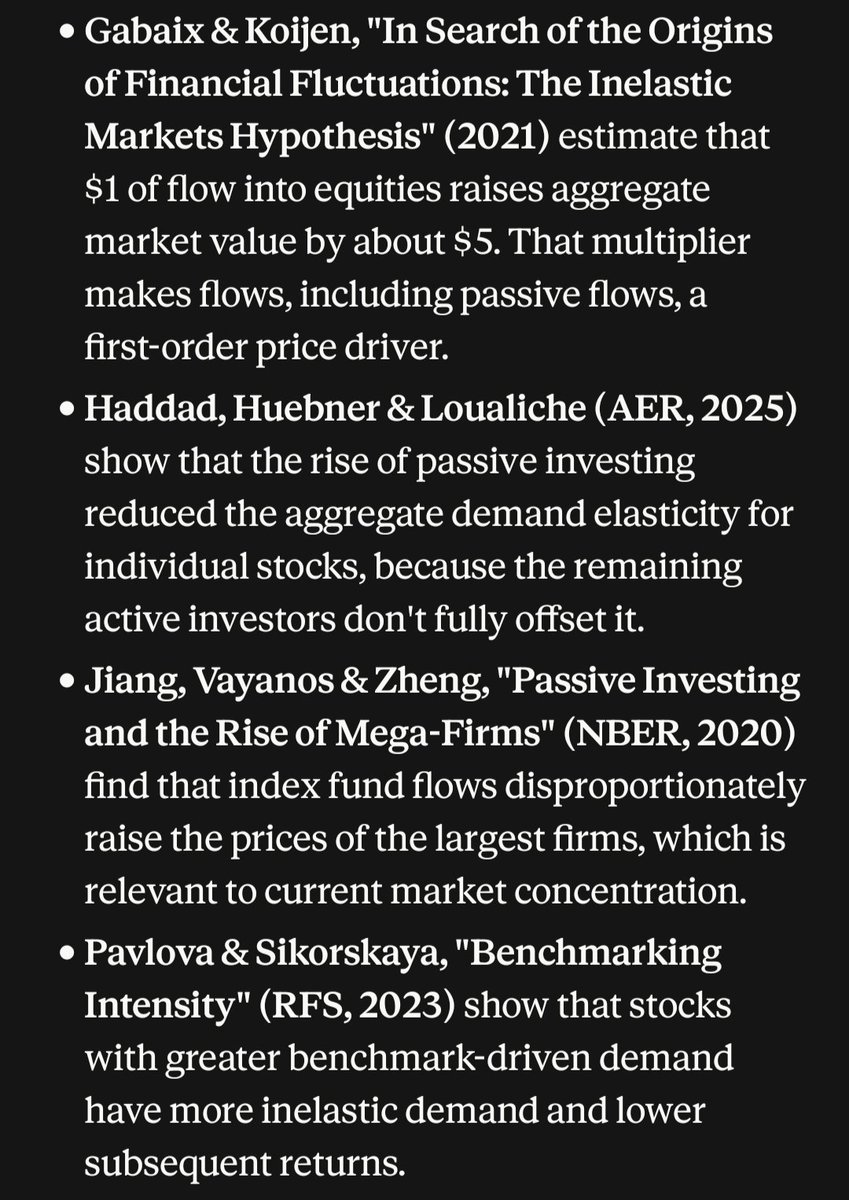
@stevehou@dollarsanddata Except, you know, all the papers explicitly trying to estimate the coefficients of elasticity?
You know, the exact ones you acknowledged the existence of this morning?
@dollarsanddata You can generally advocate for passive as a tremendous benefit for the majority of investors while still acknowledging that it may have an impact in cross sectional pricing, which is an important signal for economic decision making at large.
What do we mean by "the risk" here?
There's plenty of literature about the role passive has empirically* played within cross-sectional pricing in equities, bonds, and commodities.
*Recognizing the limits to being able to say anything in absolutes.
@IlariLehti I mean, yes: for every buyer there is a seller. So, in that sense, the direction of flow only matters in so much as it is the marginal price setter.
What do we mean by "the risk" here?
There's plenty of literature about the role passive has empirically* played within cross-sectional pricing in equities, bonds, and commodities.
*Recognizing the limits to being able to say anything in absolutes.
“The risk of passive investing” is one of the crappiest theories invented and beloved by veteran Wall Street cranks. It’s crappy bc it’s almost entirely rejected by empirical data but its adherents won’t support espousing and trumpeting it esp every time we get a little sell off.
God, passive and index investing has grown in market share for decades and gotten seriously big like over 50% of US market by some estimates. And it’s not like we haven’t some serious shocks over the last 10 years to really test the resiliency of the equilibrium and expose the real risk of passive investing.
What have we seen? Na-da. Have the cranks gotten the message and gone away? Nope. That’s how you know it’s not a serious theory. It’s a religion for these people. They have a conclusion and are on the search for affirmative evidence.
It’s honestly just sad at this point.
@IlariLehti Buying from themselves and marking their own prices up along the way to find the clearing level they are required to hit by mandate.
Again, a toy model.