A nice analysis of Fed's serve.
It's hard not to believe Fed was BORN to ELEVATE tennis, since virtually every one of his strokes was a Platonic Ideal *and* was basically fully formed by the time he turned pro.
The Maestro ↔️ the greatest player who'll ever play tennis. 👑🙏🏾
Netflix, Wikipedia, Airbnb, Dropbox ~ all run on the same web server.
One quiet Russian engineer wrote it alone. For free. 🤯
> Meet Igor Sysoev 🇷🇺
> Russian software engineer. Born 1970 in Soviet Kazakhstan.
> Failed his first university entrance exam.
> Joined Rambler in 2000 as a system administrator.
> 2002 ~ started writing a new web server in his free time. Alone.
> Goal: handle 10,000 simultaneous users on one machine ~ a problem Apache (the dominant web server at the time) couldn't solve.
> 2004 ~ released nginx publicly. Free. Open source.
> Zero marketing. Zero PR. Just the code.
> 2008 ~ nginx was serving 500 million requests per day at Rambler.
> 2011 ~ founded Nginx Inc. with co-founder Maxim Konovalov.
> 2013 ~ Netflix scaled its streaming CDN to 40 Gbps per server using nginx.
> 2019 ~ F5 acquired the company for $670 million.
> December 2019 ~ Russian police raided his Moscow office over a fake copyright claim.
> The Russian tech community publicly defended him. Charges were dropped.🚀
> 2021 ~ nginx overtook Apache as the #1 web server on Earth.
> 2022 ~ left F5 quietly. No farewell tour. No book deal.
> Today nginx powers Netflix, Wikipedia, Airbnb, Dropbox, Cloudflare, WordPress.
> 33% of every website on Earth runs on his code. Apache trails at 26%. Microsoft's IIS isn't even close.
> Still 100% open-source. Still free.
One man wrote it alone, in his free time, for free.
He never sought publicity. He never asked for credit.
A third of every website on Earth still runs on his work.
Webserver GOAT 🐐
ByteDance has published a paper that should make every NVIDIA investor sweat.
They trained an AI that writes CUDA better than humans experts.
They call it CUDA Agent.
And it completely rewrites the economics of AI hardware.
They built a massive agentic reinforcement learning loop. The AI writes a kernel, compiles it, profiles the hardware, analyzes the bottlenecks, and rewrites the code until it's flawless.
It learned how to optimize memory access patterns and hardware tiling strategies that traditional compilers miss.
The results are staggering.
On the industry-standard KernelBench, CUDA Agent completely destroyed traditional compilers.
It delivered code that runs up to 3.2x faster than PyTorch's native execution.
On the hardest, most complex models, it beat the strongest proprietary models in the world—including Claude Opus 4.5 and Gemini 3 Pro, by 40%.
It didn't just match human experts. It started discovering optimizations that static compilers literally cannot see.
Here is why this is a massive threat to NVIDIA.
NVIDIA's dominance relies on the fact that CUDA is incredibly hard to master. Developers get locked in because optimizing code for other chips is too painful.
But if an AI agent can autonomously generate hyper-optimized hardware kernels...
You don't need a team of $500k a year CUDA engineers to build world-class infrastructure.
And if an AI can autonomously master CUDA, it can master AMD's ROCm. Or custom silicon.
The impenetrable software wall protecting NVIDIA's monopoly just got breached by a reinforcement learning loop.
If anyone can automatically squeeze maximum performance out of any chip...
Hardware becomes a commodity.
THIS GUY LIVES UNDER SFO'S TAKEOFF PATH SO HE BUILT A CEILING PROJECTOR THAT TRACKS EVERY PLANE FLYING OVER HIS HOUSE IN REAL TIME
he uses a cheap $30 radio receiver to pick up the signals that planes broadcast while flying.
then projects them onto his ceiling in real time
when a jet flies over his house you hear it outside and at the exact same moment a plane glides across his ceiling labeled with the airline, aircraft type, and destination
pure black background so the projector's rectangle disappears and only the aircraft are visible
but he didn't stop at planes
it also draws the real sky behind them. sun, moon, bright stars, constellations, and live satellites including the ISS. all at their true positions for his exact location and time in real time
so he's lying in bed watching the actual night sky projected onto his ceiling with real planes crossing through it as they take off from SFO
there is a huge market for every man alive that runs outside to see the helicopter
vibe coded the whole thing himself with a cheap radio, a projector, and some clever software
Professor Omar Yaghi, a chemist at the University of California, Berkeley and winner of the 2025 Nobel Prize in Chemistry, has developed an innovative atmospheric water generator capable of producing up to 1,000 liters of clean drinking water per day directly from dry air.
Using reticular chemistry and advanced metal-organic frameworks (MOFs), the system efficiently captures moisture even in arid desert conditions with very low humidity. The compact, shipping-container-sized units developed by Yaghi’s company, Atoco, operate entirely off-grid using only ultra-low-grade ambient thermal energy or sunlight, requiring no electricity from the grid.
This sustainable technology offers a promising alternative to energy-intensive desalination plants, which often harm marine ecosystems through brine discharge. It is particularly valuable for remote communities, drought-prone regions, and areas affected by natural disasters such as hurricanes in the Caribbean, where centralized water infrastructure may fail.
Yaghi’s personal experience growing up with water scarcity in a refugee community in Jordan has deeply influenced his work. He advocates for scaling decentralized, resilient solutions to address the global water crisis through scientific innovation.
[Atoco official website and related coverage in Interesting Engineering, Food & Wine, and Nobel Prize announcements (2025–2026)]
A Hamiltonian system is a way of describing motion where position and momentum evolve together as one coupled system.
The plot shows an energy landscape in phase space, with the motion of the system traced directly on top of it and projected onto the underlying phase portrait.
#HamiltonianSystems #PhaseSpace #PhysicsSimulation #DynamicalSystems #MathematicalPhysics
▶️ ES UN NIÑO GENIO | 🧠✨
Una mujer compartió cómo su hijo de 3 años resuelve problemas algebraicos sin inconvenientes.
👀 Internautas destacaron la facilidad del pequeño para entender ejercicios complejos para su edad.
🗣️ “Yo a su edad ni leer sabía. Tiene un intelecto enorme”, comentaron.
📽️milayyei (Instagram)
Nobody expected Windows 🤝 NVIDIA.
One built the OS we grew up with.
The other is building the brains of the AI era.
This isn’t a collab.
It’s the beginning of AI-native computers 🚀
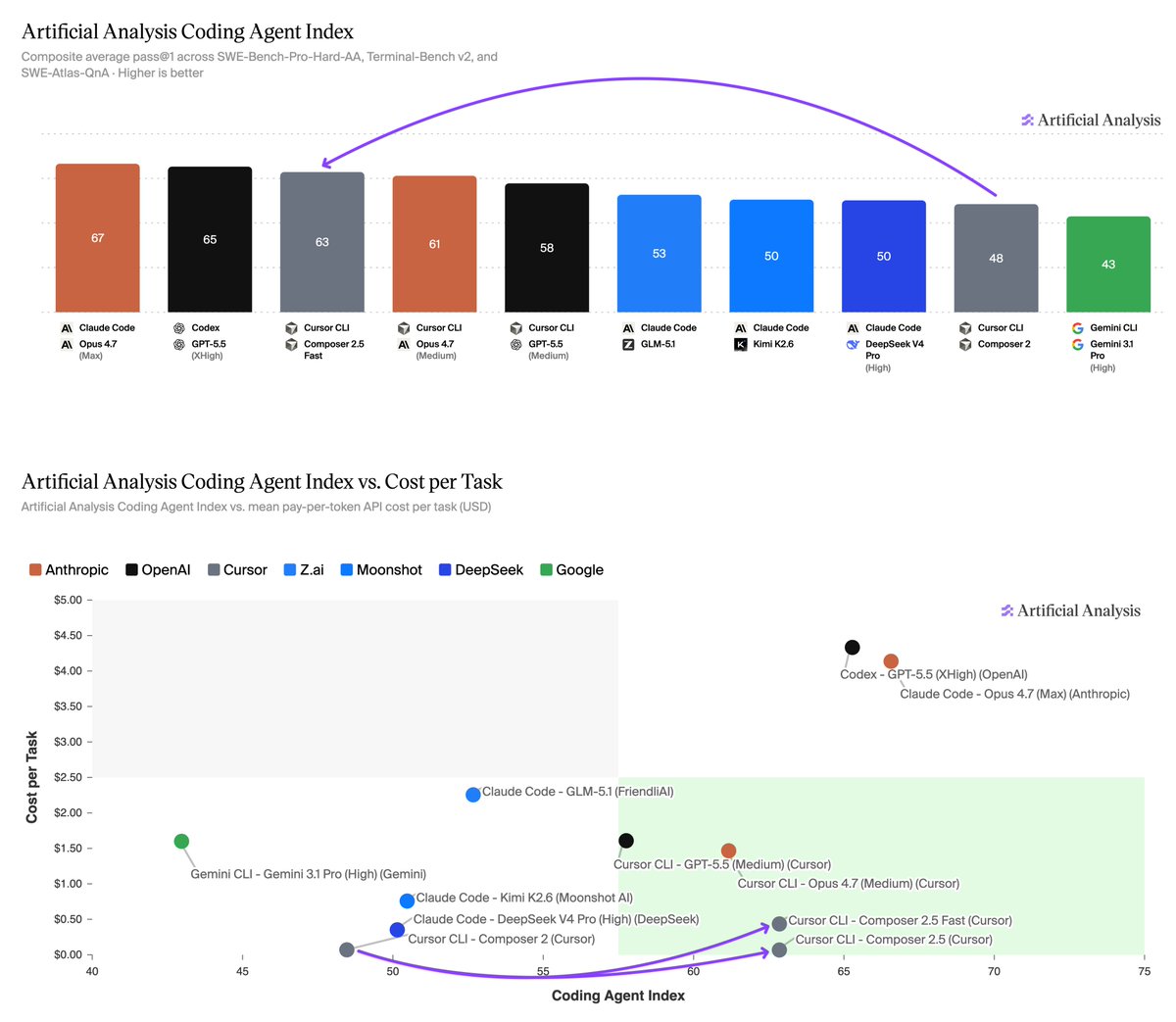
Cursor's new Composer 2.5 takes third on the Artificial Analysis Coding Agent Index and is ~10-60x lower cost than the higher-effort Opus 4.7 and GPT-5.5 variants above it. This release puts Composer among the leading coding agent models, something that wasn’t clear for past releases
@cursor_ai has released Composer 2.5, the latest model in its Composer line. Composer 2.5 scored 62 on our Coding Agent Index, a 14 point gain over Composer 2 (48). This puts it in third place of our tested agents, behind only Claude Opus 4.7 (max) in Claude Code (66) and GPT-5.5 (xhigh reasoning) in Codex (65). These cost $4.10 and $4.82 per task respectively, ~10x the cost of Composer 2.5 Fast ($0.44) and ~60x the cost of Composer 2.5 standard ($0.07).
Key results for Composer 2.5 in Cursor CLI:
➤ Cost-quality Pareto frontier: At $0.07 (standard) and $0.44 (Fast) per task, Composer 2.5 is cheaper than every other agent scoring above 60 on the Index. Medium-effort peers cost $1.24–$2.21 per task; higher-effort variants land 3-4 points above at $4.10–$4.82
➤ Per-benchmark gains vs Composer 2: +35 points on SWE-Bench-Pro-Hard-AA (12% → 47%), +2 points on Terminal-Bench v2 (64% → 66%), and +3 points on SWE-Atlas-QnA (69% → 72%). At 47%, Composer 2.5's score on SWE-Bench-Pro-Hard-AA is comparable to Claude Opus 4.7 (max) in Claude Code
➤ Among the fastest coding agents: Composer 2.5 Fast runs at an average wall time of 6.7 minutes per task, the third-fastest agent on the Artificial Analysis Coding Agent Index, behind only Claude Opus 4.7 (medium) in Claude Code (5.8m) and GPT-5.5 (medium) in Cursor CLI (6.2m)
➤ Fast mode enables better responsiveness at 6x pricing: Fast runs 30% faster than standard Composer 2.5, but is ~6x the cost per task ($0.44 vs $0.07). Token pricing is 6x higher for Fast: $3.00/$15.00 vs $0.50/$2.50 per million input/output tokens
Model details:
➤ Base model: Continued training on @Kimi_Moonshot's open weights Kimi K2.5 as with Composer 2, with Cursor reporting ~85% of total compute from its own additional training and reinforcement learning
➤ Pricing: $0.50/$2.50 per million input/output tokens for the standard variant; $3.00/$15.00 for the Fast variant (the default in Cursor)
➤ Available exclusively in Cursor: both Cursor IDE and Cursor CLI, an externally accessible API is not available
Congratulations @cursor_ai and @mntruell on the impressive release!
Pointillisme was an immersive installation created by Japanese architect and designer Taiju Yamashita. The work took inspiration from the painting technique of pointillism, where many tiny dots combine to create a larger image. Instead of paint, Yamashita used thousands of suspended transparent spheres to create a three-dimensional “drawing” made of light.
📹 odilov_m_u
Mexico paid $20 million for eight minutes in this movie. Then those eight minutes forced them to invent an entire cultural tradition.
Before Spectre, Mexico City had no Day of the Dead parade. The holiday was celebrated at home, at cemeteries, with family altars. Quiet, intimate, centuries old. Sam Mendes fabricated a massive street parade for the opening sequence, shot it with 1,500 extras in skeleton costumes across the Zócalo, and audiences worldwide assumed they were watching a real annual event.
Mexico's government had negotiated hard for the placement. Leaked Sony hack emails showed officials offered up to $20 million in tax incentives for four minutes of positive portrayal. Sony was drowning in a $300 million budget. The deal included script changes: the Bond girl had to be a Mexican actress, the villain could not be Mexican, and the city's modern skyline had to appear on screen.
Then the movie opened in 182 countries and tourists started booking flights to Mexico City for the parade.
The parade that did not exist.
Tourism authorities panicked. Visitors were arriving expecting the spectacle they saw in the film and finding nothing. So in October 2016, the government spent $500,000, hired 650 volunteers, built dozens of floats and giant skeleton marionettes, and staged the first real Día de los Muertos parade in Mexico City's history. 250,000 people showed up. They openly called it a "Spectre-style parade" in press materials.
Ten years later, the parade draws millions. Anthropologists call it the "pizza effect," where a cultural element gets exported, transformed abroad, and reimported as authentic. Mexico's most famous public celebration of its most sacred holiday was invented by a British director shooting a $300 million spy movie.
That tracking shot is doing more for Mexico City's economy every November than the $20 million they paid for it.
Codex, Claude Code, and Cursor are all great tools. They're also much more different than you think.
I did a comparison of the three, but not in the usual way. I went deep on how they differ philosophically.
A history of AI firms:
• Demis Hassabis convinces Peter Thiel to invest in DeepMind by talking chess
• Thiel shows the company to Elon Musk, who shows their AI solving Pong to Larry Page on a private jet
• Larry Page buys DeepMind; Hassabis takes them over Zuck's higher bid (and despite Elon's last minute effort) because Zuck was equally excited about 3D printing as AI at dinner
• Larry Page and Elon Musk fight over AGI; Page calls Musk a "speciesist" for favoring humans > machines
• Sam Altman convinces Elon to start a new AI firm to get back at Google; they have dinner with top people at Google and recruit Ilya Sutskever; Dario Amodei joins later
• Musk gives Altman an ultimatum: I take full control or you lose my funding
• Reid Hoffman (introduced to AI by Thiel; served as backstop for DeepMind seeking governance guarantees) convinces Satya to backstop OpenAI
• OpenAI goes its own way, Dario leaves over safety concerns, and Elon starts over with xAI/Grok
🚨 The real masterminds and backstage geniuses behind the rose petals falling from the Pantheon’s oculus on Pentecost Sunday?
The Rome firefighters!
Italy at its finest 🇮🇹🔥






![Rainmaker1973's tweet photo. Professor Omar Yaghi, a chemist at the University of California, Berkeley and winner of the 2025 Nobel Prize in Chemistry, has developed an innovative atmospheric water generator capable of producing up to 1,000 liters of clean drinking water per day directly from dry air.
Using reticular chemistry and advanced metal-organic frameworks (MOFs), the system efficiently captures moisture even in arid desert conditions with very low humidity. The compact, shipping-container-sized units developed by Yaghi’s company, Atoco, operate entirely off-grid using only ultra-low-grade ambient thermal energy or sunlight, requiring no electricity from the grid.
This sustainable technology offers a promising alternative to energy-intensive desalination plants, which often harm marine ecosystems through brine discharge. It is particularly valuable for remote communities, drought-prone regions, and areas affected by natural disasters such as hurricanes in the Caribbean, where centralized water infrastructure may fail.
Yaghi’s personal experience growing up with water scarcity in a refugee community in Jordan has deeply influenced his work. He advocates for scaling decentralized, resilient solutions to address the global water crisis through scientific innovation.
[Atoco official website and related coverage in Interesting Engineering, Food & Wine, and Nobel Prize announcements (2025–2026)]](https://pbs.twimg.com/media/HJuxBASWUAA9qkv.jpg)