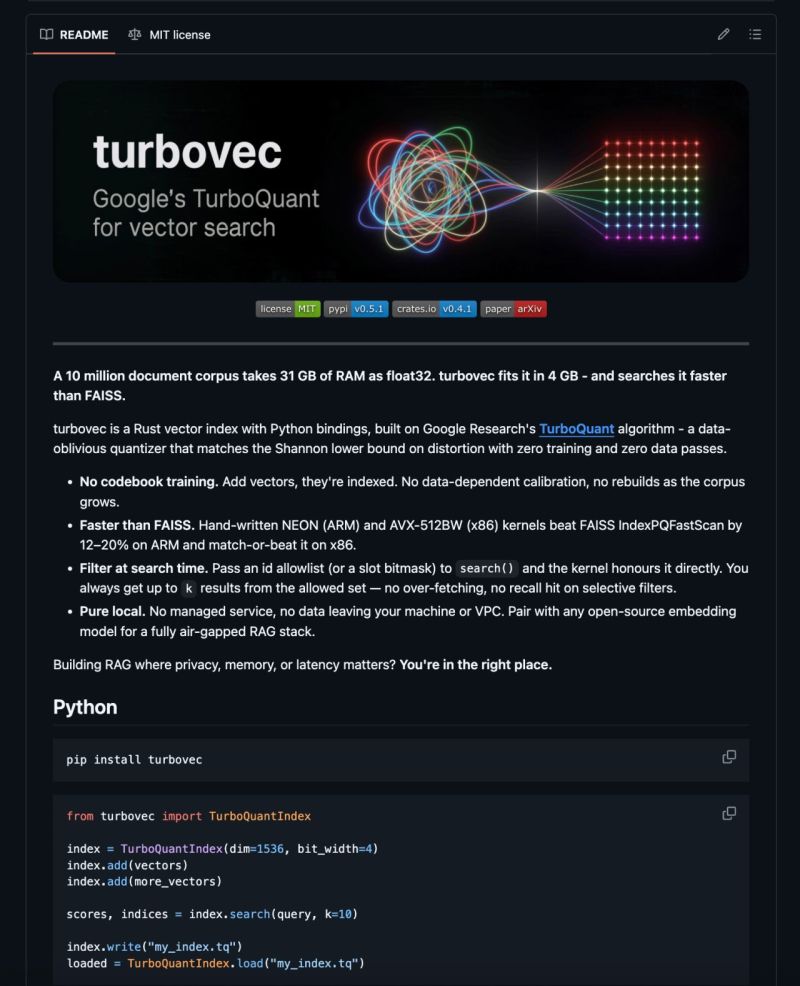
Google's new algorithm shrinks 31GB of vectors into 4GB.
Storing embeddings for RAG eats memory fast.
Ten million documents in float32 take 31GB of RAM.
A new open-source Rust vector index fits the same corpus into 4GB. And searches it faster than FAISS.
It runs on TurboQuant, a quantizer that needs zero training.
Each vector gets normalized, randomly rotated, then bucketed by precomputed math.
The result is a fixed pipeline that works on any data.
16x smaller memory footprint
Beats FAISS by 12-20% on ARM
Matches or wins on x86
Filter by ID at search time
Drop-in for LangChain and LlamaIndex
No data-dependent calibration. No rebuilds as your corpus grows.
No managed service touches your vectors.
Pair it with any open embedding model and you get a fully air-gapped RAG stack with Python bindings.
How much further can data-oblivious compression go?
https://t.co/2laJ3FCwsj
Sending the whole swarm to fix one bug that one of them wrote.
Nobody knows who wrote it.
Everyone thinks they can fix it.
You're paying for every single one
You don't need 100 tutorials to learn AI agents.
You need these 8 videos.
Watch them in this order. Bookmark this so you don't lose it.
1. LLM Introduction
https://t.co/4649Fmy9gk
2.LLMs from Scratch
https://t.co/lAJyVJzOiV
3.Agentic AI Overview (Stanford)
https://t.co/akiK2offlo
4.Building and Evaluating Agents
https://t.co/DheicDxRYa
5.Building Effective Agents
https://t.co/0hXFCanUWu
6.Building Agents with MCP
https://t.co/5BzIZGz6Al
7.Building an Agent from Scratch
https://t.co/pZ4lfobUGV
8.Philo Agents
https://t.co/lqzam96UVr
Start with how LLMs work.
Then learn what makes them agents.
Then build one yourself.
That's the whole path.
♻️ Repost to help someone master AI agents
➕ Follow @choroukmalmoum for practical AI + Business insights
Everyone wants to work "in AI."
Few can say which layer.
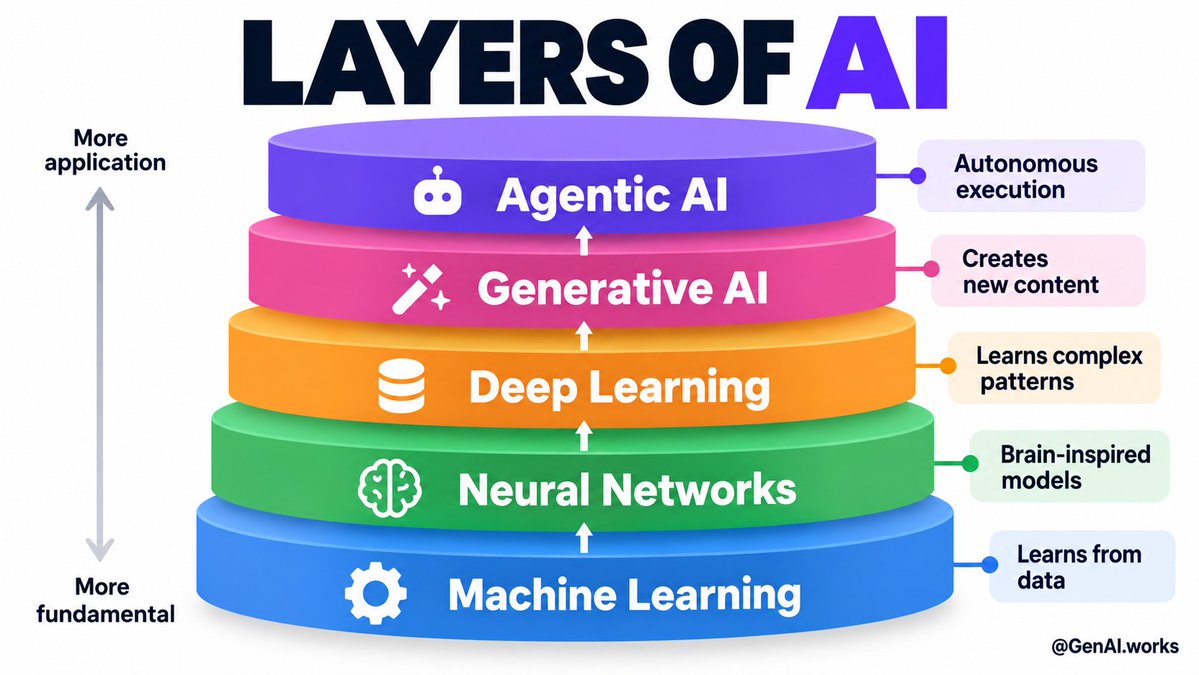
AI is 5 layers deep.
ChatGPT is just the surface.
Skills live in layers, not in hype.
The map 👇