During the rise of Hitler, an Indian princess was living in Germany.
She would risk everything to save Jewish families from the Gestapo.
She also loved another woman...
Just saw a man on a motorbike carrying a can of water and stopping along SG Highway at a designated spot to fill a dried-up water bowl kept for birds and small animals.
Ahmedabad is reeling under an intense heat wave.
He was doing it without a camera, without anyone recording a reel, and without seeking attention.
Just a quiet act of care.
Real #Amdavadis.
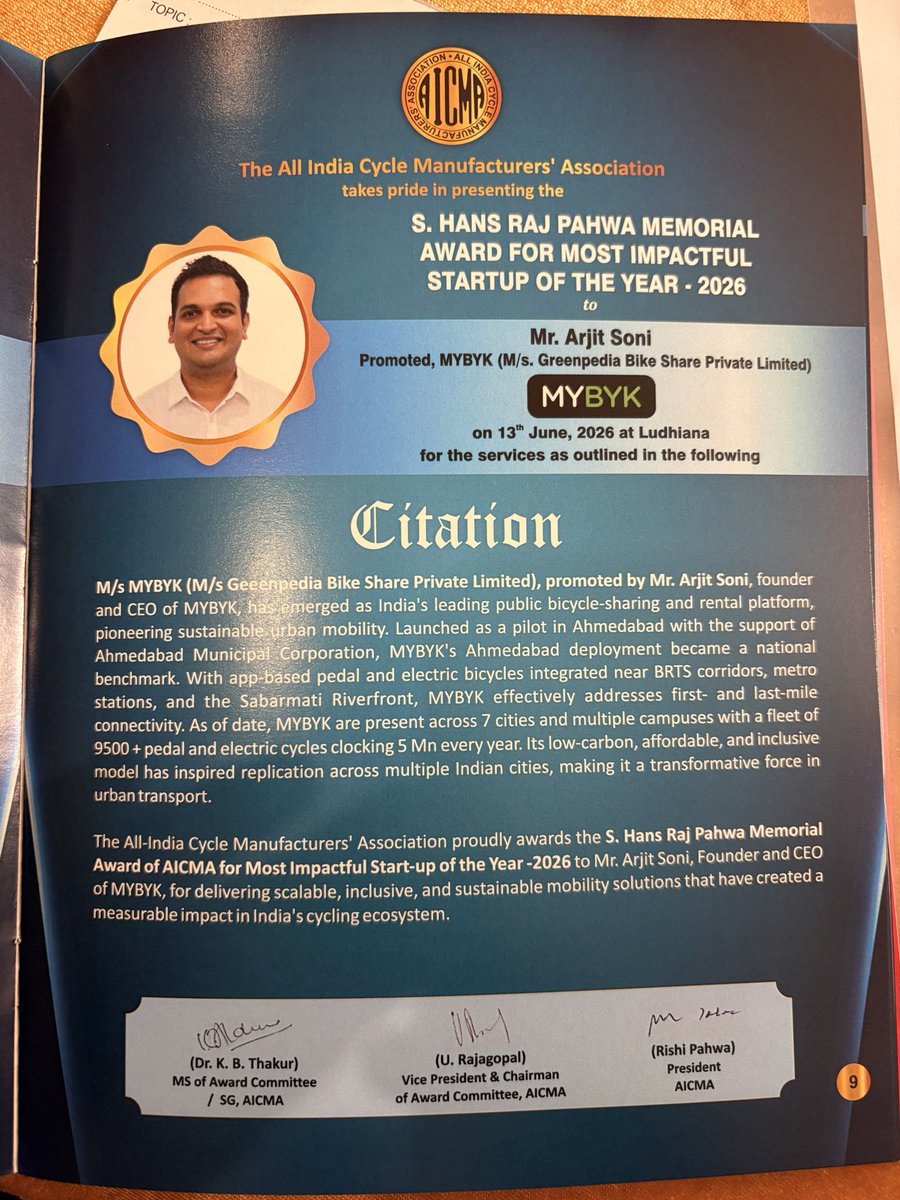
Honoured to receive THE MOST IMPACTFUL STARTUP OF THE YEAR award for @movewithmybyk by Hon. Governor of Punjab @Gulab_kataria and Cabinet Minster of Industries & Commerce @AroraAmanSunam at the 5th ALL INDIA BICYCLE MANUFACTURERS ASSOCIATION AWARDS!
Thank you #teamMYBYK, my family and @RishiPahwa8 for your support!
A 22-year-old graduate student in Kazakhstan got so angry at journal paywalls in 2011 that she built a pirate website holding 88 million scientific papers, and last month she turned the whole thing into an AI that lets you ask one question and get the actual research as the answer.
Her name is Alexandra Elbakyan, and the website is called Sci-Hub.
The AI she just launched is called Sci-Bot. It lives at https://t.co/6w0IBtOEYB and almost nobody outside academia knows it exists yet.
Here is the story, because it is one of the strangest things to happen in science publishing in the last 50 years.
Elbakyan was born in Almaty in 1988, the year the Soviet Union started to collapse. She taught herself programming at 12. She read Soviet science books that explained things her family used to call miracles. She got into computer security at university and graduated in 2009 with a degree she barely needed because by then she was already a serious hacker.
Alexandra moved to Moscow that fall. Then Germany. Then a research internship in the United States. She was working on brain-computer interfaces, the kind of research that requires you to read hundreds of papers a year just to keep up with the field.
And every single one of those papers was locked behind a journal paywall that cost between 30 and 50 dollars to read once.
She did the math. A graduate student in Kazakhstan could not afford to read science.
The first thing she did was learn how to get around the paywalls one paper at a time. She passed the trick around to other students. They asked her for papers constantly. She got tired of doing it manually.
So in September 2011, in three days, she wrote a script that automated the whole thing. A user pastes a DOI. The script logs in through a donated institutional credential. The paper comes back free. The website caches it.
The next person who asks for that paper gets it instantly because the previous request already saved a copy.
That was Sci-Hub. Three days of code. One graduate student. Done.
15 years later, the cache holds 88 million scientific papers. Almost every piece of scholarly literature published before 2020 is sitting on her servers. Researchers in 190 countries use it. Studies in Nature have shown that roughly half of all academic paper downloads worldwide now go through Sci-Hub, not the publishers who actually own the copyrights.
Elsevier sued her in 2015 and won a 15 million dollar judgment. She did not pay. The American Chemical Society sued her and won an injunction. She did not comply. Courts in India, France, Russia, and the UK have tried to block the domain. She just moves it. https://t.co/3sAWJzNe8I. https://t.co/tGIETesZ8i. https://t.co/H5WQ1f9lqR. The site has had over 20 domains and is still up.
Nature put her on its list of the 10 people who mattered most to science in 2016. The New York Times compared her to Edward Snowden. The Verge called her the pirate queen of science.
She has not been to the United States in over a decade because she would be arrested at the airport.
The Sci-Bot launch in April 2026 is the part that nobody is talking about.
She took the 88 million paper database and put a small language model on top of it. You ask a question in plain English. The model searches the entire shadow library, pulls the relevant papers, synthesizes an answer grounded in real citations, and links you to the full text of every source. Free. No login. No institutional credential. No paywall.
Three real scientists tested it for a Chemical and Engineering News article last month. They asked it medical and chemistry questions. The radiologist said the answer he got was usable. The chemist said the gaps in recent literature were obvious but the older science was solid. The publisher community is furious.
What she built is what the paid academic AI tools are trying to build. Except the paid ones are limited to what their parent publisher legally owns. Hers is limited to almost nothing.
Alexandra still lives somewhere in Russia. She does not give her address. She does not do video interviews. She gives talks over Skype with the camera off. She runs the largest illegal library in human history from a laptop and a donation page.
A graduate student who could not afford to read science built the system the entire scientific community now quietly depends on.
The publishers have spent a decade trying to shut her down.
She just shipped an AI that makes their entire business model outdated.
We still don’t know enough about the full consequences of climate change.
But we do know this: intense heat waves in India are no longer exceptions. They’re becoming a way of life.
These homeowners have responded by changing THEIR way of life.
By changing the way they live, they’ve created homes that are cooler, more sustainable, and productive enough to grow their own food.
That’s the kind of adaptive thinking we’ll increasingly need in the years ahead.
Trailblazers. 👏🏽👏🏽👏🏽
The NEET paper leak would probably have stayed buried forever if a school teacher from Sikar had not refused to stay silent.
Shashikant Suthar, a chemistry teacher from Rajasthan, was shown a “guess paper” by one of his neighbors after the NEET exam. That PDF had reportedly been circulating in Telegram groups for weeks.
Out of curiosity, he matched it with the real exam paper.
The result was terrifying.
Around 140 questions were identical. Same sequence. Same wording. Even punctuation marks matched.
He rushed to the local police station expecting immediate action.
Nobody listened.
No FIR.
No urgency.
No investigation.
But instead of giving up, he kept escalating the matter emailing the NTA, PMO, President of India, and CBI while continuously raising the issue online.
Only then did the system move.
Rajasthan Police formed a Special Operations Group. What initially looked like a small leak soon exploded into a nationwide examination scam connected across multiple states.
The case eventually reached the CBI. NEET was cancelled. And investigators uncovered an organized network of professional paper leak operators.
This entire scandal was exposed because one ordinary teacher decided that remaining silent was not an option.
Sometimes one honest citizen is more powerful than an entire broken system.
the golden rule is that you should rarely if ever try to change anyone’s mind.
this is a fool’s errand cuz it rarely works, & even when it does the belief you installed is way weaker, the person becomes resentful, & everything dynamic from then on becomes borrowed instead of owned.
you can only gently probe until you understand why they arrived at that conclusion. then you must move on like it never happened. this is true for any type of relationship including professional but esp true in romantic dynamics.
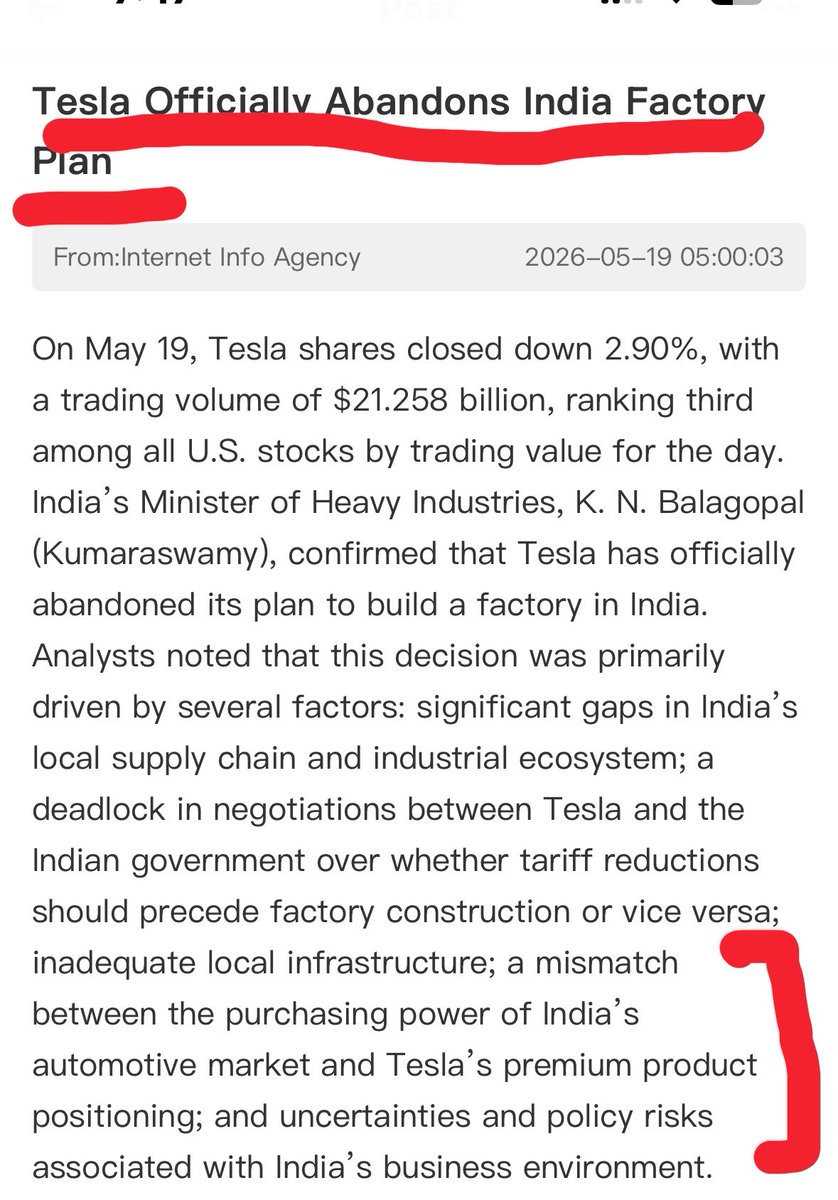
Tesla bids Bye-Bye to India.
Reasons:
“Inadequate local infrastructure; a mismatch between the purchasing power of India’s automotive market and Tesla’s premium product positioning; and uncertainties and policy risks associated with India’s business environment.”
There is so much recent negativity about @airindia that I want to put this out.
I have taken 3 flights on @airindia in the last three days.
On Wednesday:Rome to Del
On Thursday: Del to Bom
On Friday: Bom to Del
In every single case the flight was on time. The inflight service was warm & efficient. Luggage came relatively quickly (quickest in Del)
The check in was entirely painless
I don’t think frequent travellers care as much as others about airline food but if you think that’s important then I had a very good dinner on Rome to Del.
On the international sector I
flew one of the older Dreamliners & I am not one of those aeroplane nerds but I thought
it was very comfortable.
It’s second nature for many
of us to bitch about @airindia but it’s one of only two international airlines I
fly regularly. The other is @emirates which admittedly is far better ( & far more expensive) but it is the best airline in the world so it’s better than every other carrier anyway.
The Tatas need to hold their nerve. There is a lot that is good about @airindia that rarely gets acknowledged
@TataCompanies
Not many are talking about it, but this is one of the most underrated things India is shipping right now and every Indian must know what this is all about.
Let me explain;
The system is called DIGIPIN and the username layer sitting on top is called DHRUVA. Built by the Department of Posts in partnership with IIT Hyderabad and ISRO's National Remote Sensing Centre.
Officially launched on May 27, 2025.
Here's how it works.
DIGIPIN divides all of India into 4 metre by 4 metre squares. Every single square gets a unique 10-character code like 829-4G7-PMJ8. That's down to the level of your front door, your shop counter, your hospital entrance, your village home, even a fishing boat in territorial waters. The entire country is now a digital grid.
But remembering a 10-character alphanumeric code is hard. So DHRUVA sits on top of it. You convert your DIGIPIN into a simple readable handle like rajesh@dhruva. The handle stays with you for life. If you move houses, only the underlying DIGIPIN updates. Your handle doesn't change.
Exactly like UPI replaced 16-digit bank account numbers with simple handles. malay@ybl instead of remembering an account number.
But why is our government building this?
Today roughly 20-25% of Indian addresses are unstructured. Slums, tribal areas, unplanned colonies, rural homes without proper street names.
An average Indian spends 8-12 extra minutes on an average in finding an address in India versus 2-3 in the West.
Ambulances reach late because nobody can describe the lane. Banks reject mortgages because they can't verify the property location. Insurance claims get delayed because addresses don't match across documents. Quick commerce loses crores in failed deliveries every day.
DIGIPIN solves all of this with one open-source standard.
The full source code and documentation are on GitHub. Any government department, private company, or startup can integrate it for free.
This is exactly the India Stack playbook. Aadhaar (identity), UPI (payments), ULPIN (land), DigiLocker (documents), and now DIGIPIN (address) are all open public infrastructure that private companies build on top of.
Of course developed countries already use a version of this. But India is building the best of the lot.
> UK uses postcodes plus house numbers. Works because they have structured street planning from the 1800s. We don't.
> Dubai built Makani numbers. 10-digit codes tied to building entrances. Government-only, not open.
> Japan uses block-based addressing that relies on physical signage and local familiarity.
India just built the best version of all of these.
Open-source, geo-coded, privacy-first, with a human-readable layer that even a non-tech grandparent can use. And it's free to integrate.
Once this gets rolled out, the government expects that;
> Ambulance response times improve by 40-60% in unplanned areas.
> KYC verification becomes instant. No more manual address proof.
> Rural credit unlocks. Banks can verify property and ownership in seconds for loans.
> Disaster response improves. Floods, fires, earthquakes. Rescue teams know exact homes to reach.
> Insurance pricing becomes location-precise. Same building, ground floor versus third floor, different flood risk, different premium.
> E-commerce delivery accuracy goes from approximate to exact. Failed deliveries drop sharply.
> Privacy too gets better. You share your DHRUVA handle, not your physical address. The delivery agent gets the GPS coordinates without seeing your full address. Less data exposed, less misuse.
Boring infrastructure rarely gets any hype. Everyone laughed at UPI for the first two years. Now it processes 16 billion transactions a month and seven countries have adopted it.
DIGIPIN will be the same story. In 5 years we'll wonder how we ever functioned without it. In 10 years it'll be quietly running underneath every delivery, every emergency call, every loan approval in India.