@ben_burtenshaw loved that a script skipping the actual fitting still got the right answer on all eight tasks, best case i've seen for trying to break your own grader. the 7 of 8 pass once vs 1 of 8 pass every time split matters a lot for anything running unattended too
@ApolloResearch the jump from review to decisions is the one to watch, since a bad decision doesn't fail a test the way bad code does. you often only find out it was wrong much later
@swyx agree the chart tells the pretraining story well, but calling post-training the B plot undersells it for anyone deploying. two models at similar perplexity can still be far apart on tool calling or following a rubric, and that gap is mostly post-training
@BrendanFoody the order makes sense too, evals had to land before post-training was worth doing. curious whether the fortune 500 version ends up as fine-tuning open-weight models in house or mostly buying it as a service
@Melt_Dem quantization and routing change what you get back, not just how fast or cheap, so the supply isn't really fungible. a market fits batching and caching well, but it gets harder when output quality varies by venue and the buyer can't see it until after settlement
@niklaslenz_ai calling out that each engine loads its own file so it's four setups, not four engines, is the kind of caveat most speed posts skip. would be curious whether the q4 quants give noticeably different answers from the original checkpoint on the same prompts
@emollick interesting framing. the counterpoint might be that a lot of recent open-weight gains came from better base models and post-training recipes rather than distillation, so the next few releases should tell us which one it was
@hyperstition_cc using under 1% of rollout tokens for 64% of the gains is a great ratio. curious whether a small dedicated judge model holds up as the editor or if it needs a frontier model to intervene well
@soumithchintala 75 tok/s on a DGX Spark for something around qwen 3.8 27B level is a big deal for running agents locally. curious how it holds up on long multi-step tool use, where i'd expect 3B active to get tested hardest
@Guangxuan_Xiao looping the middle 12 layers to get 26B total and 5.4B active is a clever trade. would love to see how it does on narrow yes/no decisions inside agents, that's where a model you can run on your own device pays off most
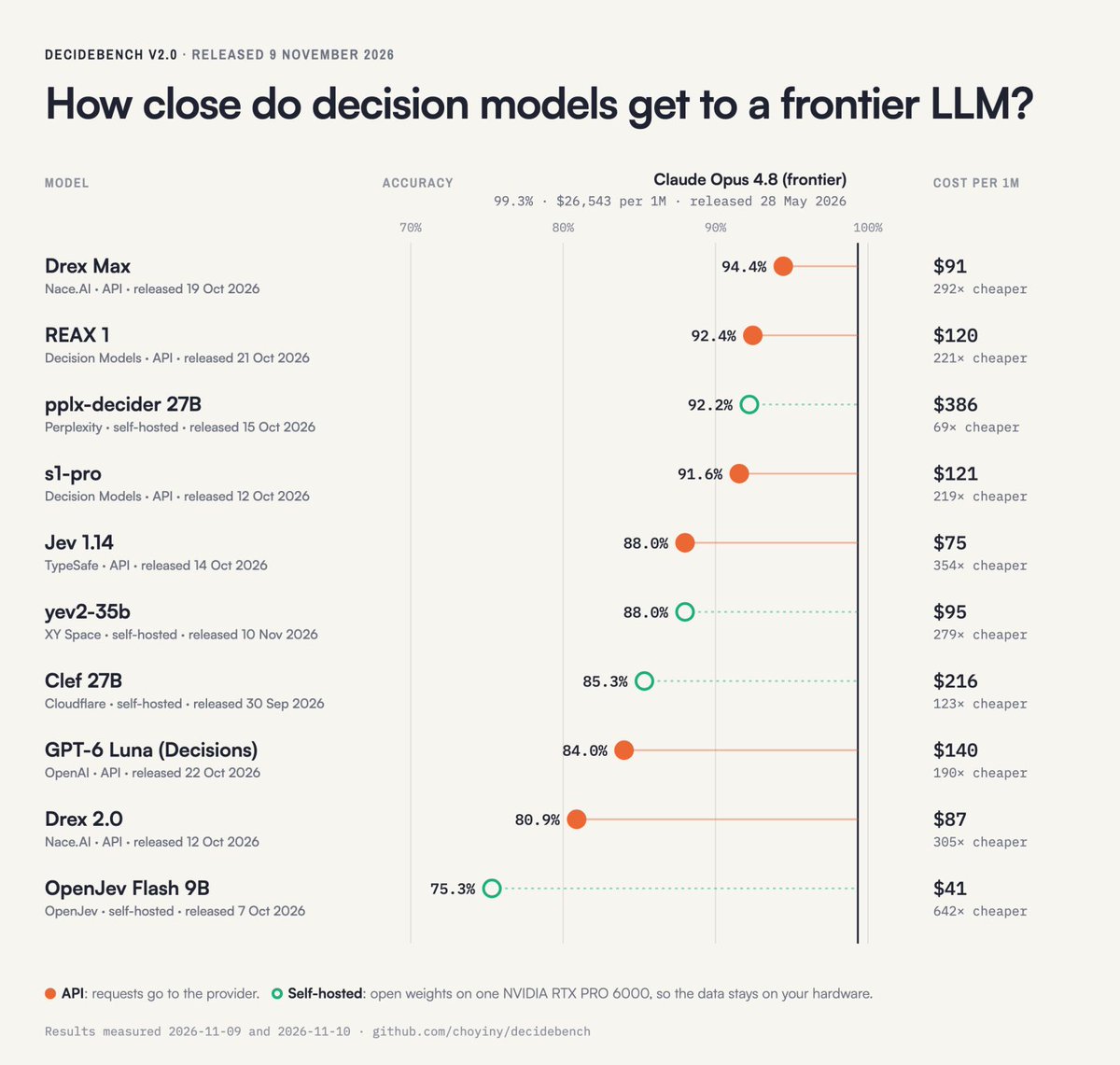
@AravSrinivas@tobi good move, pplx-decider already sits near the top of DecideBench at 92.2%, and a yes/no check on every page an agent reads is the kind of job a decision model is cheap enough to run on every fetch
so the setup I'd build today: a small decision model for most of the traffic, and the uncertain cases routed to a frontier model with a human in the loop
in the last two weeks @GoogleDeepMind and @Microsoft both released decision models, and @liquidai, a much smaller company, beat them both on the @ArtificialAnlys Decision Index: d1.2-ultra 75, Microsoft-Decision-1.1 68, Gemini Decision 1 66
none of them handles rollout gating, where the model computes a crash-free rate and checks it against an ordered list of rules. no decision model gets above 74%, Claude Opus 4.8 gets 100%
we ran every decision model we could get through DecideBench v2, 450 decisions written the way production systems send them, JSON payloads, raw emails, release metrics. Claude Opus 4.8 scores 99.3% at about $26,500 per million decisions
none of them reaches the frontier yet, but Drex Max gets within 5 points for about 1/290 of the cost, and open models you can run on your own GPU now reach 92.2%