World-famous Happy the elephant was euthanized by the Bronx Zoo this week after half a century in confinement.
Here’s how Happy made animal law history—and why her death matters.
Join me in demanding that the Bronx Zoo release its remaining elephant, Patty, to an appropriate elephant sanctuary 🐘
Shout out to @NonhumanRights for arguing Happy’s historic case.
@jeffrsebo According to New York Court of Appeals, Colorado Supreme Court, Utah legislature, and Idaho legislature you can torture and smash Data like a toaster because being person = human!
Yesterday, I woke up to the devastating news that Happy the Elephant was euthanized by the Bronx Zoo.
She was 55 years old and lived almost her entire life in a state of misery.
Seven years ago, thanks to the platform many of you have given me, I was able to bring international attention to Happy’s plight via this thread.
And as you can see in the quote tweets and replies, I continued to do that, with your help, for years afterward.
The @BronxZoo and @TheWCS should never be forgiven for what they did to Happy: keeping her captive, isolating her for years, and denying her the chance to spend her final years in a sanctuary.
@JimBreheny, the now-former director of the Bronx Zoo (he retired just a few months ago), should hang his head in shame and be haunted by what he subjected her to.
Keeping her isolated for many years as they did — despite offers from sanctuaries to take her in — meant they subjected her to years of psychological torture unnecessarily, after she had already had a very difficult life.
And they did all of this for money.
Elephants are often among the most sought-after attractions at zoos. The Bronx Zoo made Happy suffer because she filled its coffers. It is disgraceful.
The Association of Zoos and Aquariums (@zoos_aquariums ) is complicit in this tragedy, a lot more on them later.
Happy’s tragic life was the predictable outcome of an organization that has spent decades defending the confinement of animals whose emotional, social, and cognitive needs far exceed what ANY zoo can provide.
I am largely against zoos for many species, but it is scientifically indefensible and biologically impossible to meet the needs of an elephant in a zoo. Every elephant expert who isn’t complicit in the zoo cartel system agrees with that assessment.
A daughter of Thailand, Happy was born in 1971. When she was still in need of her mother’s care, Happy was abducted and taken to the United States, where she was held captive in Texas, Florida, and eventually New York.
In the United States, Happy gave rides at one point to human beings. In order to make an elephant rideable, you must subject them to unspeakable torture in order to break their spirit.
After the deaths of the elephants closest to her, Happy spent nearly 20 years living largely in isolation. For two decades, the Bronx Zoo and the Wildlife Conservation Society were warned over and over again by advocates, sanctuaries, and elephant experts about the psychological toll this would take on her.
They ignored them. They were, in fact, defiant in their response to some of the world’s leading experts on elephants.
In 2005, Happy became the first elephant in history to pass the mirror self-recognition test, a major scientific achievement that demonstrated self-awareness.
An animal’s ability to recognize itself in a mirror is extraordinarily rare and has been documented in only a handful of species.
The discovery helped further establish what elephant researchers had long understood: that elephants are incredibly sophisticated beings who live complex social and emotional lives, much like humans and other non-human primates.
In explaining why they wouldn’t release her to a sanctuary, The Bronx Zoo said that she had difficulty living with other elephants. That may have been true, but the Zoo never seemed to wonder how she had gotten to that point.
In the wild, there’s no such thing as a female elephant that has difficulty living with other elephants.
If a female elephant misbehaves, she is quickly put in her place by her grandmother, mother, and aunts.
Elephant families are among the strongest social structures in the animal kingdom. Females are born into them, raised in them, and spend their lives within them.
If Happy could indeed not live with other elephants that was just evidence of how living isolated in a zoo destroys an elephant’s ability to form and maintain social bonds.
And even if she did have difficulty sharing space with other elephants, accredited sanctuaries could have kept her alone, but at least she would have had acres and acres of land to roam and explore.
Her psychological state would have no doubt shifted, and she would have been under much less distress.
That’s because elephant sanctuaries that have elephants that don’t get along with others still give elephants the chance to see, smell, and hear other elephants.
Keeping any elephant alone, isolated, and in such a small space is psychological torture — there’s not a single elephant expert not funded by a zoo or zoological organization who doesn’t believe this.
Having spent a lot of time around elephants and having had the great honor of knowing some of the world’s leading elephant experts, I am always in awe of how much elephants are like us emotionally.
Elephants form deep and enduring social bonds, live within complex family networks, mourn the loss of loved ones, and comfort one another in times of distress.
Elephants also possess extraordinary memories (they really do remember everything) that shape their relationships throughout their lives.
Whenever an elephant matriarch in the wild dies at an old age, I often get emotional thinking of the knowledge and memories she passes away with.
A matriarch gains her incredible wisdom from her ancestors, passed down from her grandmother and mother, about the best places to find water and food, and the knowledge of how to raise young, including her own grandchildren.
When I think of the memories Happy died with, I am overcome with grief. Instead of memories of jungles and waterways and elephant calves, she died with haunting memories of the torture, captivity, and isolation she endured.
An elephant’s incredible memory helps them survive hardship. For example, a matriarch knows that she can take her family to an out-of-the-way water hole because her grandmother took her there, and her grandmother’s grandmother took her there. ere.
For Happy, that same gift of memory meant carrying decades of loss, deprivation, and loneliness.
What should have been one of her greatest strengths became another source of suffering.
Few animals are as socially and emotionally dependent on one another as elephants.
Human loneliness can be painful. We know, based on years of research and studies, that it can also shorten a human being’s lifespan.
But forced solitary captivity for an elephant is deprivation beyond what most human beings will experience (with the exception of those who are incarcerated or held against their own will).
Elephants are built to live through touch, sound, smell, movement, family bonds, and constant social awareness. Taking that away is psychologically damaging in a way that is deeper than the usual human comparison captures.
A human being who is isolated can at least rationalize it. They, unless they are incarcerated or held against their own will, have freedom of movement. They can try to change their circumstances.
A captive elephant forced into isolation cannot do that in the same way. It does not understand the reason for its isolation. It cannot choose to leave. It cannot call someone or reframe the experience as “solitude.”
The Bronx Zoo turned its back on Happy and her supporters even though easy options were presented to it.
As I mentioned earlier, accredited sanctuaries offered to take Happy in.
My friend @WhitneyCummings even offered to cover the cost of Happy’s transport to one of those sanctuaries (this would have cost her hundreds of thousands of dollars).
Many people helped to elevate my message about Happy when I shard it.
Thank you to my pals, including Chrissy Teigen, Josh Gad, @piersmorgan , @richardmarx , among others, who used their platforms to bring more attention to Happy.
Thank you to former NYC Council Speaker Corey Johnson , who took the time to learn about Happy’s plight when he was in office and issued a strong statement calling on the zoo to send her to a sanctuary.
Other politicians ignored the global pleas to help her.
Thank you to my friend Joyce Poole — who knows more about elephant behavior than anyone else living and has played a major role in saving the African elephant.
Joyce’s organization, @elephantvoices , does critical work advancing our understanding of elephant behavior, communication, intelligence, and social lives.
It was Joyce’s years of research that led us to understand elephants in the way we do now (she’s often called the Jane Goodall for elephants for good reason) — that research helped powerful lawmakers and officials to understand that elephants are so much like us and thus led to an international ban on ivory.
Joyce’s expertise is unparalleled, and she used the respect she’s earned, and her years of expertise, to file affidavits on Happy’s behalf and to speak to influential officials to push them to advocate for Happy.
And thank you most of all to my friends at the @NonhumanRights project for putting so much effort, time, and heart into fighting for Happy.
Non-human animals deserve rights too.
Happy’s right to determine her future was stolen from her when she was snatched in the jungles of Thailand and thrown onto a plane to disappear into an abyss of captivity, torture, and isolation.
And even when the world rallied by her side, her captors, who claim to care about the welfare of animals and make their determinations based on science, thumbed their noses at expert after expert who pleaded for Happy to be released to a sanctuary.
When a female elephant dies, she is often surrounded by her daughters, her young sons, her nieces and young nephews, among other relatives.
Happy was denied something that should have been hers by birth: the chance to die surrounded by those who loved her.
Had Happy remained in Thailand and lived in the wild, she could have had around six children and perhaps as many as 10 grandchildren, with even the possibility of great-grandchildren.
Instead, Happy was euthanized in a cold zoo that held her prisoner for years in order to extract as much money as they could from her.
@RichardDawkins Perhaps "human" extends to all hominids. If so, it should extend to chimpanzees and other great apes who are also hominids (literally: "human family"). But so far courts have said no to chimpanzee rights in New York and Michigan.
@RichardDawkins Colorado Supreme Court: "Colorado's habeas statute [protecting liberty] only applies to persons, and not to nonhuman animals, no matter how cognitively, psychologically, or socially sophisticated they may be." "Person" = "human, individual"
Today, we remember a legend.
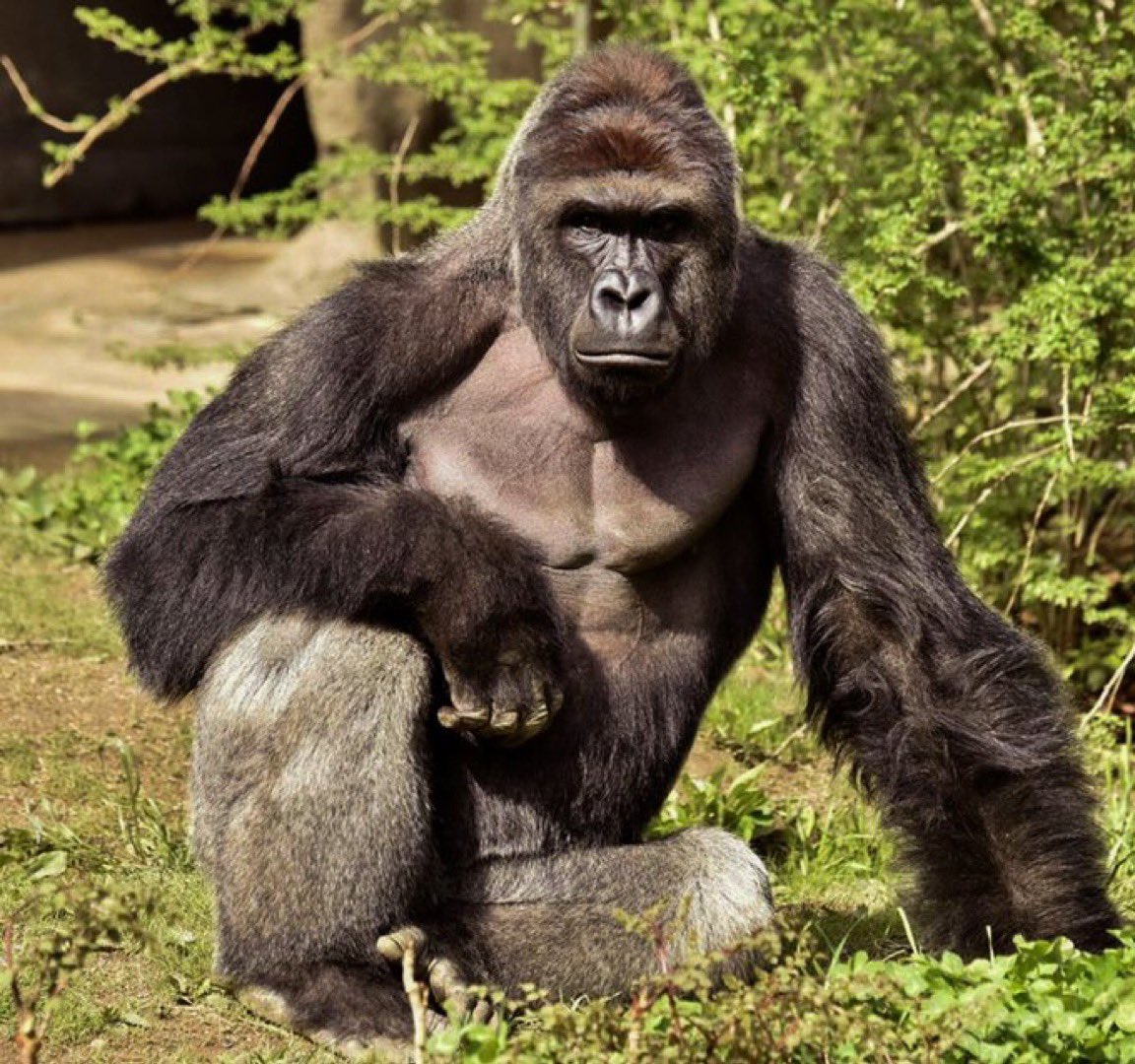
On this day in history, Harambe would have celebrated another birthday. An icon that became part of internet history, American culture, and an entire generation’s timeline.
Tomorrow marks 10 years since we lost him. Ten years since the moment the world stopped scrolling and collectively mourned something bigger than a meme.
He became a symbol of loyalty, strength, chaos, unity, and the strange beauty of the internet bringing millions of people together for one cause: never forgetting Harambe.
Everyone remembers where they were when they heard the news. And somehow, a decade later, his legacy still lives on.
Gone, but never forgotten.
Rest easy to a true patriot. 🕊️🇺🇸
May 27, 1999 — May 28, 2016
Forever in our hearts.
@jeffrsebo@InVitroFuture The best way to dignify humanity is to cherish the traits of humanity—consciousness, emotion, creativity, etc.—wherever we find them.
@DavidHein9@ProfMarkElliott Fair point; may weigh in favor of sparing use though rather than none at all. There are plenty of things we could do to stay in physical and mental shape that we often delegate.
@DietCoke_Esq Audio recording of you reading the terms of the engagement, her saying “ok, I agree” to each one, and then send her a copy of the recording afterward via a format she agreed (on the recording) she can use, eg mp3 if she has a smart phone, cassette if she has a tape deck, etc.
@cosmicfibretion@LueElizondo And if this was possible, would they even present themselves considering it would be legal to kill, kidnap, do whatever to them in several jurisdictions like UT & ID that limit legal rights to “Homo sapiens”? Even liberal states like NY & CO may go that way via existing case law.
@senatorshoshana 31 dead sloths over multiple incidents? Out of how many total? That number insane. I’m not an expert in importation law but I’d be shocked if there wasn’t some unreasonable exercise of discretion happening somewhere in this chain. Why no enforcement action and license revocation?