One of the most-viewed PNAS Nexus articles in the last week is “Community notes increase trust in fact-checking on social media.” Explore the article here: https://t.co/x1rHF7LrDI.
To learn more about submitting your own research, visit PNAS Nexus at https://t.co/tRIpcL0g8M.
One of the most-viewed PNAS Nexus articles in the last week is “Community notes increase trust in fact-checking on social media.” Explore the article here: https://t.co/dKOgWKYthK
To learn more about submitting your own research, visit PNAS Nexus at https://t.co/wbc8nNHlAu.
Gegen Misinformation und Fake News in sozialen Medien sollen Faktenchecks helfen. Aber funktionieren sie?
Darüber — und warum Warnhinweise alleine nicht ausreichend sind — haben wir anlässlich unserer neuen Studie mit der @faznet gesprochen.
w/ @NicProllochs
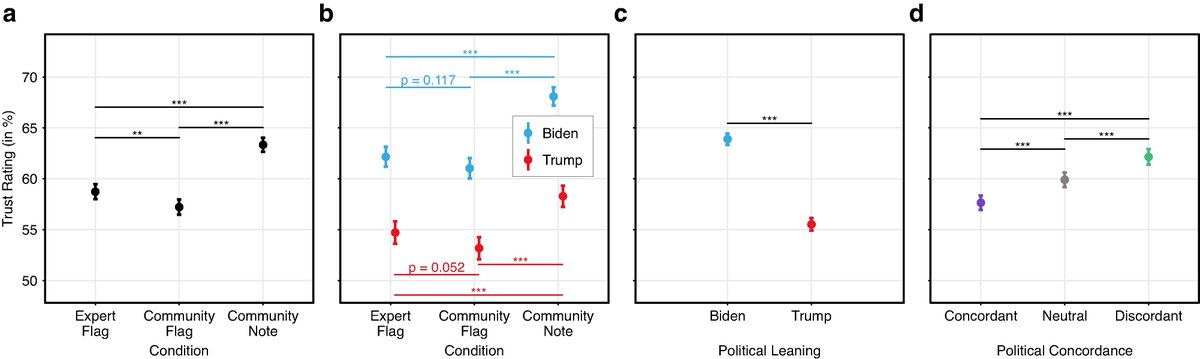
People trust "community notes" more than flags to warn against misinformation because of the additional context rather than source trust, with results holding across partisanship, finds @chrdrlsbch Solovev @NicProllochs in @PNASNexus https://t.co/peqkuoxfgn
🚨New Paper in @PNASNexus : “Community Notes Increase Trust in Fact-Checking on Social Media”🚨
Are users more likely to trust expert fact-checkers or their peers? 🤔
👉Our study shows there's almost no difference.
👉Instead, *context* is what really helps to build trust!
🧵
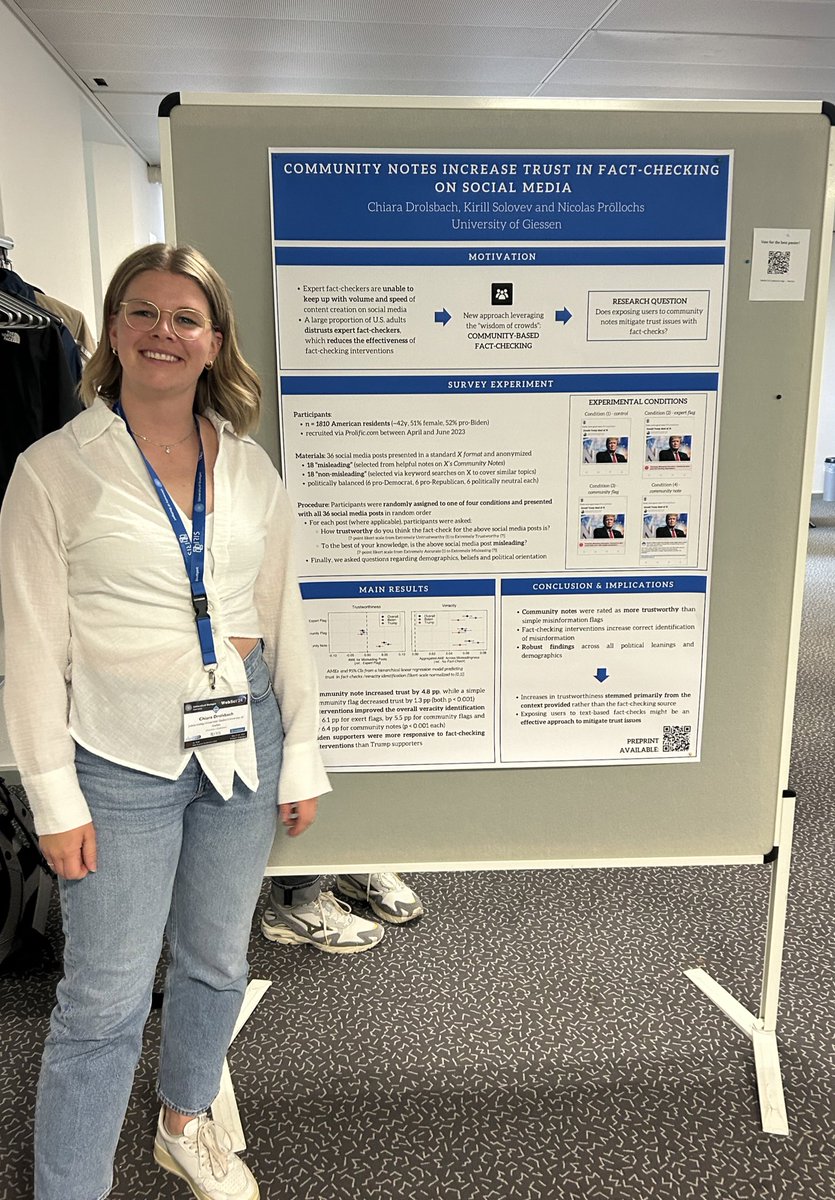
Finishing #WebSci24 in the best way possible by winning the best poster award 🏆
Full paper will be out soon. Check out the preprint via https://t.co/s2eYCLoutn
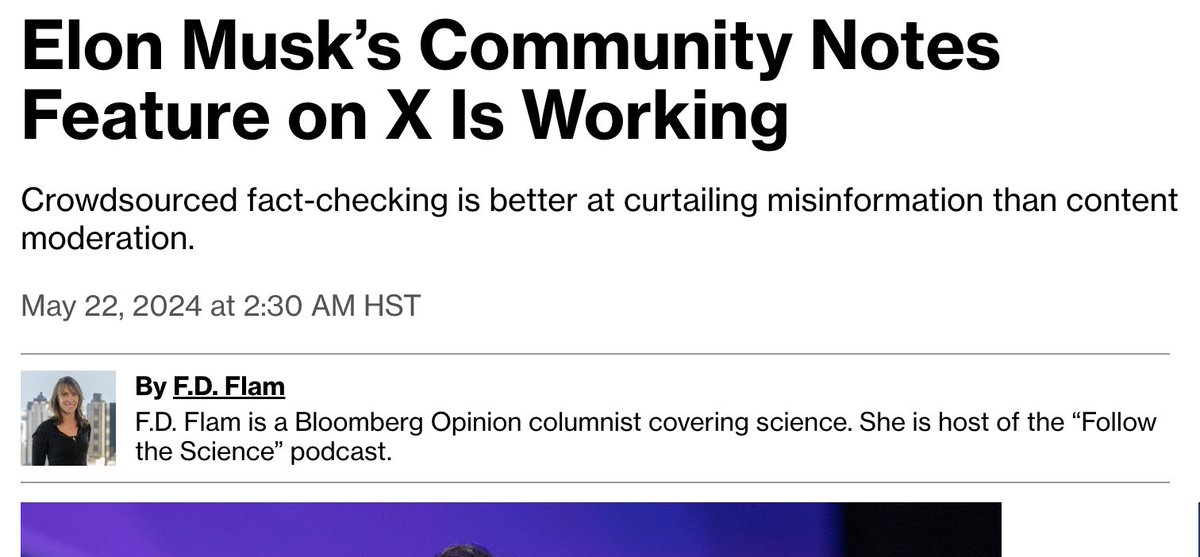
In addition the study Bloomberg cites, a recent study found @CommunityNotes were perceived as significantly more trustworthy than traditional, simple misinformation flags — across the political spectrum! And had a greater effect on improving people’s identification of misleading posts.
https://t.co/b6AbMtY2NV
What a great poster session @WebSciConf yesterday!! I had lots of enriching conversations while sharing our new paper on the perceived trustworthiness of Community Notes. Stay tuned - forthcoming @PNASNexus!
w/ @KOSolovev@NicProllochs
We find significant differences in how social media platforms implement their obligations mandated by the DSA. This indicates that there is an urge for clearer guidelines to ensure common standards and meet the goals of the DSA - safer, more open platforms.
NEW PAPER!! 🥳 w/ @NicProllochs
Unfortunately, I cannot attend @TheWebConf in person -- but check out our new paper on content moderation on social media in the EU under the DSA! #TheWebConf#WWW2024
https://t.co/iXqaY9JDyW
I am happy to announce that our paper "Pass-through of temporary fuel tax reductions: Evidence from Europe" has been accepted for publication at Energy Policy. Huge shoutout to my co-authors @chrdrlsbch and @MaxMGail. Open access here: https://t.co/yYqk5bbQAE #EconTwitter 1/2
.@chrdrlsbch presents her work on the virality of tweets that receive ‘community notes’. Tweets perceived as believable receive more retweets (different from previous results considering professional fact-checks)
https://t.co/I3ruHSPjak