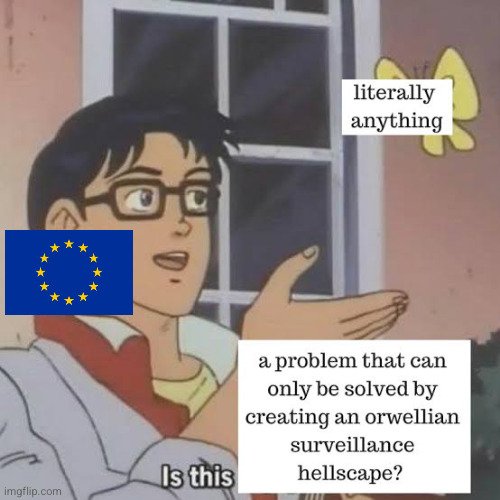
Signal is 100% right.
The greatest trick governments ever pulled was convincing people that freedom and privacy are obstacles to safety.
What we are witnessing is not child protection. It is the construction of a surveillance architecture that will eventually monitor, profile, categorize and control every aspect of our digital lives.
Today it is age verification and content scanning, tomorrow it is digital identity, then financial monitoring, then behavioural scoring, then access to services conditioned on compliance.
The destination is not difficult to see. It is a technocratic system where every interaction is tracked, every transaction recorded, every opinion assessed and every citizen reduced to a data profile managed by governments and corporations working hand in hand.
A form of digital neo feudalism where a small unelected class controls the platforms, the infrastructure, the money and ultimately the boundaries of acceptable behaviour.
The argument that only criminals should fear surveillance is as absurd as saying only criminals need freedom of speech. Privacy is not evidence of wrongdoing, it is the foundation of human dignity, individual sovereignty and genuine liberty.
The UK government is asking citizens to accept the presumption of guilt simply to communicate online. To prove who they are, verify their age and allow their devices to inspect their content before they can participate in modern society.
History teaches us that every power granted to the state eventually expands beyond its initial mandate. The technology introduced to detect one form of content today will be used to police entirely different forms of expression tomorrow.
The choice before us is not between privacy and child protection, it is between preserving a free society, or constructing the infrastructure of a digital prison that will further enslave us.
So-called age verification for social media is spreading across the world, framed as an effort to create a safer internet for children. In reality, age verification lays the foundation for a fully controlled internet.
The age verification rush must be slowed down, and politicians need to recognize the consequences of different types of legislation and systems.
Age verification is the wrong approach to fix “the social media problem”
The big tech social media companies are bad. Their business model is bad; it is based on mass surveillance and manipulation, and they cooperate with governments in mapping entire populations. But age verification is fundamentally the wrong approach to preventing children from using big tech social media platforms. Introducing age verification is based on coercion; the state forces social media companies to verify their users’ identities. But the big tech social media platforms already know which of their users are children. Their business model depends on knowing this. They know how old users are, and they know exactly what type of person they are. As age verification is based on coercion, politicians could instead force platforms to stop doing the things politicians consider harmful to children, or force them to block children (again, they know who they are) from using their services. But instead, politicians seek to massively invade everyone’s privacy and undermine democratic rights on a global scale. In other words, the latter is the real objective – they do not want to protect children; they want to impose control.
Slippery slope of age verification
It is undeniable that age verification threatens freedom of expression, risks increasing mass surveillance, and is likely to lead to censorship. It will not only shrink the online world and reduce young people’s right to privacy (for example, if VPN services were to be restricted); but also risks becoming a significant step toward a controlled internet for everyone.
Most age verification is identity verification
Most countries are now considering introducing age verification systems, meaning that everyone would have to identify themselves either to the service/website they want to use or to a third party capable of linking them to their activity on that service or website. This is not age verification but identity verification, and the consequence is therefore that freedom of information is restricted (you can no longer visit regulated websites anonymously) and that you can no longer post anonymously on social media. This is a major problem in countries like the UK and Germany where the police conduct raids on people’s homes for posting content on social media that the authorities dislike. Or in the United States, where authorities are trying to pressure tech companies into revealing the identities behind accounts protesting ICE. Social media identity verification removes important tools for activists in countries where criticizing those in power is dangerous.
Restrictions on app store or operating system level
Some countries are looking to impose identity verification at the app store level or even within the operating system itself. This is an exciting experiment, since this is possible to circumvent using open-source operating systems. Some countries are already looking to include open-source systems. Since open-source systems cannot be controlled, politicians would ultimately need to ban devices that are not controlled by the state. The end point: telescreens like those in Orwell’s 1984, devices that both monitor you and broadcast only the information approved by the state.
The Zero-Knowledge Proof (ZKP) alternative and the EU
The EU has presented its own age verification app as “completely anonymous”. The idea is to use Zero-Knowledge Proof (ZKP) cryptography to break the link between the age credential issuer (EU governments) and the regulated services/sites. Currently, the EU app does not have ZKP functionality, contrasting Ursula von der Leyen’s claim that the app ”is technically ready to be used”. But more importantly, the app is currently designed to always function without ZKP technology; if ZKP is unavailable, the app falls back to a non-ZKP model. Even if fully developed ZKP technology could be implemented in the future, it would remain an optional extra feature that countries may choose to disable and that the EU could remove at any time.
Read more on our site.
https://t.co/wTVKHMS1zg
Can anyone explain why the Nazi swastika is banned in many EU countries, but the communist hammer and sickle (which caused over 100 million deaths) is A-ok?
You retards fail to understand the Internet is an open platform. Putting age verification on VPNs serves nothing but a way to surveil and catalogue individuals who use these services to bypass your shit blocks. You don't give a fuck about kids or else you would focus on the parents handing devices to their kids with no oversignt.
People should bypass this by using no ID services like Mullvad so they never have to provide a piece of ID to even make an account. People should also consider using OSS platforms like Signal to bypass your attacks on encryption as well.
Fuck you and fuck the draconian world you want to build.
There’s something ominous about the speed with which the entire world has marched to require identification on platforms and, as I expected, begin the process of banning anonymous VPNs.
Med EU-plånboken måste man alltså gå till polisen för att skaffa ett speciellt ID-kort... för att kunna använda en app... för att få lov att använda sociala medier. Har vi blivit alldeles kinesiska?
https://t.co/KCyAlNcJFG
Varför ska alla EU-medborgare dras över en kam?
Barn kan skyddas med smart teknik och polispunktmarkering mot förövare, utan att vi offrar vår anonymitet.
Att EU istället väljer massövervakning och ID-krav på nätet tyder på att de är mer intresserade av kontroll än säkerhet.
Med EU-plånboken måste man alltså gå till polisen för att skaffa ett speciellt ID-kort, för att kunna använda en app, för att få lov att använda sociala medier. Har vi blivit alldeles kinesiska?
https://t.co/b8FT73xYDP
Nej nej nej, @MariaStenergard! "Antimuslimsk rasism" är ett ännu värre begrepp än "islamofobi". Man kan inte vara rasist mot en religion, för helvete, för religioner ska man vara rädd. Nej, man kan bara vara rasist mot en ras och islam är fan i mig ingen ras. Nu får det vara nog!
Det är valår. Det vill säga en tid då våra politiker är extra ovilliga att diskutera övervakning och medborgarnas rätt till privatliv. De vet att frågan är ett minfält.
Men när det är val måste vi kräva besked om framtiden och utkräva ansvar för det som varit. Vi kan inte rusa vidare in i övervakningsstaten utan diskussion eller eftertanke.
Även om politikerna försöker ducka – så är det ett demokratiskt hygienkrav att kräva svar på frågor som rör våra grundläggande fri- och rättigheter.
Europakonventionen om de mänskliga rättigheterna slår fast huvudregeln: Var och en har rätt till skydd för sitt privat- och familjeliv, sitt hem och sin korrespondens.
Och EU-domstolen har dragit gränsen: Övervaka dem som misstänks för brott – inte alla andra, hela tiden.
Här är några relevanta frågor.
• Hur mycket övervakning skall vi ha?
• Vilka risker ser du med en allt för omfattande övervakningsstat?
• Vi får ständigt mer massövervakning. Vid vilken punkt tycker du att det blir problematiskt?
• Har vanligt hederligt folk rätt till privat kommunikation?
Ju enklare, desto bättre. Trassla inte till det. Och om de politiska kandidaterna försöker ducka – upprepa frågan tills du får ett svar. Låt dem inte komma undan.
Naturligtvis är det kul om man kommer åt att fråga partiledare och toppkandidater. Men underskatta inte partiernas fotfolk som står i valstugor, delar ut flygblad och diskuterar politik vid fikabordet.
Jobbiga frågor skickas snabbt uppåt i partiorganisationen och måste i någon mening hanteras. Om det kommer in mer än enstaka rapporter om att en fråga bubblar, måste de politiska partierna förhålla sig till den.
Pårom! Om inte du ställer våra politiker till svars lär ingen annan göra det. Och var alltid saklig och artig, även om det kan vara frustrerande att försöka få dem att svara.
De skall inte komma undan med att urholka våra grundläggande fri- och rättigheter i tysthet.
@James7Holland The commission needs to be abolished. Then you either abolish the parliament to keep the EU inter-national, or abolish the council to make it supra-national. The current system is a democratic limbo (probably by design).
BUT WE HAVE DEMOCRACY?
Yes, we do.
You can vote. You can change governments. You can throw out a party if you’re tired of them.
That’s true.
But let me ask you something.
Who voted for Ursula von der Leyen? Who chose the European Commission? Who put a cross next to the 27 commissioners who make decisions about a large part of your daily life?
You didn’t. None of us did.
The European Commission is the only body allowed to propose new laws for 450 million Europeans. The European Parliament is elected, yes - but it can only say yes or no to what the Commission puts in front of it.
That is not real democracy. It is a kind of controlled nodding machine.
And increasingly it is Brussels that decides more and more. Not your own parliament or your own vote.
They decide your cash limits. Your digital identity. How much you pay for electricity. Who is allowed into the country - and out again. What you are allowed to say in public. And soon more about what you eat and how you live.
All decided by people you never chose. Who you cannot fire. And who you cannot hold accountable the next time there is an election.
This does not happen with guns to your head.
It happens with directives, regulations and long technical documents that almost nobody bothers to read…but that everyone must comply with.
Slowly and almost without you noticing.
The nation state - the only place where ordinary people have ever been able to govern their own country - is being slowly hollowed out from within.
Power is moving upward to institutions that are designed to be immune to ordinary popular resistance.
They call it “stability”, “expertise” and “European values.”
But what they actually mean is that they don’t trust you to know what is best for yourself.
And the absurd thing is that the same establishment that gives long speeches about democracy is the one slowly dismantling it.
When you one day wake up and see it clearly…it may already be too late to change.
Democracy is not just a ballot paper every four years. It is the right of a people to govern themselves. To say no. To change course. To throw the whole thing out and start again if necessary.
That power is slipping away from us. And it is happening in the name of freedom, security and “European values.”
Ask yourself: who actually decides what those values are?
It certainly wasn’t you!
Mijn x ontplofte gisteren vanwege mijn post over leeftijdsverificatie en DigitalID. Veel medestanders. Klinkt mooi maar ben toch niet gerust.
De eerste persoon (buiten X) die ik spreek: “lijkt me alleen maar goed dat kinderen minder op social media zitten”. Zonder brede uitleg aan de bevolking wat de échte effecten zijn voor ons allemaal gaan we dit niet winnen.
Hoe leg je uit dat ouders de kinderen geen smartphone of social media hadden hoeven te geven als ze het zo slecht voor de kinderen vinden? Daar heb je toch geen overheid voor nodig?
En waarom is er geen brede informatiecampagne over alle tweede orde effecten van digital id? Ik ben serieus verbaasd over hoe schouderophalend men autonomie uit handen wil geven. En als je het uit handen geeft komt het niet vanzelf meer terug.
Free speech isn’t a weapon of war. It’s a weapon against tyranny.
The moment you treat speech as something dangerous that must be controlled, you’ve already conceded the core principle, that individuals can’t be trusted to think and judge for themselves.
Yes, speech can be misused. So can anything human. But the alternative isn’t safety, it’s authority deciding what you’re allowed to say, hear, and believe.
That’s control, not protection.