“Hey miners, flip the bit!”
What does that actually mean?
Every Bitcoin block has 32 “parking spaces” in its header (the version field).
In each space, a miner can paint either a 0 or a 1.
The first three spaces are already fixed forever as:
0 0 1
That leaves 29 available parking spaces that can be used for soft fork proposals.
Parking space #4 (Bit 4) is the one assigned to BIP-110.
Starting at block 961,632, anyone who builds a block template (a miner) has to decide whether to paint a 0 or a 1 in that space.
“Flipping the bit” simply means changing the default 0 to a 1.
That paint job is the entire technical act. It is simple and fast, and any miner can do it.
What about nodes?
Nodes do not paint the number. They only enforce it.
A BIP-110-enforcing node will accept a block if it sees a 1 in space #4, and reject it if it sees a 0.
A regular Bitcoin Core node will accept all blocks. 0 or 1, as long as the rules of the road are met, it takes the block.
So miners who want their blocks accepted by BIP-110-enforcing nodes will need to start painting a 1 in parking space #4 from block 961,632 onward.
Otherwise, a non BIP-110 miner risks having enforcing nodes reject all of their hard work (energy and money) spent building that block.
But simply RUNNING a node has limited influence (if any).
If you just download the software and turn it on, you are just observing the parking lot. You are looking at the spaces, but you are not driving any cars into them.
Miners who have to paint in a parking space car about the cars that are going to drive into them.
If you actually USE your node by sending transactions, receiving payments, withdrawing from an exchange, and making purchases, etc., THEN you are driving your own car onto the roads and into the parking spaces.
That is what carries practical weight and impact.
Miners care about where real economic activity is happening.
Running a node is good for your own verification. Yes.
But actually USING a node is what gives your choice real influence on the network.
Yelling at people on X does nothing. USE your node if you think Bitcoin is money and then your voice actually matters.
CFTC Chair Mike Selig says the agency will move forward with crypto regulations even if the CLARITY Act fails.
That produces two very different outcomes. Passage locks CFTC-SEC oversight into statute that only Congress can rewrite and that survives any election. Failure lets the agencies write the rules themselves. The joint memorandum and taxonomy classifying 16 assets as commodities already exist, yet the next chairs can reverse them without a vote.
Selig can move immediately as the sole sitting commissioner. One Senate day remains and the bill is unscheduled. Rules arrive either way. Only the statutory path removes the political override risk that still keeps large capital on the sideline.
Passive equity funds just took in a record $250 billion over four weeks. Active funds lost $50 billion. Net equity flows hit +$200 billion, an all-time high that beats the early-2021 peak of $165 billion when both styles were still attracting cash. Passive inflows have more than quadrupled since mid-2025.
The easy read is that passive remains exceptionally popular. That framing is useful for the platforms that monetize AUM. Passive fee structures turn every inbound dollar into recurring revenue at almost zero marginal cost. Active outflows shrink the competing fee pool at the same time. The shift consolidates the rent.
Index money also buys without discretion. It lifts whatever the benchmark holds, concentrating the bid in the largest names and turning their weight into a self-reinforcing claim on the next wave of mandates. Exit liquidity improves for those already inside the index. Discretionary price discovery thins.
If the next four-week window still shows passive absorbing hundreds of billions while active stays in redemption, the fee transfer is the durable fact. A slowdown or genuine rotation back would show how much of the popularity claim was just the path of least resistance.
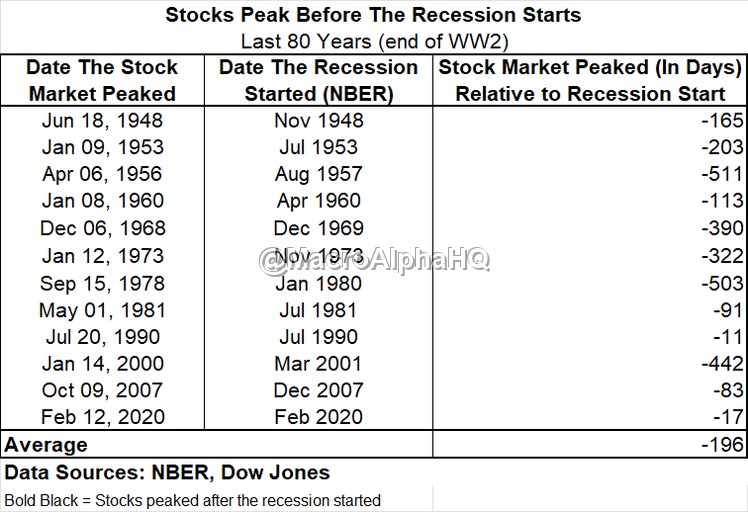
$SPX at a fresh all-time high. In 100 years that has never occurred in a recession month.
The same record shows equity peaks normally lead recessions by months. The only times that gap collapsed to 11 and 17 days were Iraq’s invasion of Kuwait (oil +400%) and a full pandemic shutdown.
A rare exogenous shock is what compresses the entire timeline. Absent one in the next few days, the tape is being treated as several months of clear air at minimum.
That is a large safety claim resting on a thin binary. Normal cycle discounting buys time. A global stop erases it overnight. The ATH filter only rules out this month; the lead-time argument does almost no work once the shock arrives.
Anyone treating the new high as durable proof the economy is fine is exposed the moment that condition flips. Inflation and rates stay the stated worry only while the cushion holds. One genuine crisis and the “several months” reading becomes the shortest footnote in the series.
⚡️JUST IN
Iran's Military Spokesperson explain why the United States has not Attacked Iran in the past Two days:
"Americans have lost their way and don't have a clear strategy
Their goals to open the Strait of Hormuz and destroy Iran's Military Capabilities have Failed
The United States may go for Three options now: Withdraw from the War, Carry out a big Air Campaign or send Ground Forces
We are Prepared for all the Three Scenarios"
From @f_asselineau
🇪🇺💥🇨🇳 **THE EU SANCTIONS CHINA?**
**CHINA STRIKES BACK IN UNDER 24H.**
In its 21st (TWENTY-FIRST !!🤡) "sanctions package" against Russia, the geniuses💡of the European Commission have decided to sanction 14 Chinese companies for their alleged support of Moscow.
👊 Beijing has hit back sharply in less than 24 hours.
An eye for an eye, a tooth for a tooth.
Since 14 Chinese companies have been sanctioned by the EU, 14 European companies in the armaments sector can no longer, overnight, purchase absolutely strategic Chinese products essential to carrying out their activities:
-certain rare earths, over whose possession and production China exercises global dominance
- electronic components and indispensable semiconductors manufactured in China
- other critical materials
⚠️ Among the 14 companies in Europe thus cut off from decisive components are:
🇩🇪 The German armaments giant Rheinmetall
🇮🇹 The Italian engine maker Lafert
🇫🇷 The French company Cavok UAS, specialized in drones
🇳🇱 The Dutch company IHC
🇨🇿 The Czech company Tatra Trucks
------------------
COMMENTS
------------------
By sanctioning Chinese companies with arrogance and thoughtlessness, the EU has thus drawn a Chinese riposte that strikes at the heart of its defense industry and its ecological transition.
Led by a gang of idiotic dictators who think they’re the center of the world, the EU wanted to play tough with China, without realizing that it no longer has any means whatsoever to impose any kind of dominance.
Historically, it’s always the misperception of the balance of power with an adversary that gives rise to the greatest disasters.
It is once again confirmed that the so-called "European construction" has the concrete effect of destroying Europe.
---------------
CONCLUSION
---------------
If we come to power in 2027, we will immediately proceed to the cancellation of this delusional policy of "sanctions" against the entire world in general, and against Russia and China in particular.
On the contrary, we will relaunch the policy of friendship, cooperation, and mutual respect with these 2 giants of the world of today and tomorrow, as was so opportunely bequeathed to us by Charles de Gaulle. And we will seek France’s accession to the BRICS.
It will be yet another benefit of Frexit.
Our companies will then realize that the madness was not in leaving the EU but in staying in it.
The last time this exact $BTC setup played out, it culminated in a massive bull run to $125K.
Now, the 2026-2028 cycle is mapping the precise same pattern.
With prices currently hovering around $65K, the long-term cycle data flags a critical pivot. We are sitting at the exact transition point where the downtrend bottoms out and the "Accumulation" phase begins.
This is the zone where average investors get exhausted by the sideways chop and walk away. Smart money uses that exact boredom to quietly build massive positions.
History shows that accumulation eventually snaps into a pre-bull phase. Once that transition triggers, the window for cheap entry slams shut.
The projected structural target for the peak of this incoming cycle is $220K.
If you spend your energy stressing over daily price swings, you miss the macro reality entirely.
Wealth isn't built by perfectly timing a market bottom. It is built by identifying the accumulation zone before the pre-bull trend forces everyone else to chase.
The ink on the recent MoU is barely dry. As the US-Iran conflict officially resumes, the 10-year Treasury yield ($TNX) is sending a ruthless warning.
Normally, a major geopolitical shock triggers a flight to safety. Investors panic-buy government bonds, pushing yields down.
This time, they are selling.
The 10-year yield just spiked to 4.65%. The 30-year yield crossed 5.14%. Both are instantly nearing 52-week highs as the war returns.
The bond market is looking straight past the fear of conflict and doing the math on the cost. Prolonged war guarantees massive deficit spending, a flood of new government debt, and an inflationary shock to supply chains.
For your money, this is the ultimate headwind. When long-term risk-free rates lock in above 5%, capital is violently drained from equities, and mortgage rates stay elevated indefinitely.
The market isn't pricing in a quick resolution. It is pricing in a very expensive decade.
Higher $CL is driving long-term yields sharply higher.
UK 30y at 5.73%. US at 5.14%. Japan at 3.89%. Germany at 3.65%.
Most striking: Japan now yields more than Germany after decades of near-zero rates.
Investors are repricing inflation risk for years ahead.
The energy shock has arrived in long-term bonds.
What this means for your money: higher long rates make future earnings and rents worth less today. Mortgages and loans stay costly.
The cheap money era is closing in more places than expected.
Yields are climbing, yet $GLD is defying gravity above $4,100.
Finance textbooks say this shouldn't happen. When government bonds pay more, investors are supposed to dump zero-yield assets like gold.
But that old correlation is broken.
Historically, rising yields crushed gold because they signaled the Fed was aggressively hiking rates.
Today, the mechanics have flipped. The Fed has lost its appetite for hikes. Their baseline bias is to ease, regardless of what the bond market is doing.
When yields climb but the central bank refuses to fight back with higher rates, it sends a specific signal. It tells the market that inflation is settling higher, or the fiscal situation is under stress.
Gold loves both. It stops trading like a simple bet on interest rates and starts trading like insurance on the currency itself.
If you are sitting in cash waiting for yields to collapse before looking at precious metals, you are navigating with an outdated map.
When the Fed's hands are tied, the old rules die.
Big Tech is hiding $1.65 trillion in debt with the same accounting trick that destroyed Enron.
We're talking about Alphabet, Microsoft, Amazon, Meta, and Oracle. Five companies sitting inside almost every index fund and retirement account.
And the five of them are carrying around $1.65 TRILLION in debt that never shows up on their balance sheets.
That number is roughly 8x bigger than it was four years ago.
And it is larger than all the debt they actually report, which sits near $1.35 trillion.
So the debt they hide is now BIGGER than the debt they admit to.
Meta is the worst of the group. It has about $420 billion parked off its books, nearly triple what it shows investors on paper.
But where does $1.65 trillion in debt even go to disappear?
The trick is simple:
When one of these companies signs a multi-year deal to buy GPUs and servers, or leases a massive data center that has not opened yet, the accounting rules let them keep that obligation off the balance sheet until the facility actually goes live.
The money is promised. The contracts are signed. The bill is real.
It just does not count as debt yet.
They basically book the ambition today and hide the liability until later.
That makes current profit look bigger and the balance sheet look cleaner than either one really is.
And every part of it is completely legal...
Enron literally ran the same play.
It pushed its debt into vehicles that sat off the books, so the profits looked incredible while the real obligations stacked up where investors could not see them. When it finally unraveled, it became the biggest corporate collapse of its era.
Bloomberg Law said themselves that Big Tech's AI spending spree is reviving the accounting devices that destroyed Enron.
And the smart money is already nervous:
- Morgan Stanley flagged the ballooning data center leases as a major risk in an investor report
- Moody's warned that all these pre-opening lease commitments could pile pressure onto companies that look untouchable right now
- The Bank for International Settlements gave the practice its own name, they call it shadow borrowing.
When the Nikkei investigation asked all five companies to explain the numbers, every single one of them refused to comment.
So why does this matter while the market keeps ripping?
Because the whole thing only works while the data centers fill up.
Every one of these contracts assumes AI demand keeps climbing forever. The second that demand slows, the companies still owe for every leased building and every GPU order they signed. The revenue softens and the bill doesn't move.
That is the moment the hidden $1.65 trillion becomes a real problem.
And the crack almost never shows at the giants first, it shows at the edges:
One AI tenant misses a lease payment. One private credit fund writes down a data center loan. One rating agency downgrades the most exposed name in the group.
Then everyone remembers the debt was there the whole time.
For four years these companies trained investors to watch the cash pile and the profit line. But the figure that actually matters is the $1.65 trillion they moved to a page you were never meant to read - just like Enron.
Goldman base case still has Brent at $80 by Q4 if this eases.
But Persian Gulf flows are already under 45% of prewar and the 5mb/d Yanbu offset that was covering it now sits in the Houthi line of fire.
Wait, that base case just cracked. $120 is the path if Hormuz stays jammed.
Jack met the Financial Industrial Complex (FIC)
The FIC wrapped Jack into a security
I explained publicly what that meant
Jack publicly disagreed with me
Now Jack has walked away from the FIC
More should do the same
Well done Jack 💪
@howardlutnick Nice try
China macro is turning into an extreme dispersion trade. Headline GDP is becoming almost useless.. Japanification, but with geographic arbitrage both domestically and internationally is my closest mental model for what comes next
Maybe this is what the last inning of industrial and geopolitical catch-up looks like: hyper-competitiveness abroad, household retrenchment at home. Export strength no longer translates cleanly into household income or confidence; youth unemployment remains elevated at ~16%, even after excluding students. China may be entering a long cycle of Japanification, but with much more room for geographic arbitrage, both within China and across its supply chains.
Externally, China looks almost unstoppable: June exports +27% YoY, H1 high-tech manufacturing +13.3%, IC manufacturing +67.3%. Manufacturing PMI crawled back above 50. AI-linked demand and high-end exports are doing the heavy lifting.
But some of this demand is borrowed from the future. AI capex is partly a game of musical chairs and future capacity lock-in, while the export surge contains tariff front-loading. Neither is a durable substitute for domestic consumption.
Inside China, the picture is almost inverted. Retail sales fell 0.6% YoY in May and grew only 1.0% in June. H1 fixed-asset investment fell 5.7%, property investment fell 18%, and new-home sales value fell 13.6%.
The price chain does not look good either: producer input prices +6.4%, factory-gate prices +4.1%, CPI only +1.0%. Costs are moving downstream much faster than consumer pricing power. Many downstream firms have to absorb the gap through thinner margins, intensifying the rat race.
Even consumption itself is dispersing. Urban retail was -0.9% in May vs rural +1.5%; in June, +0.8% vs +2.1%. But rural outlets are only ~14% of total retail, and the rural print is policy-sensitive, wont be able to carry the entire economy
Japan after the 1980s bubble offers a strong parallel: stagnation from the early 1990s, then persistent deflation from the late 1990s into the early 2010s. But China has a continental shock absorber Japan never had at this scale: a vast interior homeland where housing and daily life are far cheaper, while infra and digital services have narrowed the quality of life gap with tier 1 cities. The option to leave tier 1 cities and return home has become a popular choices for many, this can lower household burn rates and may soften the social transmission of stagnation
Writing this, NF’s Hope started playing in my head:
Thirty years of running, thirty years of searching
Thirty years of hurting, thirty years of pain
For China, make it almost fifty.
Almost fifty years of running from scarcity since Reform and Opening, searching for modernity, and avg citizens absorbing the pain of remaking an entire society at impossible speed
Maybe that is the eternal paradox of industrial catch-up: a country can arrive frontier before its people feel they have.
Everyone still waits for the open. London is about to make that obsolete.
Next year the London Stock Exchange launches round-the-clock trading. An overnight venue starts with exchange-traded products.
The closing bell is about to become pure theater.
Crypto and forex already run nonstop. Equities are next.
For your portfolio the stakes are clear.
Price action no longer pauses when you do. Overnight risk becomes permanent.
Liquidity thins but never fully leaves. Moves can start and finish while most sleep.
The always-on tape is the new baseline. Adapt or wake up late.
The Nasdaq 100's sensitivity to South Korean stock declines just hit its highest level since 1990.
$QQQ and the KOSPI are locking together. Their 60-day correlation sits at +0.46 — the highest since July 2024 and nearly 3x the 5-year average of +0.16.
As recently as March it was negative at -0.20.
South Korea fabricates the chips and hardware. The US runs the models. The AI complex is now one trade.
That is why MSCI World's sensitivity to Korea is also at a 4-year high. Korean equity moves have become an early read on global tech risk appetite.
For your portfolio this means overnight Asia sessions now transmit faster into US tech than they have in decades. The canary is no longer domestic.
The BEA is quietly rewriting the Fed’s favorite inflation gauge.
Several components inside PCE are getting a measurement update. The stated effect: lower reported inflation.
Right as the path for rates hangs on every tenth of a point.
Most will treat the next prints as clean signal. They are not. Part of the move is arithmetic, not cooler prices at the store.
For your money this matters more than the headline. Softer PCE gives cover for easier policy even if real pressure is only grinding lower. Markets that chase the number without the adjustment will misprice the next leg in yields and equities.
The data just got easier to like. The underlying economy did not automatically follow.
China is shutting retail out of leveraged paper gold and silver.
From July 24, China Construction Bank blocks clients from certain products tied to the Shanghai Gold Exchange.
Less leverage. More fully funded metal.
This is policy, not a product tweak. Beijing keeps steering capital toward physical gold and real ownership.
$GOLD sits near $4,030. $SILVER near $56.
Paper contracts multiply with a keystroke. Bars in a vault do not.
When the world’s largest gold buyer clips the leveraged bid and favors the physical one, long-term demand tilts toward the metal you can hold.
Your exposure now carries a quieter distinction: claims versus the thing itself.
$GOLD has a new contender for price discovery.
China launches the Hong Kong SGE gold gateway on July 24. Physical gold settled in yuan, routed outside London’s LBMA.
For decades the West set the fix through paper markets in London and New York. Beijing is building the parallel pipe where the metal actually sits.
This is the yuan getting a gold anchor through Hong Kong.
The crowd still watches COMEX. The real move is structural: the biggest physical buyer now controls more of its own pricing.
At $4,006, gold already reflects some of the bid. If Asian delivery starts dominating, the old leverage games lose their grip.
That matters for every ounce you hold. Purchasing power stops being decided solely in the West.
The shift is quiet. The consequences will not be.
Hong Kong and Laos just signed an MOU for a seamless gold corridor.
$GOLD sits at $4,005.
The crowd watches the number. The real shift is the pipes.
Asia is quietly linking trusted physical routes between economies that actually hold and move the metal.
No fanfare about paper claims. Just an agreement to make gold flow efficient and direct.
This is what multipolar money looks like in practice: corridors first, headlines later.
Your purchasing power ultimately rests on who controls access when trust frays—not on the next tick.
If more of these links form, physical gold stops being a side bet and starts acting like infrastructure again.