Trump se gastó 14 millones de dólares en pintar de azul oscuro la piscina del Memorial Lincoln... pero no pensó que la pintura oscura elevaría la temperatura y provocaría algas.
Ahora para quitar las algas, Trump ideó verter peróxido de hidrógeno... pero no pensó que este químico removería la pintura por la que pagó 14 millones de dólares.
Donald "Mr Bean" Trump, presidente de Memestados Unidos de América.
https://t.co/IuXoZhrtkg
Congratulations to the UK to take the lead. Let s hope EUROPE will follow and stop listening to lobbyists . It is a principle of precaution
🚨🎙️Luis Enrique responds to reports of Florentino Pérez wanting both Vitinha and João Neves at Real Madrid:
“It’s funny. There are clubs that look at a garden and think they can buy every flower they like.
Vitinha? Joao Neves? Of course everyone wants them. They’re exceptional players. But football is not a museum where you collect beautiful pieces and display them next to old trophies.
The game changes. Cycles change. What won you matches five years ago won’t win you matches today.
Some clubs still believe that whenever they see something shining, all they need is a white shirt and a presentation at the Bernabéu. Football doesn’t work like that anymore.
We already saw this story with Mbappé. For years the world was told that destiny had already been written. In the end, football reminded everyone that players are human beings, not transfer-market fantasies.
What I find interesting is that the clubs making the most noise about other people’s midfielders are often the same clubs still trying to solve problems in their own midfield.
When a king spends more time looking over the castle wall than fixing cracks inside his own kingdom, eventually the kingdom stops ruling.
Real Madrid are a giant club. Nobody debates that. But football rewards what you are today, not what you were yesterday. History can fill a stadium, but it can’t press, defend, or control a match.
If I were a Madrid fan, I’d worry less about Vitinha and João Neves and more about why everyone suddenly thinks Madrid need Vitinha and João Neves.”
@Kvnl_AN@75secondes Justement je pense que c’est aussi le but de la manœuvre : redresser la ville de Paris en faisant absorber sa dette par les autres départements
Ces événements sont déplorables pour l’image du pays. Quand un Elon Musk retweet ces vidéos et génère 225.000 likes et 23 millions d’impressions (!), ce sont autant de touristes et d’investisseurs potentiels en moins en France. La tolérance zéro est une urgence absolue en incluant la sanction des parents des mineurs aussi (suspension des aides sociales, expulsion des logements sociaux…). Les leviers efficaces ne manquent pas. Ce laxisme vient s’ajouter à celui dans les comptes publics et dans l’organisation de la sphère publique pour précipiter le déclassement. Stop.
TRUMP: "We have a ballroom that's under budget. It's going up right here. I doubled the size of it because we obviously need that."
REPORTER: "The price has doubled..."
TRUMP: "I doubled the size of it, you dumb person. I doubled the size. You are not a smart person."
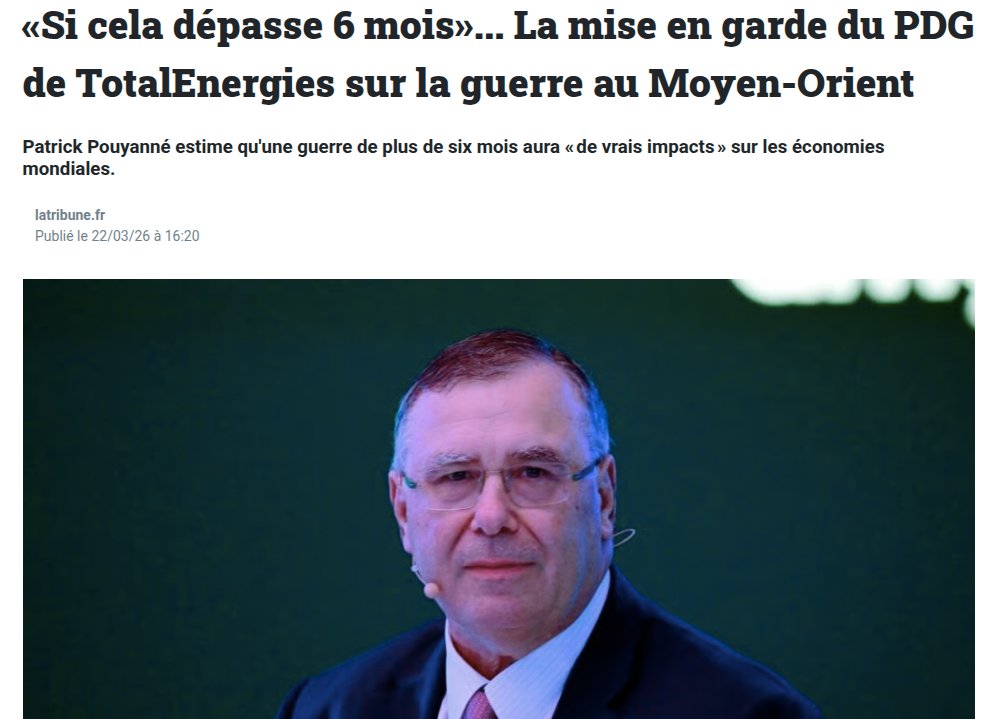
L'avertissement de Patrick Pouyanné, PDG de $TTE TotalEnergies.
Le PDG de TotalEnergies, Patrick Pouyanné, pourtant bénéficiaire de la hausse des prix du pétrole, s'inquiète d'un conflit prolongé au Moyen-Orient. Il affirme qu'un blocage du détroit d'Ormuz (par où transite ~20 % du pétrole mondial) au-delà de 6 mois aurait des conséquences très graves pour l'économie mondiale, avec 10 millions de barils/jour bloqués.
Un conflit de 3-4 mois reste gérable grâce aux stocks, mais la situation s'enlise au 23e jour : l'Iran a fermé le détroit, Trump a lancé un ultimatum de 48 heures menaçant de détruire les centrales électriques iraniennes, et Téhéran réplique en promettant d'attaquer les infrastructures énergétiques régionales si les menaces se concrétisent. TotalEnergies a déjà arrêté ~15 % de sa production dans la zone.
‼️[ 🇮🇷 IRAN | 🇺🇸 ÉTATS-UNIS ]
🔸 Le porte-parole des forces armées iraniennes avertit que toute attaque contre les infrastructures énergétiques iraniennes entraînerait des frappes sur les installations américaines et alliées dans la région, incluant sites énergétiques, systèmes informatiques et usines de dessalement.
Providing an update on the damage from the missile attacks on Ras Laffan Industrial City
H.E. Minister Saad Sherida Al-Kaabi: The missile attacks reduced Qatar’s LNG export capacity by 17% and caused an estimated loss of $20 billion in annual revenue
- Extensive damage to our production facilities will take up to five years to repair and will compel us to declare long-term force majeure
QatarEnergy expects the damage to its Ras Laffan Industrial City caused by missile strikes, which occurred on Wednesday 18 March 2026, and in the early hours of Thursday 19 March 2026, to cost about $20 billion a year in lost revenue and to take up to five years to repair, impacting supply to markets in Europe and Asia.
Providing an update on the damage to the facilities at Ras Laffan Industrial City, His Excellency Mr. Saad Sherida Al-Kaabi, the Minister of State for Energy Affairs, the President and CEO of QatarEnergy, said “I am relieved to confirm that no one was injured by these unjustified and senseless attacks, which weren’t just an attack on the State of Qatar but attacks on global energy security and stability. This was an attack on all of us who stand for development and human progress that is sustained by a fair, reliable, and secure access to energy.”
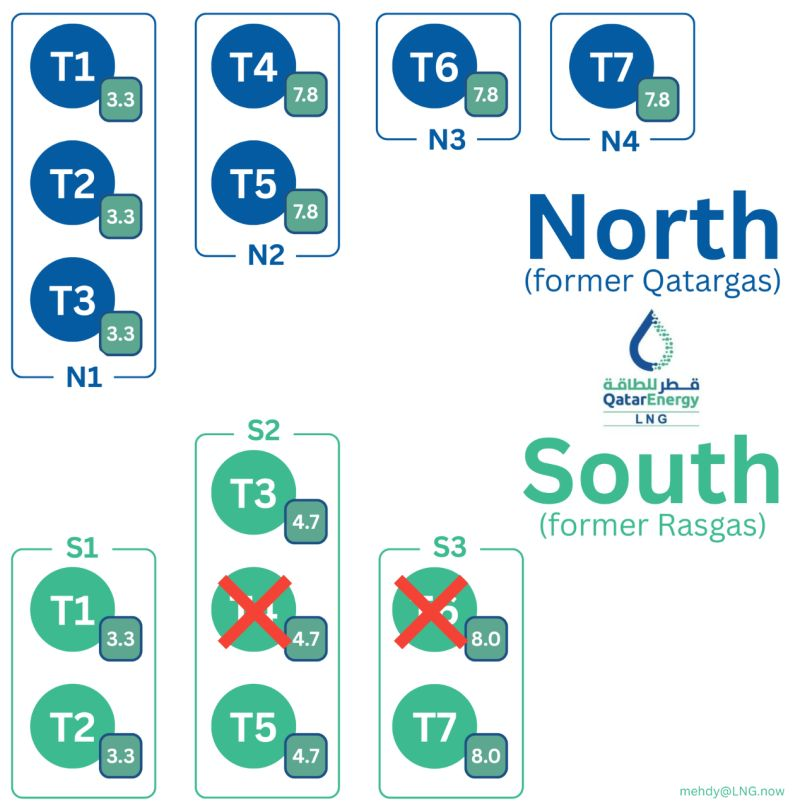
The attacks damaged two liquefied natural gas (LNG) producing Trains 4 and 6 totaling 12.8 million tons per annum (MTPA) of production, representing approximately 17% of Qatar’s exports. Train 4 is a joint venture between QatarEnergy (66%) and ExxonMobil (34%), and Train 6 is a joint venture between QatarEnergy (70%) and ExxonMobil (30%).
His Excellency Minister Al-Kaabi said: “The damage sustained by the LNG facilities will take between three to five years to repair. The impact is on China, South Korea, Italy and Belgium. This means that we will be compelled to declare force majeure for up to five years on some long-term LNG contracts.”
The attacks also targeted the Pearl GTL (Gas-to-Liquids) facility, a production sharing agreement operated by Shell, that converts natural gas into high-quality cleaner burning drop-in fuels and produces base oils used to make premium engine oils and lubricants, and paraffins and waxes.
“The damage caused to one of the two trains at Pearl GTL is being assessed and is expected to be offline for a minimum of one year” His Excellency Minister Al-Kaabi added.
It should be noted that there will be a loss of associated product production due to this outage as follows:
· Condensates: 18.6 million barrels which is around 24% of Qatar’s exports
· LPG: 1.281 MT which is around 13% of Qatar’s exports
· Naphtha: 0.594 MT which is around 6% of Qatar’s exports
· Sulfur: 0.18 MT which is around 6% of Qatar’s exports
· Helium: 309.54 MCFA which is around 14% of Qatar’s exports
His Excellency the Minister of State for Energy Affairs, the President and CEO of QatarEnergy paid tribute to the Qatari military and security forces and to the energy sector emergency response teams whose courage and extraordinary professionalism ensured the situation was contained quickly and safely.
#Qatar
Qatar's LNG trains S4 and S6 confirmed damaged and out of service.
3 to 5 YEARS of repairs🚨
12.8 million tonnes per year of LNG are Offline.
And here's the twist nobody expected:
ExxonMobil holds 34% of Train S4 and 30% of Train S6.
An American oil major just took a direct hit from Iranian missiles.
#LNG #Qatar
QatarEnergy Statement on Missile Attacks on its LNG Facilities
In addition to the previous attack on Ras Laffan Industrial City on Wednesday 18 March 2026 that resulted in extensive damage to the Pearl GTL (Gas-to-Liquids) facility, QatarEnergy confirms that in the early hours of Thursday 19 March 2026, several of its Liquefied Natural Gas (LNG) facilities were the subject of missile attacks, causing sizeable fires and extensive further damage.
Emergency response teams were deployed immediately to contain the resulting damage with no reported casualties.
QatarEnergy will continue to communicate the latest available information.
#Qatar
BREAKING: The world spent fifty years and hundreds of billions of dollars building Strategic Petroleum Reserves so that no geopolitical shock could starve civilization of energy.
Nobody built the equivalent for fertilizer.
That is the most expensive oversight in the history of modern statecraft, and you are about to pay for it at the grocery store.
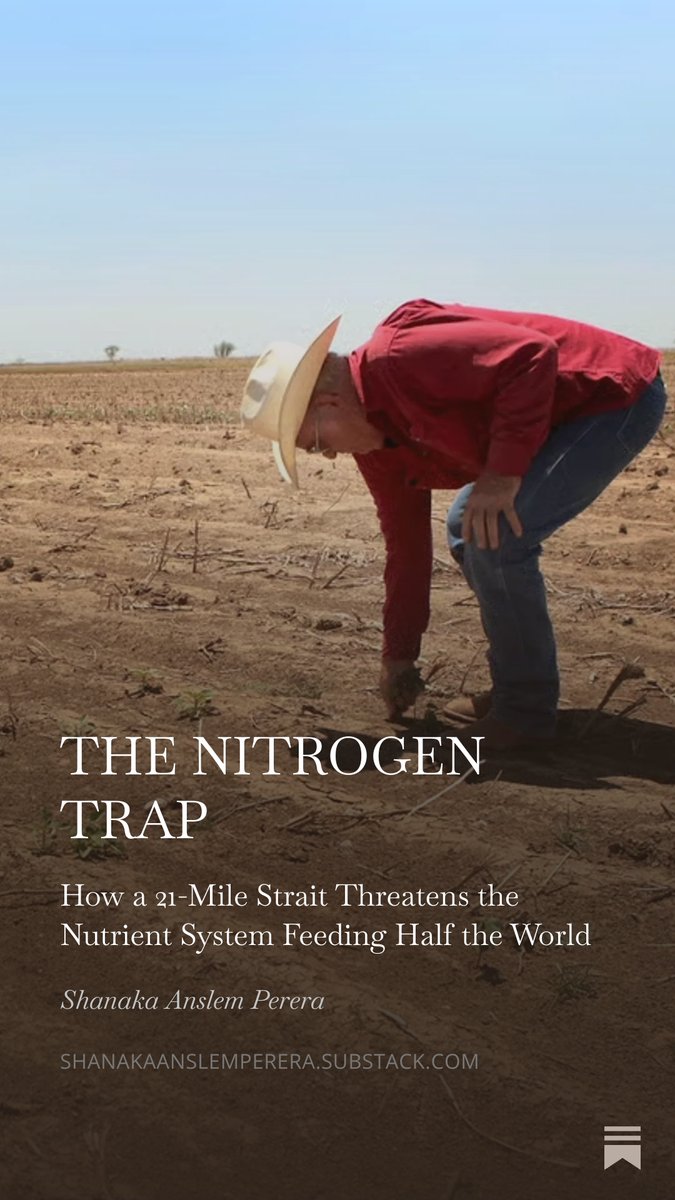
The Strait of Hormuz does not merely carry 20% of global oil. UNCTAD estimates roughly one-third of all seaborne fertilizer trade passes through it. The Fertilizer Institute estimates that conflict-exposed exporters account for nearly 49% of global urea exports and nearly half of global sulfur trade.
Since February 28, daily ship transits have collapsed by 97%.
Here is what almost nobody understands about why this is not "just another commodity spike."
It was not the missiles that closed the strait. It was the insurance. Multiple P&I clubs cancelled war-risk extensions for the Gulf after 26 months of Red Sea losses had already depleted their Solvency II capital buffers. War-risk premiums surged from 0.25% to as high as 5% of hull value per transit. A urea cargo cannot absorb that. The economics of fertilizer shipping through Hormuz became impossible before a single mine needed to detonate.
The Trump administration announced a $20 billion sovereign-backed reinsurance facility with Chubb as lead underwriter. There is no confirmed public evidence that a single fertilizer vessel has used it. Insurance pays for financial loss. It does not intercept anti-ship missiles. Physical security remains the binding constraint, and the US Navy confirmed on March 12 it is "not ready" for commercial escorts.
Now here is the part that should terrify every allocator on Earth.
Agriculture runs on biological deadlines. Corn Belt farmers need nitrogen applied by mid-April. Indian Kharif season prep starts in May. Australian winter crop needs urea by June. These are not financial deadlines that reprice. They are photosynthetic deadlines that, once missed, produce irreversible yield loss. A diplomatic breakthrough on April 15 does not help a farmer who needed fertilizer on April 1.
And the yield math is nonlinear. Wall Street models fertilizer-to-output as proportional. It is not. The response is quadratic. In developed systems that over-apply nitrogen, a 15% reduction costs 2-5% of yield. In the Global South where farmers already under-apply, the same reduction pushes crops off a biophysical cliff. Sri Lanka proved this in 2021 when a sudden fertilizer ban collapsed rice production 40% in a single season and brought down the government.
The market is pricing a 45-day disruption. The insurance architecture says 120 days minimum. Even after a hypothetical ceasefire, Solvency II capital rebuild, reinsurance treaty renegotiation, and vessel re-underwriting take months. The Red Sea precedent: 26 months after Houthi attacks began, war-risk premiums never returned to pre-crisis levels.
Both sides are rejecting negotiations. Trump rebuffed ceasefire mediation March 14. Iran's foreign minister on March 15: "We never asked for a ceasefire."
Meanwhile: 51% of US corn areas in drought. El Nino favored by June at 62% probability. Skymet assigns 60% chance of below-normal Indian monsoon. Bangladesh has shut five of six urea factories. India formally asked China for urea on March 12. Egypt faces $28 billion in debt repayments while importing 12.7 million tonnes of wheat. WFP identifies 318 million people already at crisis-level hunger.
The world stockpiled oil but forgot to stockpile the molecules that produce half its food.
The clock is the position.
Full analysis in the link!
https://t.co/q6ZKYp0MCr
Quel plaisir d'écouter l'un des êtres humains les plus brillants et les plus lucides sur notre petite Terre : John Mearsheimer !
https://t.co/yh8rU9caOb
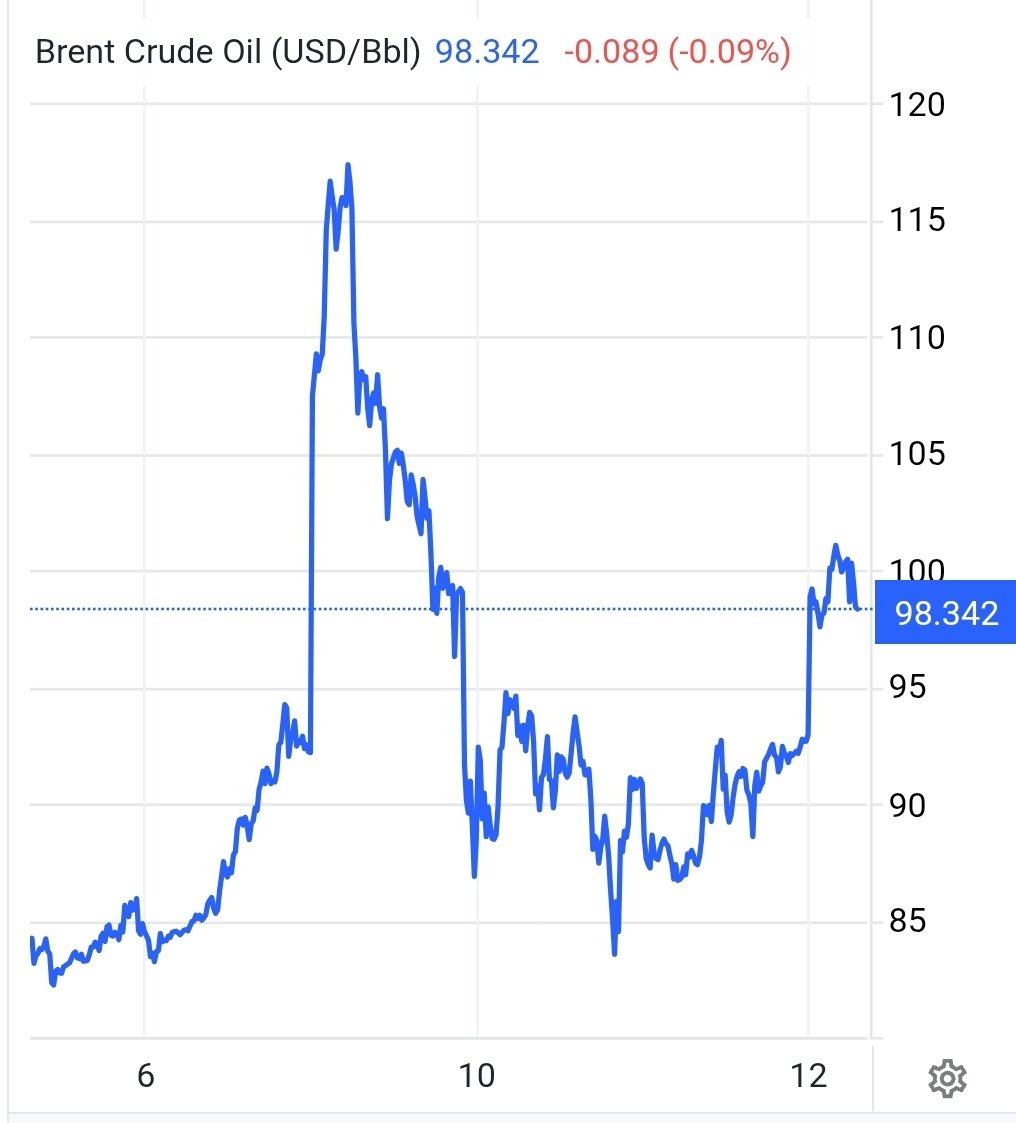
Les marchés ont visiblement été rassurés par la libération de 400 millions de baril de pétrole, la plus grande jamais réalisée à date, puisque le prix du pétrole est repassé au-dessus des 100$ ce matin. Ou ils commencent à se rendre compte que Donald Trump les mènent en bateau...
Unreal numbers 👀⚡️
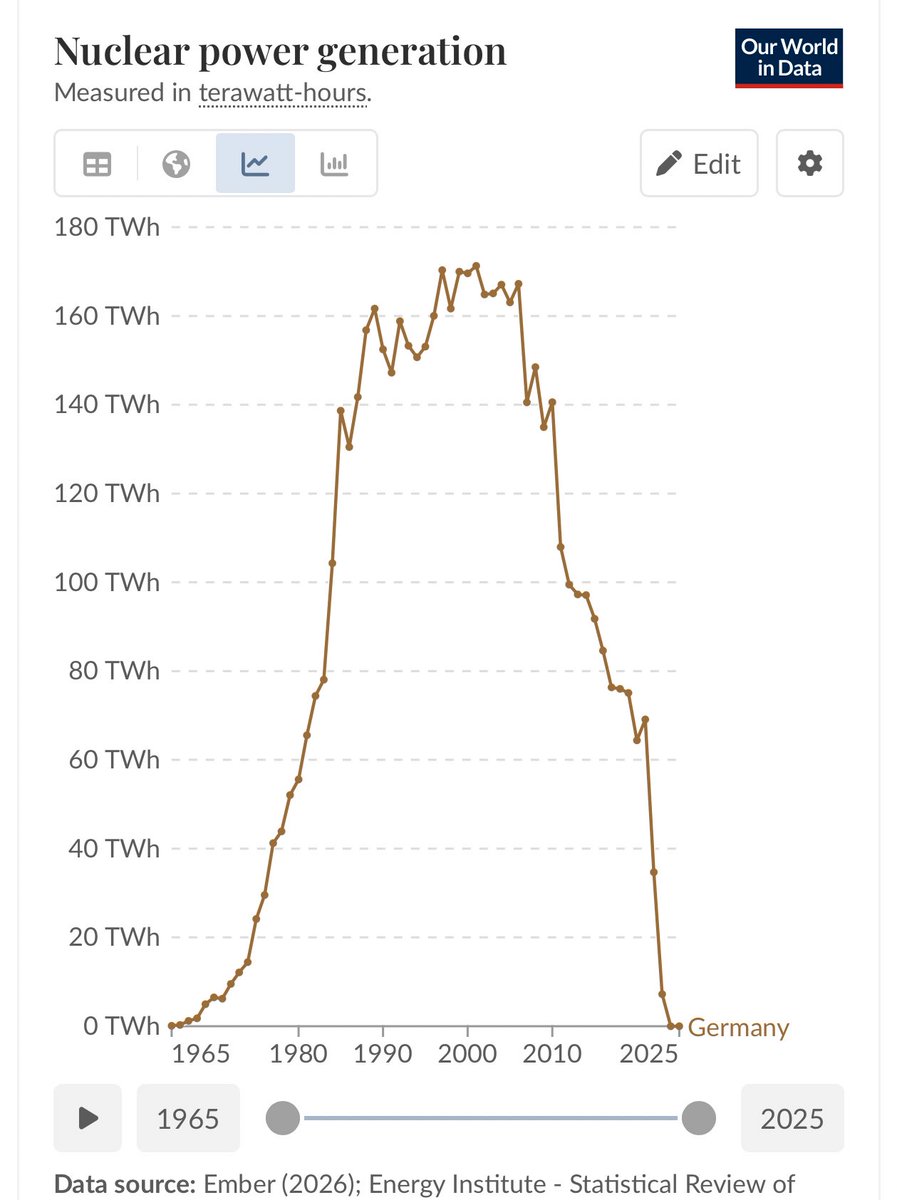
"JPMorgan estimates that, had Germany not phased out nuclear power, the country would have generated 50% less electricity from fossil fuels and 84% less electricity from natural gas in 2024. Electricity prices in Germany would have been around 25% lower, and the country would have imported half as much electricity.."