Johnny Depp has spent decades creating unforgettable moments on screen.
But this may tell you more about the man than any movie ever could.
This little girl is battling cancer.
And for a few precious moments, Johnny Depp didn’t treat her like a patient. He became Captain Jack Sparrow and stepped completely into her world.
He made her laugh.
He made her smile.
He gave her a moment where cancer wasn’t the biggest thing in the room.
That’s what gets me.
Because when a child is fighting something no child should ever have to understand, sometimes the greatest gift you can give them is a few minutes to simply feel like a child again.
Johnny Depp is incredible on screen.
But the humanity he shows off screen may be the most beautiful thing about him.
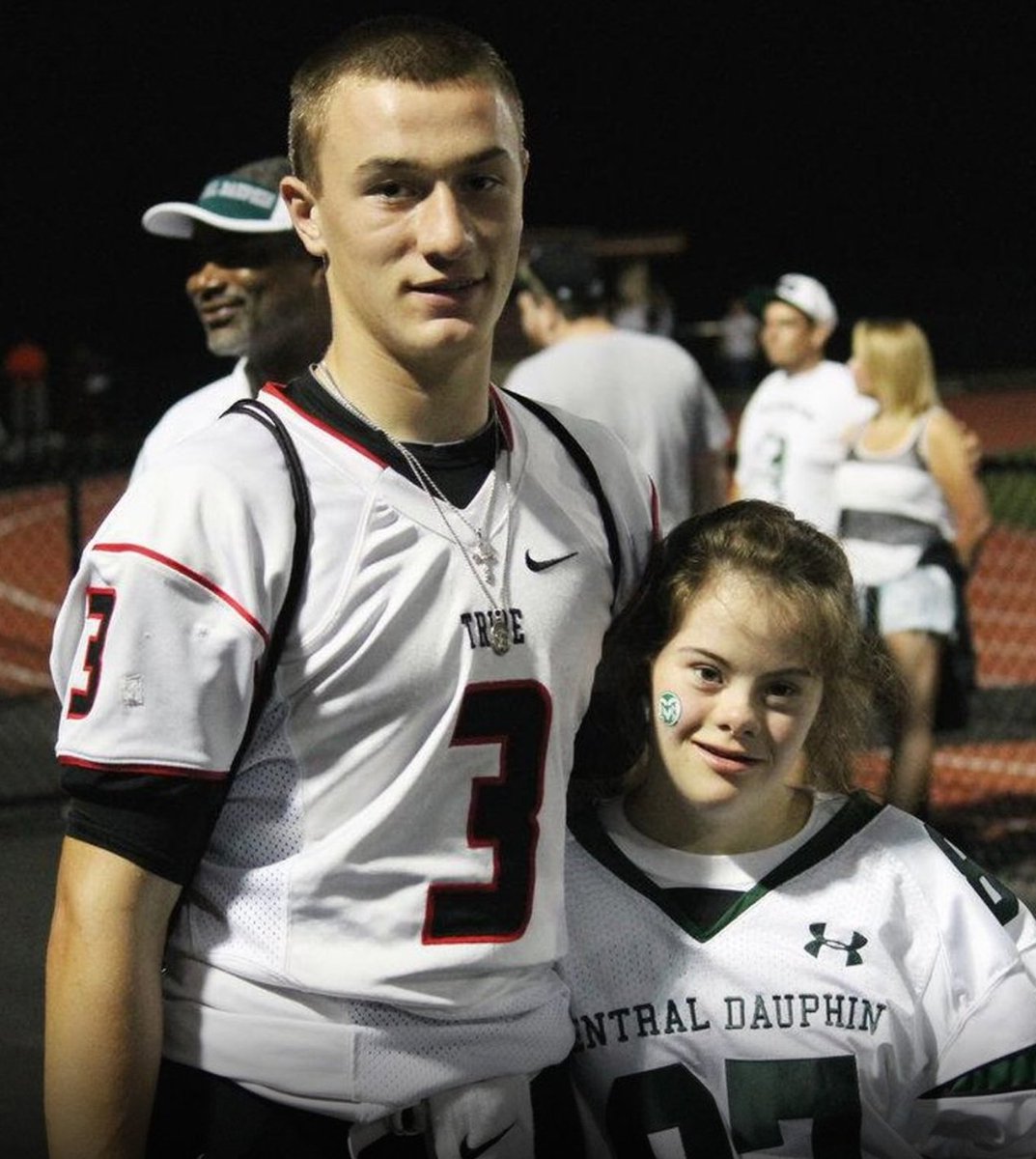
When they were just kids in elementary school, Ben Moser made a promise to his friend Mary Lapkowicz.
Mary had Down syndrome, and while other children didn't always know how to include her, Ben did.
He looked out for her.
He made sure she was picked for games.
And one day, in fourth grade, Ben told Mary something she would remember for years.
He promised to take her to prom.
Then life moved on.
They went to different schools. Years passed. The childhood friends slowly lost touch.
But seven years later, football unexpectedly brought them back into each other's lives.
Ben was now a high school quarterback.
Mary was still the girl he had made a promise to all those years ago.
And Ben hadn't forgotten.
In 2015, he surprised Mary and asked her to prom.
She said yes.
Mary arrived in a beautiful lavender dress, and Ben stood beside her in a matching tie.
They danced.
They smiled.
And a little promise made by a fourth-grade boy became real.
Mary's brother later said Ben's actions had "restored my faith in humanity."
Because keeping a promise is easy when it's convenient.
Keeping one seven years later, when nobody is asking you to...
That's character
PURE HAPPINESS: This 16-year-old girl was disappointed that she missed a Jonas Brothers concert because she was undergoing chemotherapy treatment. But then, she got a surprise right in her hospital room 🫶
🚨WOW!!!!
A Vietnam vet gave up his dream car, a '69 Mustang Mach 1, to raise his 6 sons.
He never let them see what it cost him.
50 years later, his youngest traded away his OWN Mustang to track down the exact car... and handed his dad the keys on Father's Day.
His name is Daniel Allen and he came home from the Vietnam war and bought his dream car.
It was a white 1969 Mustang Mach 1.
Black hood, red stripes, four-speed.
And then he gave it up.
Because one baby became two. Then three. Then six sons. And a two-door muscle car can't raise a family.
So Daniel traded away his dream, the way good fathers do.
He never made his boys feel the cost of it.
But his youngest son, Shane, was always listening.
Every time his dad told the story of "the one that got away," it stuck. The two of them even made a tradition of it, going to Father's Day car shows together, hunting for Mustangs, reminiscing.
So this year, Shane found it.
A white '69 Mach 1, exactly like the one his father described for decades.
He traded away his OWN restored Mustang GT to get it, then had it repainted and reupholstered to match his dad's memory down to the detail.
And to get it, he traded away his OWN restored Mustang.
On Father's Day, at their car show, Daniel walked past a Mach 1 and noticed a name tag hanging from the mirror that read "Daniel."
He figured it was a coincidence. Half-joking, he said, "Where are my keys?"
His son reached out and put the keys in his hand and told him to fire it up.
This grown man. This veteran. He climbed out of that car, asked his son how on earth he'd pulled it off, and when Shane told him he'd traded his own custom Mustang to do it...
...Daniel broke down and wrapped his boy in his arms.
Fifty years later, the dream he laid down for his kids... his kid handed right back to him.
God bless the Allen family. That's what it's all about.
A woman told her brother with Down syndrome that she was pregnant. His reaction was so genuine and full of joy that it's impossible not to smile upon seeing it.
💥NEW: Stephen A. Smith: "I wanna emphasize: you're a Republican, you somebody that wanted our border closed because Biden left the border open — I ain't got no problem with you! As far as I'm concerned, the liberals and Democrats need to shut the h*ll up on that issue!"
"When Obama deported 3.1 million people, you ain't say anything! You had networks doing features on ICE! Suddenly, they the bad guys! They're the scourges of the earth!"
"Shut the h*ll up! I don't wanna hear from you!"
🚨 BREAKING! Barstool's Dave Portnoy says he MIGHT RUN for ELECTION 🚨
"I might run against Mamdani… I feel like I could make a change." 🔥
"I've had a real job, I've done real things, unlike these clown politicians who have never had a job" 🔥
In 1997, actor John C. McGinley’s son, Max, was born with Down syndrome. Shortly after, John's talent agent pulled him aside to deliver what was framed as practical advice: Do not talk about this publicly. Keep it quiet. People will stop hiring you.
For some, that might have sounded like reasonable career preservation. Protect the livelihood, avoid the spotlight, and pretend nothing had changed.
John’s response was immediate. He fired the agent.
Then, he did the exact opposite of what he had been told. He brought Max everywhere. Red carpets, talk shows, film sets, and public events. Wherever John went, Max was right beside him. At a time when society still largely preferred to keep individuals with developmental disabilities out of sight, John made a different choice. He made his son visible. Openly, proudly, and entirely without apology.
What began as a father's protective instinct grew into decades of fierce advocacy. John became one of the country's most recognizable voices for Down syndrome awareness. He spoke at global conferences, testified before Congress, and fought hard for employment law reforms that created real opportunities for people with disabilities to work, earn, and live independently.
During this journey, a reporter asked John a question that revealed far more about society's biases than it did about Max. The reporter asked if John ever wished his son were normal.
John didn't hesitate. He replied that Max was normal. The question wasn't. It was a blunt rejection of the idea that a person’s worth is measured by how well they fit into a narrow, conventional box.
Decades have passed since that conversation. Max is now 27 years old. He works, navigates his community, and lives an independent life filled with possibilities that the critics in 1997 never could have imagined for him.
Reflecting on their journey, John often says that Max never limited his life. He expanded it. Through his son, he learned what love, patience, and true commitment require.
The world signaled early on that it would have preferred Max to remain hidden in the shadows. John spent nearly three decades ensuring that the world looked Max right in the eye. Some fathers protect their children by shielding them from the world. Others protect them by refusing to let the world look away.
True inclusion begins when we stop treating differences as deficits. Max didn't need to change to fit into the world.
The world needed to change to make room for Max.