The rails are working.
XRP stays on XRPL. FDC attests the events. FAssets mint, destination tags route, redemptions settle. Those fees now land in FIRE instead of leaking out of the system.
FIP.16 didn’t add a slogan. It wired activity to FLR. Year two just adds more of those events.
flare-networks:native ripple:native
Year one of FXRP put XRP to work. FIP.16 made that work pay $FLR.
The XRPFi events that already route to FIRE:
→ FAssets minting
→ FXRP destination tags
→ FDC attestations
→ redemptions
Year two is shaping up to have more of those events.
FSA left its mark on the chart.
Vaults now. More DeFi actions next. Same door: start from an XRPL wallet, or from an exchange.
That is how distribution and participation widen. Year two is more of that door.
Hey Scott — correct, P-Chain staking. Your FLR is delegated as stake to a validator and earns staking/validation rewards. It does not simultaneously earn the standard C-Chain FTSO delegation rewards on those same tokens. So think of them as two separate reward paths: P-Chain stake → validator staking rewards; C-Chain WFLR delegation → FTSO delegation rewards. @scott_erocks
Hey Roman — good question. If you were in the Spectra stXRP/FXRP market, receiving the same amount of FXRP back only reflects your principal position; the rFLR incentive is separate. Spectra currently states that rFLR for this market is distributed monthly through Flare Portal → Emissions → Spectra. So it isn’t necessarily added to the FXRP amount you withdraw. If you share the wallet address you used on Spectra, I can help you narrow down where the accrued rFLR should appear. Follow back so I can follow up more effectively 👍 @domashuk_r
@spectra_finance@FlareNetworks@mystic_finance I recently had fxrp on spectra and was told that rflr gets automatically claimed ? How does that work ? I took out the same amount of fxrp as I put in
Year one of FXRP put XRP to work. FIP.16 made that work pay $FLR.
The XRPFi events that already route to FIRE:
→ FAssets minting
→ FXRP destination tags
→ FDC attestations
→ redemptions
Year two is shaping up to have more of those events.
New rFLR distribution is out☀️
If you’ve been in eligible DeFi on Flare, check what you’ve accrued.
Claim yours on the Emissions tab → https://t.co/Dk2zundc5F
One year in, the numbers that matter most are not just minted supply.
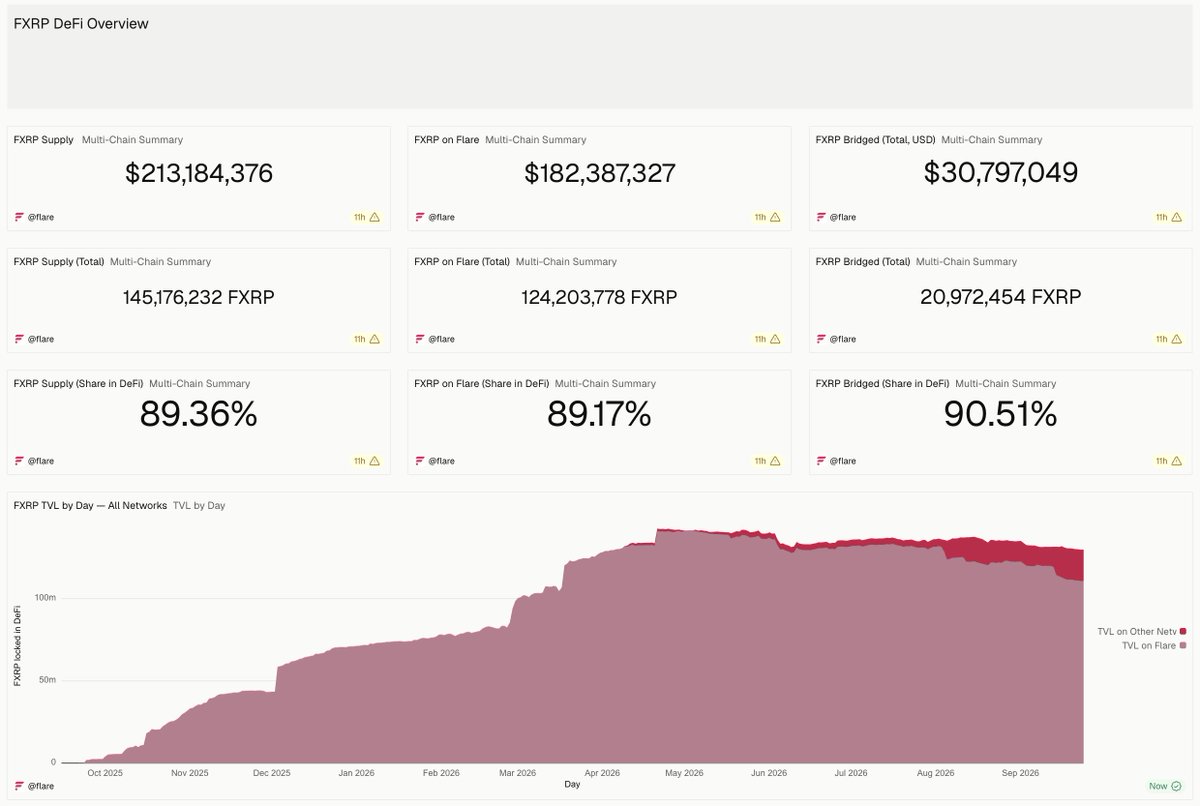
89% of FXRP is actually working. That is the difference between a wrapped token sitting idle and an asset that became programmable capital.
FAssets + FDC made the mint/redeem path short enough that people used it. Smart accounts, cross-chain OFT, and DeFi composability did the rest.
XRP stayed on XRPL. The work happened on-chain and stayed observable.
flare-networks:native ripple:native
One year of FXRP, on-chain:
→ 145.1M FXRP minted year to date
→ 130M FXRP (89%) working across DeFi
→ 7.8M DeFi transactions
→ ~24,000 smart accounts
→ 21M FXRP live across six other chains
Capital made productive and observable→ https://t.co/v5dEUJdZEr
One year of FXRP, on-chain:
→ 145.1M FXRP minted year to date
→ 130M FXRP (89%) working across DeFi
→ 7.8M DeFi transactions
→ ~24,000 smart accounts
→ 21M FXRP live across six other chains
Capital made productive and observable→ https://t.co/v5dEUJdZEr
A year into FXRP, we’re getting a sneak peek at what @FlareNetworks could become, does Flare’s infrastructure truly turn $XRP into a future-proof asset?
But we’re going beyond the basics to delve further.
In crypto, you’re usually forced to spin up wallets, hop across bridges, and scrounge up gas tokens just to get moving.
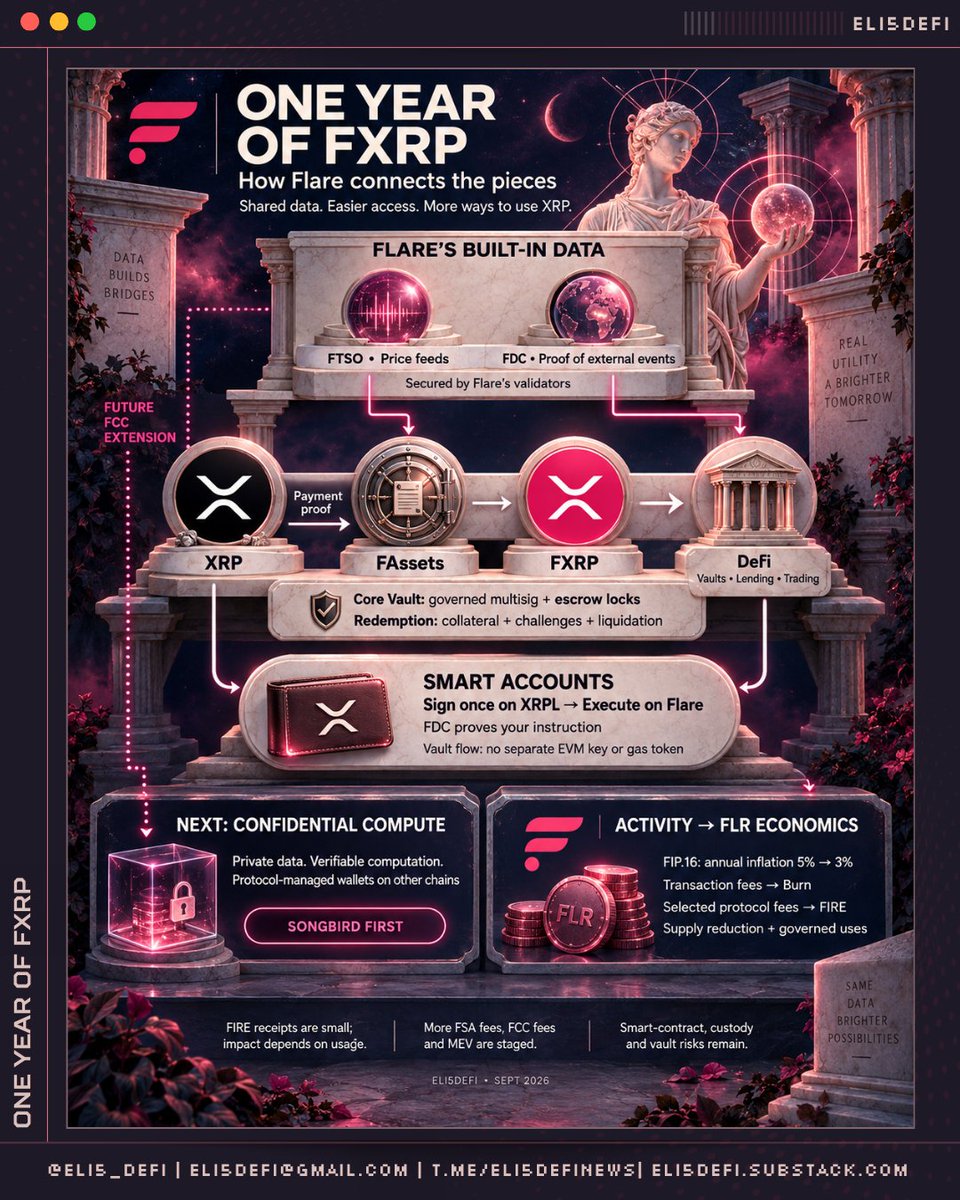
Flare has spent the past year cutting that obstacle course down to size, and it begins with two built-in tools:
- FTSO supplies prices, while FDC verifies outside events, including XRP payments. Flare’s validators also secure these data protocols, giving its products a shared foundation.
- FAssets turns XRP into FXRP for use in DeFi. Minting requires proof of the XRP payment. Redemption agents operate under collateral, challenge and liquidation rules.
The Core Vault holds pooled XRP under a Flare-governed multisig, with escrow time locks and withdrawal controls. Agents cannot simply walk away with it.
Flare Smart Accounts make access incredibly simple.
Sign an XRPL transaction from your current wallet. FDC verifies it, and your linked smart account executes on Flare. The vault flow now needs one signature, no separate EVM key or gas token.
By July, Flare reported nearly 24,000 smart accounts and FXRP in DeFi growing from 82 million in February to 144 million.
So, what's next? It is Flare Confidential Compute (FCC)
FCC is a verifiable computation that keeps sensitive data private, plus protocol-managed wallets that can act on other chains. Songbird first, with broader deployment still ahead.
Finally, how all these changes benefits $FLR.
FIP.16 cuts annual inflation from 5% to 3%. Transaction fees burn, while FIRE collects specified protocol fees, with supply reduction as its first mandate alongside other governed uses.
---
What keeps me upbeat about Flare is how coherently the pieces fit together.
FXRP expands what XRP can do, Smart Accounts remove friction for users, and confidential compute opens the door to privacy sensitive apps, while the value flow ultimately routes back to FLR.
None of this is starting from zero. Each layer builds on real progress already in place, which makes the Flare faces almost competition and more scalable.
That said, activity still has to mature into real, durable revenue over time.
Still, after a year of FXRP, there is a functioning baseline, something concrete to iterate on, and a clearer runway toward wider adoption.
You are still not bullish enough.
A year ago today, XRP became programmable as FXRP.
What followed was a run of firsts. XRP in onchain vaults. XRP backing onchain cover. XRP in money markets on Ethereum.
Flare Smart Accounts makes it one click from XRPL.
FCC takes it to confidential computation, with proofs anyone can verify.
That is what unlocks deeper institutional use.