XRP now has institutional credit rails on Ethereum mainnet, enabled by @FlareNetworks.
FXRP is live as collateral in @SentoraHQ's RLUSD vault on @Morpho — supply FXRP, borrow RLUSD, permissionlessly.
A milestone for $XRP in institutional DeFi 🤝
https://t.co/JHvtoFDR4p
Session 25 is a few days away.
@FlareDevHub walks through a real FCC build on Coston2 — architecture, execution flow, and how it works on testnet.
RSVP in the post 👇
🧑💻 The next @FlareDevHub Workshop will be covering how Flare Confidential Compute can apply to the XRPL.
Private intent in. Verifiable execution on chain. One case study, end to end.
RSVP: https://t.co/ooEuPFsuMf
XLS-66 and XRP-collateralized DeFi: two different credit primitives for developers.
XLS-66 is designed around borrower credit.
Liquidity sits in XRPL Single Asset Vaults, loans are fixed-term, underwriting happens offchain, and first-loss capital helps absorb defaults. Building on it means thinking about borrowers, underwriting standards, repayment schedules, loan brokers and default risk.
Collateralized DeFi takes a different approach.
XRP becomes FXRP, FXRP is deposited into a lending market, and borrowing capacity is determined by the value of the collateral. That requires reliable pricing, liquidity and liquidations rather than borrower underwriting.
These models complement each other.
XLS-66 can support underwritten credit where the identity and creditworthiness of the borrower matter.
FXRP + Smart Accounts can support permissionless XRP-backed credit where the collateral itself secures the debt, while XRPL remains the user control layer.
As @Firelightfi moves toward launch, the docs spell out the coverage protocol's details.
Who participates. What is covered. How claims and payouts run. FXRP / stXRP and the Phase 1 to Phase 2 transition.
@DJCorkey No need to be confused , check out this site that consolidates all XRP DeFi opportunities and let us know if you have any further questions
https://t.co/tw6OYFZmT7
If you're putting XRP to work this weekend, start on one page.
Vaults, lending, staking, cover as it comes.
Compare the routes, then pick.
https://t.co/FaPeIhyaCw
If you're putting XRP to work this weekend, start on one page.
Vaults, lending, staking, cover as it comes.
Compare the routes, then pick.
https://t.co/FaPeIhyaCw
As its Alt SZN (TM) I wanted to recapitulate the Flare offering.
• Flare is the only major L1 with a built in data.
• That data is used to power onchain markets and interoperability with tokens like XRP and Bitcoin which have historically been massively underutilised.
The utility just from this is huge - Firelight, the entire DeFi ecosystem in Flare, Flare smart accounts etc. This is where we are today but the best is yet to come… read on
• Those same data capabilities are being used to assure a verifiable compute layer that sits above Flare.
• Verifiable compute lets you run huge programs (example - a whole LLM) privately and with sufficient security to use the results onchain.
The use cases for the combination of Flare’s data, interoperability and compute are manyfold:
Protocol managed wallets which let a decentralised application on Flare take actions on any chain.
Autonomous crypto or RWA portfolio creation & management.
Private data streams that can interact with applications - so a public app can use data that can’t be exposed publicly but a user can be certain that the data came from the correct source.
Applications built directly on chains like XRP (with baked in privacy).
Private equity or perps markets.
Privacy tooling that can be applied to other markets.
Private and verifiable agents.
These are just a few of the ones that appeal to me.
Everything feeds revenue into FIRE - the Flare mechanism for buying back the FLR token.
We are ALL early.
Start on XRPL. Flare Smart Accounts execute on Flare.
Today that presents as imbedded wallet flows: mint and deposit in a vault in one click for yield on your XRP.
The same pattern can originate a loan: FXRP as collateral, RLUSD out.
The mint, the route, the borrow stay under the hood. The possibilities extend from wallets and dApps to exchanges and more.
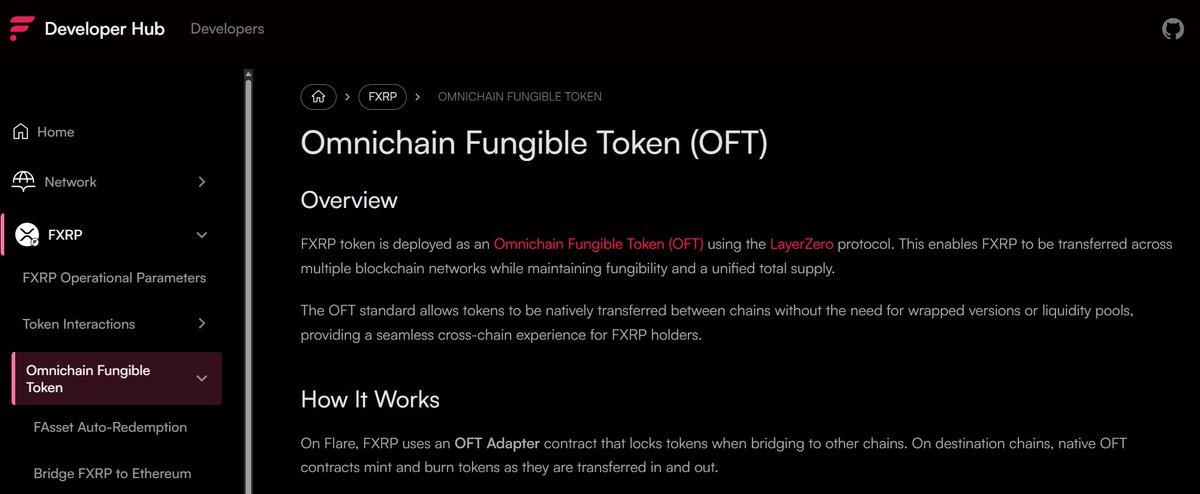
FXRP’s OFT architecture is built around a single canonical asset.
On Flare, the OFT Adapter locks native FXRP. On destination chains, LayerZero OFT contracts mint and burn the corresponding supply.
That means developers can move FXRP across supported chains without introducing fragmented wrapped versions of the asset.
One supply model, multiple execution environments.
Architecture and deployments:
https://t.co/wkNCGVHnLz
When Firelight moves to Phase 2, an on-chain coverage protocol, all Phase 1 positions automatically migrate.
Get a closer look at the architecture of the protocol. 🔥
JUST IN: RLUSD lending hits 89% utilization against FXRP
About $7.13 million in $RLUSD has been supplied while $6.35 million is borrowed against FXRP, meaning roughly 89 cents of every $1 supplied is already being put to work in lending markets.
Flare $FLR is now tradable on Swyftx.
Flare is a Layer 1 blockchain built to bring outside data onto the chain, so smart contracts can use price feeds and information from other blockchains and the web.
Buy, sell and trade $FLR now: https://t.co/6VlNpFlXaB
DeFi cover needs dependable collateral.
XRP reaches Flare through FAssets, our core infrastructure.
Mint FXRP, stake via @Firelightfi, hold stXRP, and that capital can still move across Flare DeFi while you earn yield on it.
FAssets gets XRP here. Firelight is what it can do next.