Your $XRP can now sing a new tune 🐦
FAssets are LIVE on Songbird, @FlareNetworks' canary network, with the mainnet launch coming soon.
Mint FAssets, explore DeFi, and be rewarded!
Find out how to get started: https://t.co/DQyk4zPFWo
@shaneparrish 💯 When I practiced as a lawyer, it was my job to assume the worst about my clients’ counterparties. Whereas in my own business deals I see the contract as nothing more than a clarification of responsibilities. If I felt like I would need to enforce it, I wouldn’t do the deal.
Durov’s arrest is another argument from crypto; censorship-resistant currency in a world at war with free speech. The battle lines are drawn.
https://t.co/MTJSBjjQDm
FAssets Open Beta is here ☀️
Phase 1 starts now: technical users get early access and help shape the #FAssets system.
Phase 2 launches soon: everyone is invited to mint FTestXRP with the FAssets dashboard.
A retroactive airdrop is planned 📷
Details: https://t.co/f3ie8B0o2F
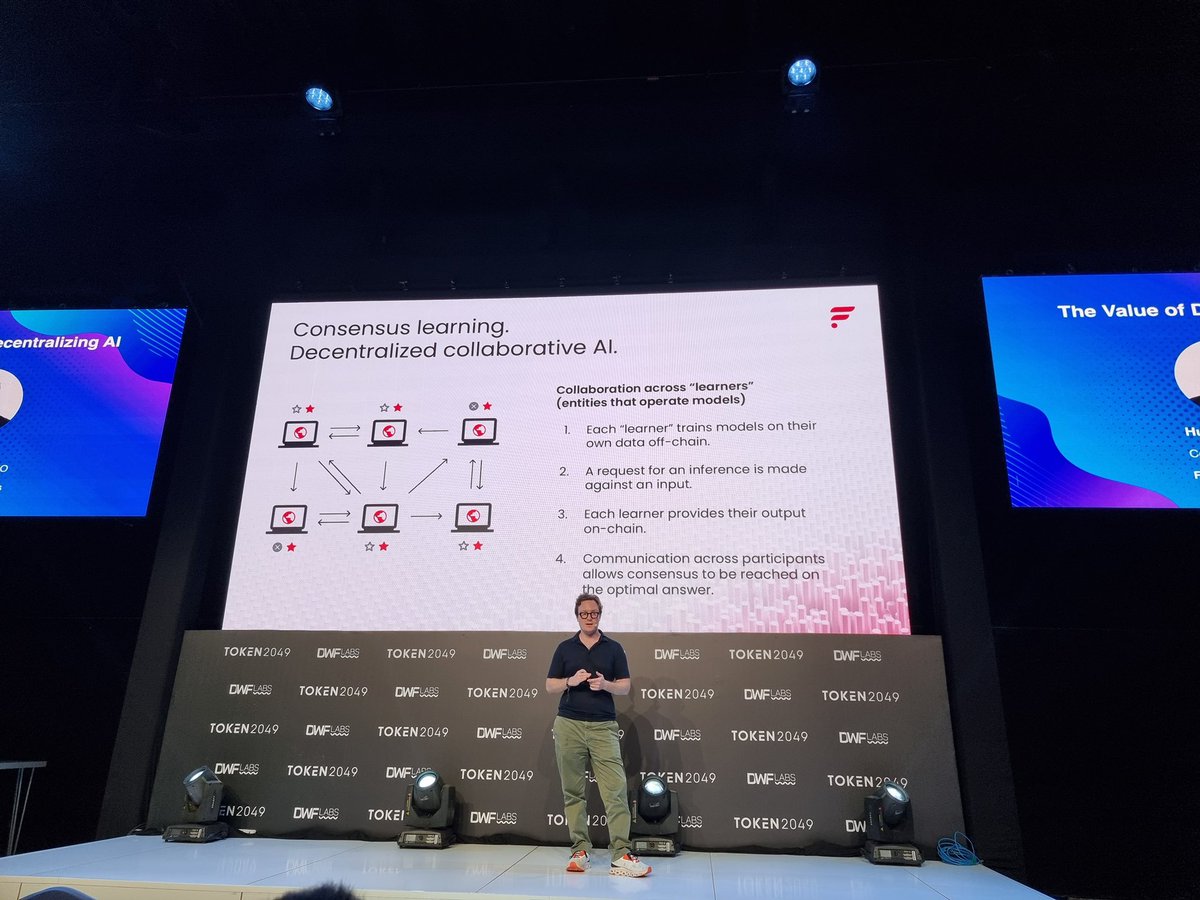
@HugoPhilion on the value of decentralising AI.
Flare is working on:
- Moving from distributed learning to decentralized learning.
- Enabling collaborative Al, whilst allowing participants' underlying data and models to remain private and maintain a natural substrate for rewarding.
#TOKEN2049 #FlareNetwork
We've grown to a whopping 482K wallet addresses (that's 60K more since December 2023). ☀️
Time to revisit some lesser-known facts about $FLR...
Did you know? 58.3% of the Genesis Flare supply is allocated to the community.
🔎 https://t.co/XcklBBvOzv
@Danrocky Data curation is the most natural use case for AI (as far as humans are concerned). Enabling a trustless solution for that would be a most natural use case for blockchain.
AI is held back by centralisation:
• Accuracy - training on private datasets can only capture some of the information leading to poorer models.
• Scale - massive funding is needed, limiting competition and results.
• Trust - unknown biases and strategic objectives of centralised model providers impedes usage of AI for mission critical usecases.
Decentralisation leads to more accurate AI, through competitiveness, openness and access to more data whilst preserving data privacy.
Introducing: Consensus Learning, a novel decentralised machine learning paradigm. https://t.co/VCkcQxEFl8
AI is held back by centralisation:
• Accuracy - training on private datasets can only capture some of the information leading to poorer models.
• Scale - massive funding is needed, limiting competition and results.
• Trust - unknown biases and strategic objectives of centralised model providers impedes usage of AI for mission critical usecases.
Decentralisation leads to more accurate AI, through competitiveness, openness and access to more data whilst preserving data privacy.
Introducing: Consensus Learning, a novel decentralised machine learning paradigm. https://t.co/VCkcQxEFl8
🚨 BREAKING: NEW PROPOSALS!
These proposals are huge, especially the proposal to launch the FTSO Scaling on Flare and Songbird, which will support the use of up to 1000 data feeds on each network, and for next to no cost for dapps (just minimal gas).
https://t.co/1mFLaW9OUL
Just uploaded a new video for the #Flarenetworks community! 🔥 What is the Flare Networks FTSO? 🤔
In this video, I dive deep into the Flare Networks FTSO and explain how it works. 🧠
This video is especially for you if you're interested in:
- How the FTSO can bring trust and reliability to DeFi
- How the FTSO works on the Flare Network
- The benefits of the FTSO for Flare token holders
Watch the video here: https://t.co/SvNt7B4b7L
Don't forget to like, subscribe, and share! 👍
#FlareNetworks #FTSO #DeFi #Crypto #Web3
Flare demonstrates how a diverse network of decentralized data providers can collaborate on solving complex problems, outperforming any single entity.
The Flare Time Series Oracle is a good example.
This model could be a starting point for other interesting use cases...
Flare onboards @GoogleCloud as an infrastructure provider to validate the network and contribute to the Flare Time Series Oracle.
Enshrining decentralized data delivery in a dual role with network validation is what makes Flare the Blockchain For Data.
https://t.co/bJF9yX7GrX
We’re celebrating 3 BILLION #FLR staked on Flare, just in time for FLR’s TGE 1-year anniversary in 3 days.
This is a testament to our awesome #Flare community.
In crypto, users like to think in terms of days, weeks, or months. Rarely does the patience and forward thinking extend beyond that time period. This sets entirely unrealistic expectations for development timelines where users expect constant updates, constant releases, and constant explanations of why the devs aren’t meeting the user expected schedule.
With the announcement of the beginning of Beta testing for F-Assets, I wanted to reiterate exactly what it took to get here and how fast it really happened.
Three years ago, most of us were just hearing about the concept of Flare for the first time. It was the start of the bull run, with BTC about to break ATH and XRP still freely trading. Flare managed to put together an agreement with Exchanges to conduct the largest and most ambitious token launch the space had ever seen.
Heading into 2021, Flare put out the first Coston test net to let developers start getting used to the chain and work of ensuring validator efficiency. This also allowed them to begin work on the first decentralized oracle system, the FTSO.
Only 9 months later, they launched the Songbird Network, a Canary Network meant for development groups (including Flare) to test new protocols in a real market environment where users were fully aware of the heightened risks of using real value in experimental products.
This would be the first test for the novel detachable vote delegation system that underlies the Flare tokenomics. The ability to passively secure a core protocol of the network and be rewarded for it with no token lockups or risk is still a much overlooked achievement.
Over the next year, the focus was on scaling the FTSO system and deploying the State Connector. Scaling the FTSO system meant a lot of work recruiting and educating both users and providers. For a decentralized system to succeed, it needs to be simple enough for a new provider to join and operate while remaining robust enough to resist bad actors. Not an easy task.
The State Connector was another novel protocol designed and deployed by Flare, allowing data to be transmitted and attested to across chains in a decentralized manner. This has the same decentralization issues as the FTSO, since this data and attestation group would be the core of network interoperability.
These two protocols combined create the necessary infrastructure for F-Assets to function in a decentralized way. Both needed to be launched, tested, scaled and iterated - a process which was made all the more difficult by the utter collapse of the market and regulatory environment that started just two months after the Songbird Launch.
However, it wasn’t even a year later when the Flare Network was officially spun up and the work to onboard FTSO data providers and validators began. This also meant developing and deploying the FlareDrops mechanism, which utilized the detachable vote nature of WFLR to adjust for the drastic changes the crypto space had seen since the original airdrop was announced and the actual launch.
In 2023, just over two years since most users even heard of Flare, the network publicly launched. This launch was a fresh, fast, cheap L1 with a novel detachable vote system, a novel decentralized Oracle system and a novel decentralized data/attestation system which had been battle tested on a Canary Network for over a year. And there were two additional novel decentralized, trustless bridge systems on the way which made use of all of that novel, decentralized infrastructure.
In the rest of 2023, there have been improvements to the incentive and security systems of the FTSO, deployment and testing of the State Connector to perform cross-chain transactions, and decentralization of the Network Validators (now sitting at 79 validators).
And now, still in 2023, the F-Asset system is entering its first Beta testing period.
I’ve said it before, but I’ll say it again: each and every one of these steps had to be researched, developed, deployed, tested, iterated, and decentralized to get to this point. Building the first decentralized, trustless, collateralized bridge system is not an easy task.
The F-Asset system requires a decentralized network
The F-Asset system requires a robust, decentralized Oracle
The F-Asset system requires a robust, decentralized data/attestation system
This is an incredible amount of progress at an incredible rate. All done in one of the most difficult and adversarial environments there is to work in. Well done again to @HugoPhilion and the @FlareNetworks and @Flare_Labs teams. And well done to all of the infrastructure providers who have stuck it out this far.
So what else do we need?
The F-Asset system requires a more scalable and shorter interval FTSO
The F-Asset system requires a robust, distributed, decentralized agent system
The F-Asset system requires thorough testing from a technical, market, and user perspective
The F-Asset system requires a robust and deep liquidity market
If you aren’t a developer, don’t worry about the first two. Those are coming.
However, the last two points are all on the #FlareNetwork Community.
If you want this system that you have been waiting for to succeed, you are going to need to test it.
You are going to need to take some risk with it, especially on Songbird.
And you are going to need to participate in creating the market that allows it to scale.
Use it or lose it folks.
"I would like to see multi-sig bridges, trusted bridges, consigned to the dust bin of history."
🎙️@HugoPhilion of @FlareNetworks closing out yesterday's @WebX_Asia panel on the future of interoperability. #LayerCake