“If you invest in Bitcoin and let people use it as currency, you’ll melt down your economy.”
- Goes all in, builds a $500 million strategic reserve, achieves 3% annual GDP growth, secures $3.5 billion in foreign investment, and the country’s credit rating is upgraded five times.
“You can’t imprison your way out of crime.”
- Builds CECOT and transforms San Salvador from the most dangerous city in the Western Hemisphere to one of the safest in the world.
“You can’t just fire the corrupt judges. Your people will hate you.”
- Fires the corrupt judges. Approval rating soars to over 90%.
“You can’t just go to Haiti and take out the gangs. It’s a sovereign country.”
- Goes into Haiti, takes out gang compounds, drives criminals into hiding, thousands of Haitians rush to the streets to celebrate their liberation, all while making the UN look like fools.
“You’ll never be able to fix the education system with discipline and focusing the curriculum on the basics.”
- Enrollment up. Graduation rates up. Truancy down. Drop out rates down. Youth literacy up. 225 schools rebuilt or renovated. Teen pregnancy down 68%.
Stop listening to the “experts.” You can just do things.
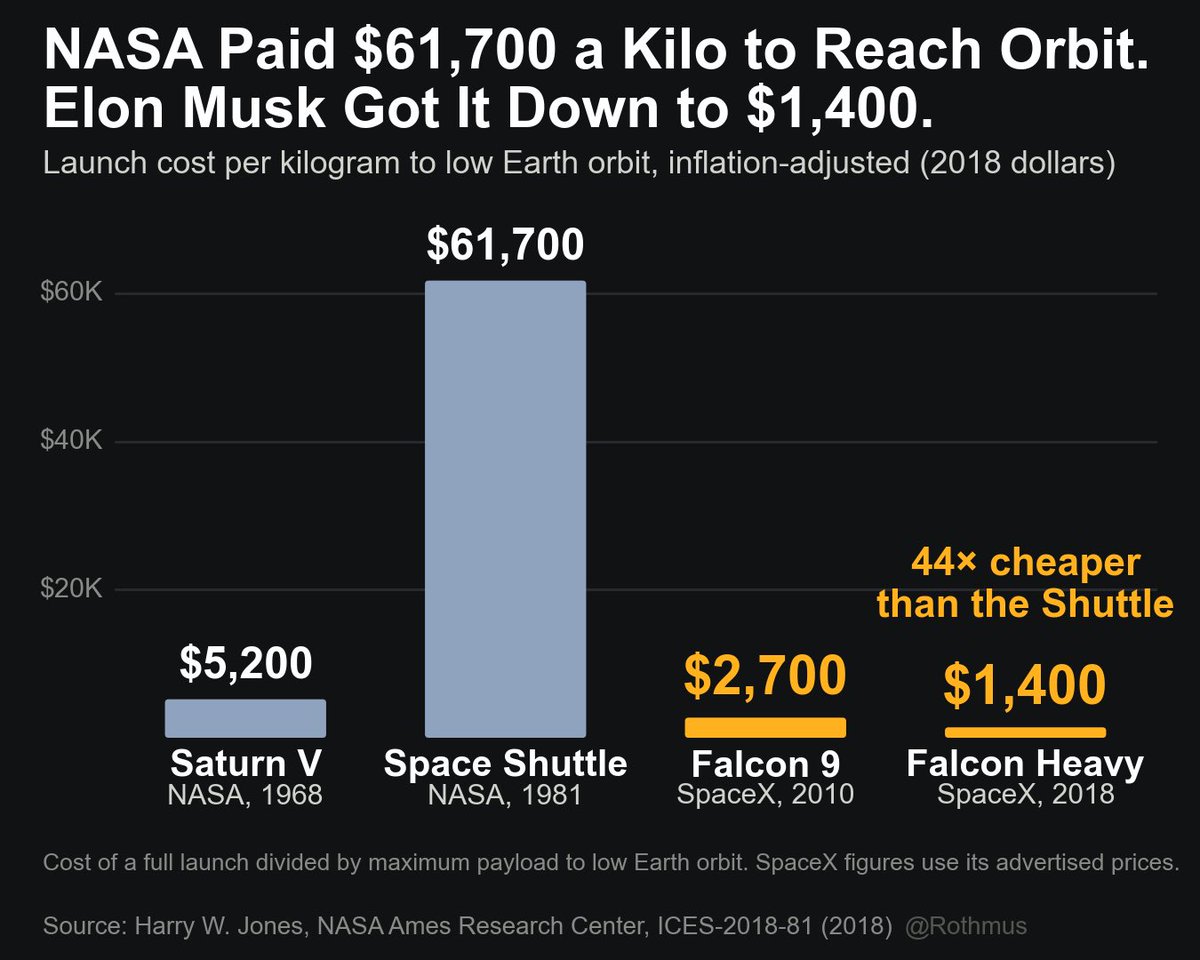
NASA: $61,700 per kilo to orbit
SpaceX: $1,400
The Shuttle was a $200B government money pit that barely flew and exploded twice, while Saturn V was already better at $5,200/kg.
Then one private company cut the cost 44x while actually reusing the rockets.
The difference is the incentive to get paid for making things work.
The profit and loss system is a miracle.
🚨 RUBIO JUST SAID THE NUMBER THEY NEVER WANTED ON TV 🚨
Americans work 40 years.
They retire.
Social Security: $800. $900. A thousand a month.
Somebody who got here from Cuba three months ago: $1,500 a month.
Marco Rubio said it out loud.
“So imagine if you’ve been working here for 40 years and your Social Security check is smaller than the benefits going to a 28-year-old, able-bodied person who just got here. That’s real. That happens. That’s happening every day. That makes no sense.”
You paid in.
They landed.
They beat your check.
That’s not compassion.
That’s a slap in the face with your own tax dollars.
The Electoral College was basically a compromise. The Founders wanted the president chosen with the people’s support, but they didn’t want a straight national popular vote or to just hand the decision to Congress.
At the 1787 Constitutional Convention, they talked for months about how to pick a president. A direct popular vote worried them. Bigger states would almost always win. A lot of voters wouldn’t really know candidates from other parts of the country. And someone who was just good at stirring people up in one area could end up winning.
Letting Congress pick the president worried them even more. The president would end up depending on Congress, which goes against the idea of keeping the branches separate. It also opened the door to backroom deals, corruption, or other countries trying to influence the choice.
So they settled on the Electoral College. Each state gets electors equal to its number of House seats plus its two senators. Those electors cast the actual votes for president. You need a majority to win. If no one gets it, the House decides, and each state gets one vote. The states get to decide how they pick their electors.
This setup treated the country as a union of states instead of one giant population. It gave smaller states more of a voice, kept the president from being controlled by Congress, and still let the people’s choice matter.
Alexander Hamilton explained it in Federalist 68. He said the people’s voice still counts because they choose the electors. The electors would be people who could actually study the candidates and make a careful choice. Meeting in their own states (instead of all in one place) would make it harder for chaos, bribery, or foreign influence to take over. And the president would still depend on the people, not Congress, to stay in office.
Hamilton also pointed out that being good at “the little arts of popularity” might get someone ahead in one state, but it would take real ability and character to win the confidence of the whole country. He thought the system made it very likely only someone highly qualified would end up as president.
That’s the idea they were going for: a capable president with support across the country, protection for smaller states, and an executive that stayed independent. Things changed later with political parties and the winner-take-all system most states use now, but the basic structure is still what the Constitution set up.
The Electoral College must be protected at all costs— it’s common sense in a country filled with lunatics.
A Free Press reporter asks New Yorkers if socialism is good for America.
They all say yes.
Then she brings out Daniel Di Martino, who fled Venezuela, and they get a firsthand horror story they weren’t ready for.
NEW YORKER: “I think socialism is actually really good for society.”
DI MARTINO: “Are you familiar with how socialism worked out in other countries historically?”
NEW YORKER: “Just because it didn’t work out so well in other parts of the world doesn’t mean it won’t work out well for New York.”
Di Martino’s family lived through the promises these voters are buying.
DI MARTINO: “My family went from making $2,000 a month 20 years ago to $100 a month in 2016. That was because the government gave everything you can imagine for free.”
“We went from being a normal middle-class family with a car and then no electricity, no water.”
Asked if they support “government grocery stores,” the answer is just as confident.
NEW YORKER: “Of course I do.”
So Di Martino explains what grocery shopping looked like under socialism.
DI MARTINO: “There was very little supply of chicken, toilet paper. It was a line for blocks and blocks for a grocery store.”
NEW YORKER: “What happened in Venezuela isn’t going to happen here. The policy is more focused on helping people out.”
A man describes lines stretching for blocks just to buy chicken and toilet paper, and a Mamdani voter waves it away. Because THIS time, they’re sure it will work.
REPORTER: “You know, they have tried that in the Soviet Union from where my parents and my grandparents are from. All they remember of grocery stores is empty shelves.”
DI MARTINO: “The DSA went to Venezuela just last year to support the dictator and say that he won the election that he didn’t.”
NEW YORKER: “I had no idea. I did not know.”
DI MARTINO: “Government rent control. It’s going to stop people from renting apartments because they’re not going to be able to profit. There are going to be fewer apartments for rent.”
NEW YORKER: “That’s a good point. I agree with that. Okay. I understand more about socialism now for sure.”
Socialism always sounds good to people who’ve never had to live under it.
Those who have never want to live under it again.
Milton Friedman on 4 ways to spend money:
1) Your money on yourself (you’re careful about both cost and quality)
2) Your money on others (you care about cost, less about quality)
3) Someone else’s money on yourself (you care about quality, not cost)
4) Someone else’s money on others (you care about neither)
The last one is how government spending works.
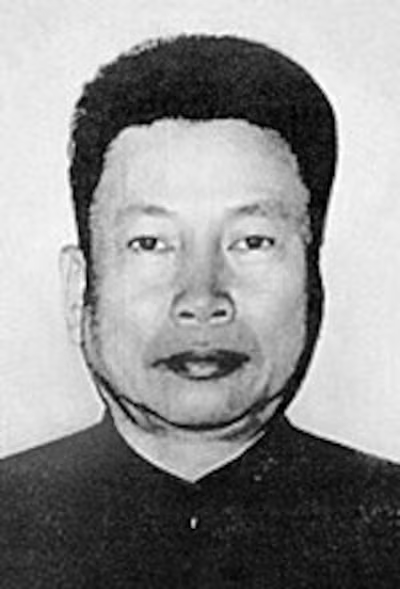
Pol Pot. This piece of shit killed an estimated 1.7 million Cambodians between 1975 and 1979, somewhere between 25 and 33 percent of the entire population. He did this by applying an ideology to its logical conclusion. Ideology always has a conclusion; socialism's conclusion is death.
The Khmer Rouge abolished money in 1975. Completely. Banks closed. Markets dissolved. Currency became contraband. They then abolished private property, forcibly relocated urban populations to collective farms, and set central planners the task of organizing rice production for the entire nation. The result was predictable: mass starvation beside the rice fields. Planners cannot coordinate production without prices. Prices require private property and voluntary exchange.
Pol Pot studied in Paris during the 1950s, absorbing French Communist Party doctrine and Maoist agrarianism. Western universities provided the intellectual scaffolding for the killing fields. Coercion requires enforcers, tribunals, and eventually mass graves; Cambodia's are at Choeung Ek.
Every collectivist experiment reaches this same point, because central planners cannot solve what free exchange solves automatically every second of every day.
DSA candidate Tim Denson tries to sell the crowd on “democratizing the workplace” and says Walmart should belong to the workers.
Big mistake. The guy 6 ft away from him grew up in Venezuela. And he’s heard this communist fairy tale before.
DANIEL DI MARTINO: “So you want to take it [Walmart] from its owners and have the workers do what?”
TIM DENSON: “I want the workers to own it and get paid better and have better benefits and be able to provide better lives for their families.”
DI MARTINO: “We can buy shares in Walmart right now. In fact, all of the SpaceX workers became millionaires overnight.”
“You can start a workers’ cooperative right now. It’s legal, but under a socialist country, you’re not allowed to own your own property and start your own private corporation.”
Denson tried to refute Di Martino’s point. Then Di Martino dropped this line on him:
DI MARTINO: “It’s very easy to be a socialist in a capitalist country. It’s illegal to be a capitalist in a socialist country. That is the difference.”
[audience applause]
Then it got personal:
DI MARTINO: “When I had to go to the grocery store, Tim, I had to put my fingerprint in a scanning machine so that they would tell me what I was allowed to purchase.”
“And I could only go Mondays and Saturdays because we have to ration food, because that’s what happens when there’s no profit motive and the farmers, their food is confiscated because they had to sell it to the government and everybody else at the price the government tells the farmers.”
“My mom made chocolate bonbons for parties.”
“Well, people have a right to chocolate, so we had a price control on chocolate.”
“So my mom had to buy counterfeit chocolate, put it in black bags as if we were cocaine drug dealers. That’s what socialism was in Venezuela. That’s what worker ownership of the means of production is.”
“Where has it ever worked?”
Denson had no answer. Because there isn’t one.
@leemarh7099 Well, hagrid never would have carried Harry if we didn't go to Harry's point of view after avada kedavra, right? Dracos mom comes and does a pulse check, and only confirms Harry is "dead" after Harry confirmed that Draco was inside the castle and alive.
@anymanfitness This graph could be looking only at simple sugars and not counting carbohydrates (complex sugars). Also around this time of sugar use lowering, all the sugar replacements were gaining momentum
Want purpose?
Fatherhood may help: 59% of men without kids say they understand their purpose in life, vs. 72% with one child, 79% with two & 83% with three+. Kids give life meaning.
Source: Dr. Stephen Cranney @FamStudies
The greatest fulfillment for a man and a woman is becoming parents.
They try to convince you that this is pure evil. Don’t fall for their trap. Don’t end up at 70 alone and miserable.
Create life, as much as you can. Carry on your bloodline. It will be your greatest joy.
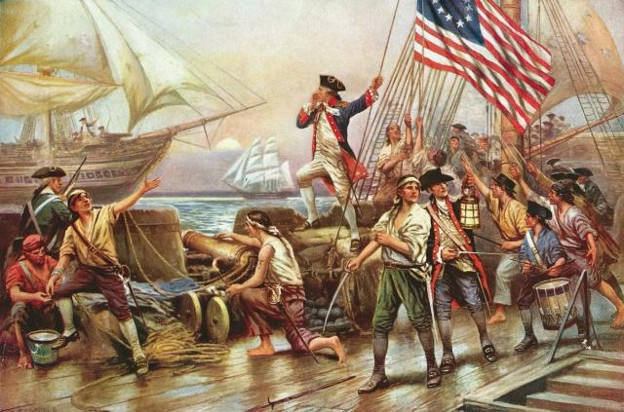
On this day in 1779, an American captain stood on the deck of a ship that was literally sinking under his feet, on fire, riddled with holes, half his crew dead or wounded, and when the enemy shouted across the water asking if he surrendered, he roared back a line that the United States Navy has never forgotten: "I have not yet begun to fight!" His name was John Paul Jones, and what he did that night made him the founding legend of the American navy.
Understand how insane the setting was. Jones was not defending American waters. He had taken the fight to the enemy's home, cruising in a small squadron right off the coast of England itself, terrorizing British shipping in their own front yard. His flagship was an old, worn-out French merchant vessel he had converted into a warship and renamed the Bonhomme Richard, in honor of Benjamin Franklin's "Poor Richard." It was slow, tired, and outgunned.
Off Flamborough Head, Jones ran into a British convoy escorted by a brand-new, faster, more powerful Royal Navy frigate called the Serapis. By every rational measure, Jones should have run. The Serapis was a better ship with heavier guns. Instead, Jones attacked.
The battle that followed, fought into the night under a rising moon, was one of the most savage ship-to-ship duels of the entire age of sail. Early on, disaster struck the Americans: two of the Bonhomme Richard's big old cannon burst when fired, blowing apart their own gun crews and leaving Jones dangerously short of firepower. The Serapis hammered the Richard mercilessly, its heavier guns tearing the American ship to splinters, opening holes below the waterline, setting fires. The Richard was being destroyed.
So Jones did the only thing that could save him. If he could not win a gunnery duel, he would not fight one. He drove his ship straight into the Serapis and lashed the two vessels together, hull against hull, muzzle to muzzle, so close the gun crews were practically fighting through each other's ports. Now it was not a naval battle so much as a brawl, and Jones's American and French sailors and marines could rake the enemy's decks with musket fire and grenades from the rigging.
It was in the middle of this hell, with his ship clearly sinking and afire, that the British captain called over, reasonably, to ask if the Americans had had enough and wished to strike their colors. And Jones, standing on a doomed deck, gave the answer that became immortal: he had not yet begun to fight. And he meant it.
The turning point came from above. One of Jones's men climbed out on a yardarm over the enemy ship and dropped a grenade down through an open hatch into the Serapis, where it touched off a chain of gunpowder charges. The explosion ripped through the British gun deck, killing and maiming dozens of men in an instant. The fight went out of the Serapis. Its captain, his own ship now wrecked and burning, finally surrendered.
And here is the almost unbelievable ending. John Paul Jones had won, but his own ship was beyond saving. The Bonhomme Richard was so shattered that it slowly sank over the next day, and Jones had to move his victorious crew onto the captured Serapis and sail away in the enemy's ship, because his own had gone to the bottom. He won the battle and lost his vessel, all at once.
The victory made him a hero on both sides of the Atlantic, a symbol that the infant United States could carry the war to the mightiest navy on earth and win. To this day, the Navy calls John Paul Jones its father, and it teaches new sailors his answer from that burning deck. Remember September 23, 1779, and the man who was sinking, and on fire, and outgunned, and answered a demand for his surrender by saying he had not yet begun to fight, and then proved it.