Reality isn't optional, just hidden. A web of forces is reshaping Britain, and tactics keep it that way. Follow to see how it connects and take back control.
What is Britain?
It is a whole way of living, built up over a very long time. It is the language and the everyday humour, the common law, the habit of fair play, the odd trust between people who will never meet and still somehow feel like one nation. That is the real wealth of the place, and almost none of it is written down anywhere. It is carried, in the people who were raised inside it and raise the next lot the same way.
Which means the people and the shared life of the place are a single thing. You cannot keep the shared life while losing the people who carry it, and a people who let that shared life dissolve lose the ability to act as one. They come as a pair, and that pair is what we really mean when we say "the country."
That pair is being hit from two sides at once. On one side we have lost confidence in the shared life, half stopped believing it is worth much, so we barely pass it on to our own children and we flinch from defending it.
On the other side we have taken in more people, faster, than any country could fold into its common life, and gathered them in places where there was little settled common life left to fold into.
The dangerous part is that the two feed each other.
A country that has lost faith in itself has nothing confident to bring a newcomer into, so the newcomer stays apart, in his own world with his own rules. The more who stay apart, the less the place holds together as one society. And the less it holds together, the fewer people, long-settled or newly arrived, find any reason to believe in it or join it.
Round it goes, each turn a little weaker than the one before. That is the loop we are actually in, and it is why arguing about numbers alone, or culture alone, never quite lands.
So what turns the loop the other way?
Two moves, and they are the same recovered confidence seen from two sides.
Believe in the shared life again, enough to teach it without apology and to expect those who come to take it up.
And slow the arrivals to a pace we can genuinely fold in, so the people who come are taken into the life of the place over time and become part of it, the way every wave that ever settled here was in the end, instead of left to set hard as a world apart.
Do both together and the loop runs in our favour. A country sure enough of itself to teach and to welcome on its own terms folds its newcomers in, and folding them in keeps it the kind of country worth believing in. That is where we began, with something whole still here to hand on, if we choose to keep it.
@Artemisfornow 100%
The establishment has had its way for a long time. It cares not about party colours and it has become excellent at rejecting change.
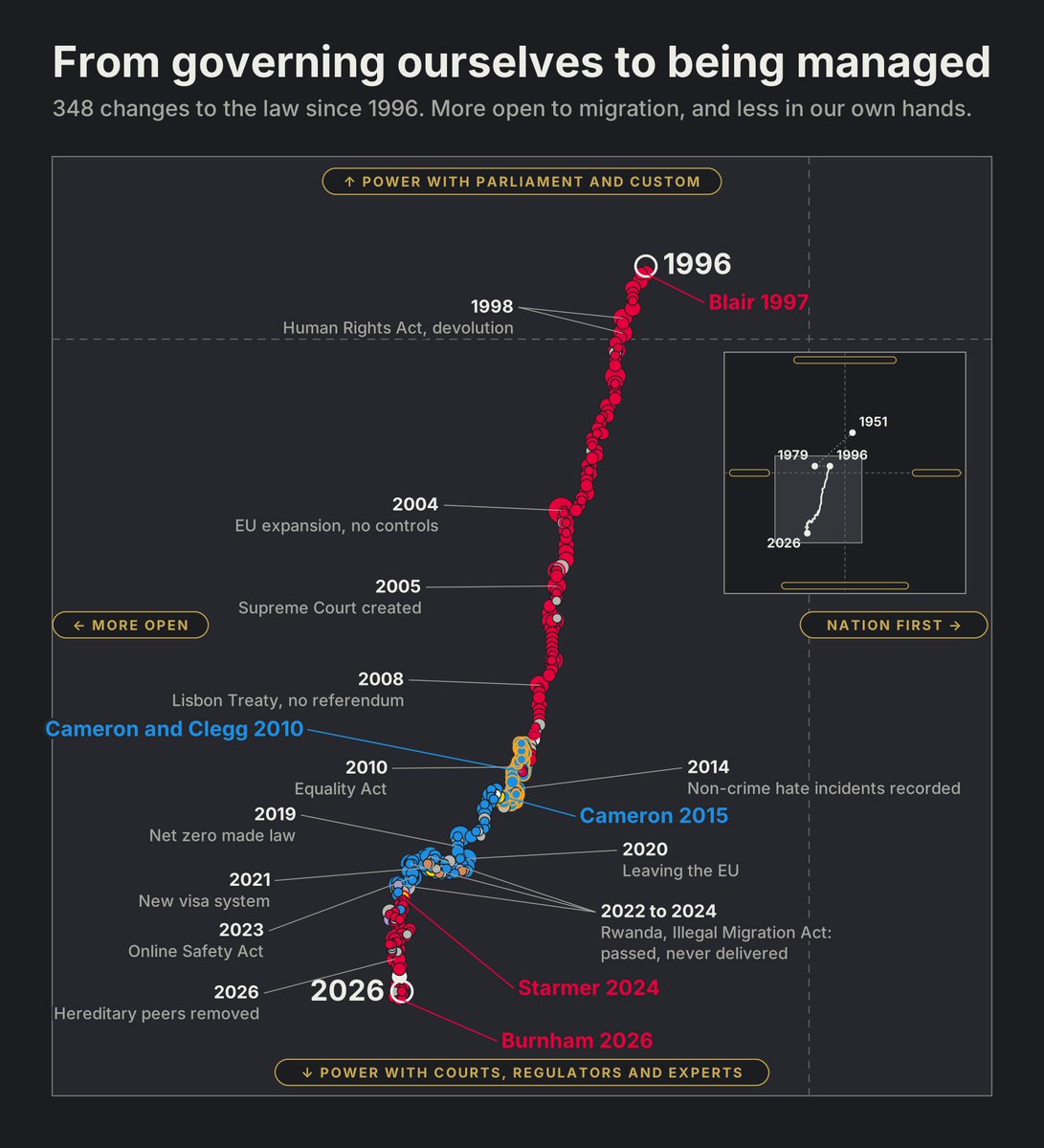
Every government since 1996 has moved Britain the same way: more open to migration, with more decisions handed to courts, regulators and experts.
348 changes to the law. Labour moved it furthest. The Tories' tough laws were mostly never delivered.
Every government since 1996 has moved Britain the same way: more open to migration, with more decisions handed to courts, regulators and experts.
348 changes to the law. Labour moved it furthest. The Tories' tough laws were mostly never delivered.
Carl, you keep presenting your personal belief that only people with English ancestry can be English as though it's some immutable law of the universe. It isn't.
You're essentially saying that only your "tribe" gets to decide who belongs. That's not an objective fact, it's YOUR definition of Englishness.
And telling people that they can never belong because of their ancestry doesn't make you the guardian of English identity.
And the repeated attempts to intimidate or browbeat people into accepting your definition don't make your argument any more convincing.
It just makes the racial exclusion in your argument rather difficult to miss.
There is no debate, it is a settled matter.
For those having difficulty, the learned @Tom_Rowsell explains what an Englishman is - here - in @ReinersProject :
https://t.co/ZwxvrPwq5h
@elonmusk Indeed. The battleground is people's worldview and one worldview has it all but stitched up right now.
Resist while you still can.
https://t.co/FJHsayQw8L
Where does your worldview come from?
Most people think their political views are conclusions they reached. They're closer to inheritance.
By the time you're twenty, your worldview is mostly already in place. Four things put it there.
Family is the deepest channel. Your worldview tends to start as a slight modulation of your parents', who were a slight modulation of theirs. Two clicks back is usually still recognisable. Religion or its absence sits inside this one: for most British families now, whether you grew up going to church is set by your parents, not chosen later.
School and university are the formal channel. Schools transmit a worldview by what they treat as obvious: what's celebrated, what's ignored, which questions are interesting and which aren't. University does the same with more concentration. The institutions young people pass through tend to reward universalist-constructivist worldviews (rebuild everything for everyone). Students aren't being indoctrinated. They're being socialised, the way every culture socialises its young. The worldview that gets you good marks tends to become your worldview.
Peer group and place are the lateral channel. The five people you spend most time with shape your worldview more than the BBC or any newspaper. Worldview is contagious within social networks. Place matters too: a village in Lincolnshire and a flat-share in Hackney install very different defaults, even on the same person. People who move between them often shift worldview without noticing.
Media and information diet is the saturation channel. What you read, watch, and scroll shapes which questions feel important and which positions feel reasonable. The diet matters less than people think for settled worldviews. Adults rarely change their minds from a podcast. It matters more for young people whose worldview is still forming. The under-25 information environment is overwhelmingly digital and overwhelmingly skewed in one direction. Most adults' media diet confirms the worldview they already had.
By the time you're twenty, the worldview is mostly already there. Family, schooling, peers, media. After twenty, worldview only shifts under significant disruption: parenthood, illness, financial collapse, religious conversion, exile.
This doesn't mean your worldview is wrong. It means it isn't quite the considered conclusion you might have thought.
Four questions to ask.
First: ask your parents what their parents believed politically. Then ask yourself how much of you is still in that pattern.
Second: think back to your school. Was history mostly kings and parliaments, or mostly global movements and colonial critique? Was the literature canon Shakespeare and Dickens, or contemporary world voices? Were assemblies Christian, secular-civic, or world-religions equivalent?
Third: think about your few political conversations with friends or colleagues. What positions got nodding agreement? What positions would have got raised eyebrows? The pattern of what's sayable shows the worldview around you.
Fourth: look at your podcast queue, your follows on X, the first three things you read this morning. The shape of your media diet is a near-perfect map of your worldview's edges.
Your worldview was installed before you chose it. You can keep it, but you can't keep pretending you chose it. Where you sit on the political map is mostly where you were put.
@peterboghossian Peter recognises stereotyping then proceeds to stereotype in a clumsy and myopic way.
So the question is why he seeks to do so?
Does he need to periodically jab every political group to maintain his air of centrality?
@RestoreBritain Remember the judiciary, they might be an easier place to restore first.
But don't stop at the GRA. Keep going -> Equality Act -> Human Rights Act -> ECHR... It's all part of the same legal framework being used against us.
@charliecolecc Sadly I am always suspiscious of any action that seems favourable.
With NCHI's being scrapped, I look towards Clause 1 "Respect Orders" passing through readings *right now*.
They Could be NCHI's on steroids - subjective definition, criminal offence and breadth of control.
@MDC12345678 Understand how worldviews are formed.
Understand how they are manipulated and reinforced.
Shield yourself from that manipulation.
Think independently.
Warning though, independent thinkers are not welcomed by the establishment.
Where does your worldview come from?
Most people think their political views are conclusions they reached. They're closer to inheritance.
By the time you're twenty, your worldview is mostly already in place. Four things put it there.
Family is the deepest channel. Your worldview tends to start as a slight modulation of your parents', who were a slight modulation of theirs. Two clicks back is usually still recognisable. Religion or its absence sits inside this one: for most British families now, whether you grew up going to church is set by your parents, not chosen later.
School and university are the formal channel. Schools transmit a worldview by what they treat as obvious: what's celebrated, what's ignored, which questions are interesting and which aren't. University does the same with more concentration. The institutions young people pass through tend to reward universalist-constructivist worldviews (rebuild everything for everyone). Students aren't being indoctrinated. They're being socialised, the way every culture socialises its young. The worldview that gets you good marks tends to become your worldview.
Peer group and place are the lateral channel. The five people you spend most time with shape your worldview more than the BBC or any newspaper. Worldview is contagious within social networks. Place matters too: a village in Lincolnshire and a flat-share in Hackney install very different defaults, even on the same person. People who move between them often shift worldview without noticing.
Media and information diet is the saturation channel. What you read, watch, and scroll shapes which questions feel important and which positions feel reasonable. The diet matters less than people think for settled worldviews. Adults rarely change their minds from a podcast. It matters more for young people whose worldview is still forming. The under-25 information environment is overwhelmingly digital and overwhelmingly skewed in one direction. Most adults' media diet confirms the worldview they already had.
By the time you're twenty, the worldview is mostly already there. Family, schooling, peers, media. After twenty, worldview only shifts under significant disruption: parenthood, illness, financial collapse, religious conversion, exile.
This doesn't mean your worldview is wrong. It means it isn't quite the considered conclusion you might have thought.
Four questions to ask.
First: ask your parents what their parents believed politically. Then ask yourself how much of you is still in that pattern.
Second: think back to your school. Was history mostly kings and parliaments, or mostly global movements and colonial critique? Was the literature canon Shakespeare and Dickens, or contemporary world voices? Were assemblies Christian, secular-civic, or world-religions equivalent?
Third: think about your few political conversations with friends or colleagues. What positions got nodding agreement? What positions would have got raised eyebrows? The pattern of what's sayable shows the worldview around you.
Fourth: look at your podcast queue, your follows on X, the first three things you read this morning. The shape of your media diet is a near-perfect map of your worldview's edges.
Your worldview was installed before you chose it. You can keep it, but you can't keep pretending you chose it. Where you sit on the political map is mostly where you were put.
Every direction on this map works in moderation. Push too far and each corner breaks in its own way.
Since 1996 Britain has moved steadily towards the bottom-left corner, where families and communities break down and trust collapses.
Every government since 1996 has moved Britain the same way: more open to migration, with more decisions handed to courts, regulators and experts.
348 changes to the law. Labour moved it furthest. The Tories' tough laws were mostly never delivered.
@DavidBe31099196 Many things you say ring true but
fundamentally, civic nationalism has never succeeded in history.
Where it has been tried, it only lasted as long as it did through force and second class citizenship. Once that eroded, natural in-group preference resurfaced.
Agreed. The current establishment is skewed heavily universalist-constructivist, rather than particularist-inheritance. Meaning they heavily favour new laws, new rules and blank slatism over slowly refined and inherited laws and rules for a specific people.
What follows and what we are seeing is a denial of a particular people because that breaks their universalist viewpoint - their new laws applicable to everyone (in the World).
And of course, some are using that as cover for furthering their own in-group preferences by importing people more like them.
Hey Cathy, there is quite a lot to unpick here.
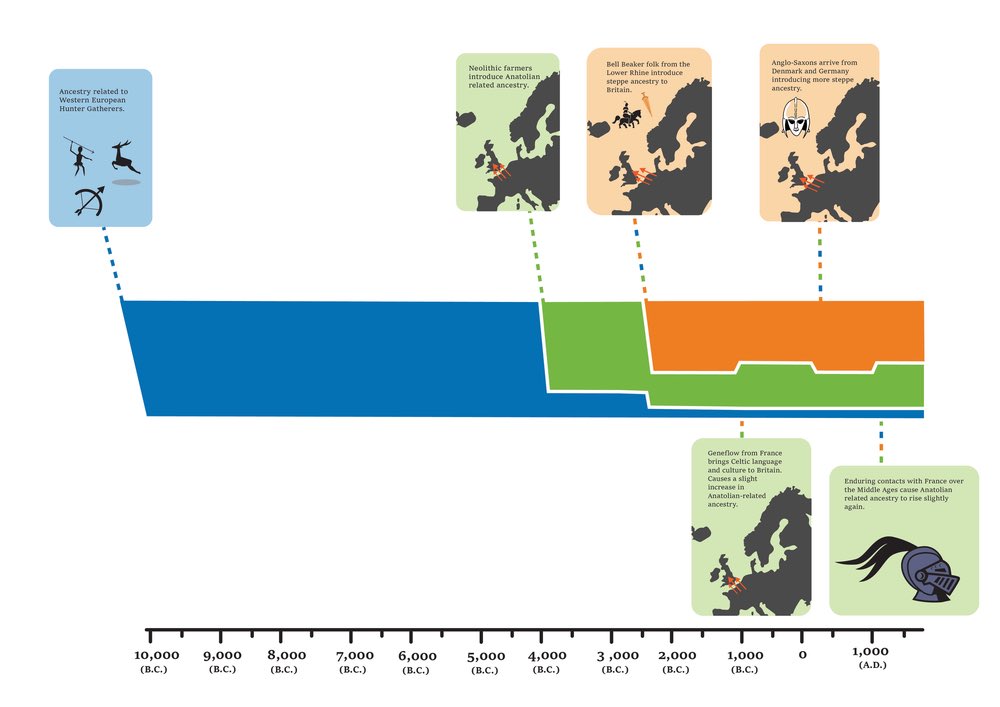
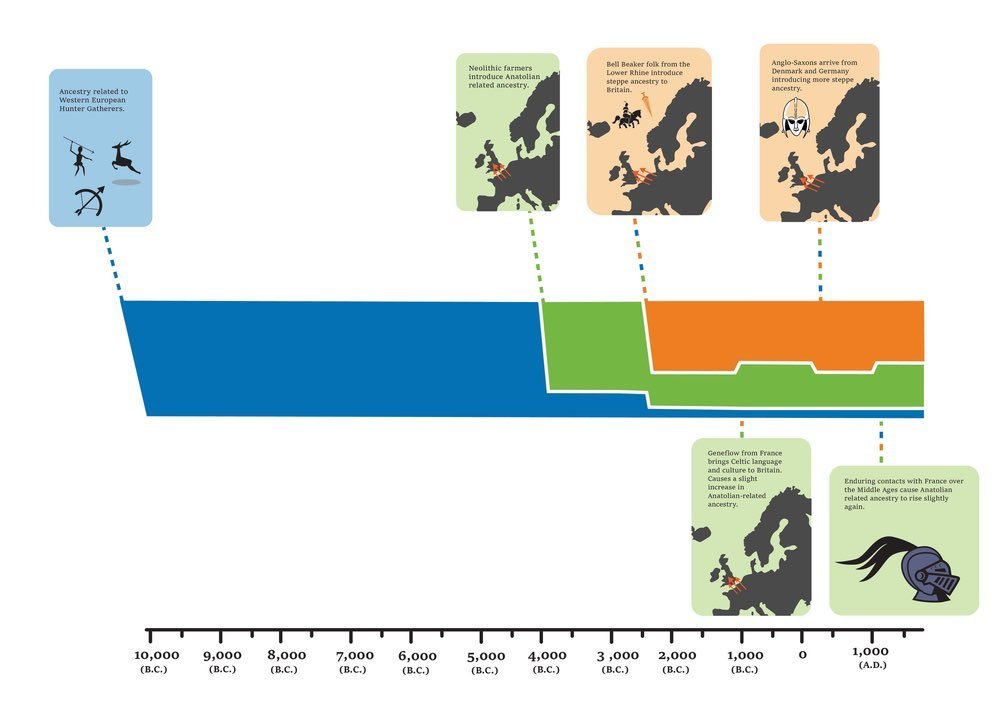
* English peoples, just like Icelanders, Japanese or anyone considered "indigenous" by the UN, are simply definable through ancestry - a direct single sex lineage. Which has been stable for about 3000 years in England.
* A *minority* are "mongrels" as you put it, a mixed ethnicity. See above if they qualify as English. If not, then they still have a/multiple rich histories to tap into, inspire them and be proud of.
* Being born somewhere is not what make you of that place.
* Being culturally English does not make you English but it is an obvious, but not only, neccessity for integration.
* The history of successful intergation has always been through marriage and children with the native "tribe", slow and steady.
I'll leave aside Sonia's racism angle as although a valid concern against a small minority of people, it is being used to shut down a conversation that is too important to ignore. I trust you can tell from my response above that race is not a defining factor of Englishness.
More of my thoughts about the symbiotic nature of a place and its peoples: https://t.co/DwKSS988RQ
@soniasodha@Independent Quite. English people aren't a definable ethnic group. We are mongrels. If English refers to definable ethnic group, what is it? My offspring have an Indian grandparent & Croatian/American/Scottish great grandparents. Are they English? They were born in England as was I.
@RupertLowe10 👏
Conservatives and Reform will forever struggle trying to define culture 'top-down' because culture is _created_ *bottom-up*, by the *Britons*.
The Left will also fail in trying to replace culture and ancestry with _their rules_.
https://t.co/GdRkeEkUNH
I welcome this philosophy - I've certainly been agitating for it - knowing that compromise is the skill of politics.
I also read this as a philosophy, not an operational document - I am not expecting detail on 'how' at this stage (although it is very much needed).
Restore rightly says: "Borders matter. Citizenship matters. Belonging matters. Enforcement matters. Democratic consent matters. National continuity matters. Demographic security matters."
But *why* do these things matter?
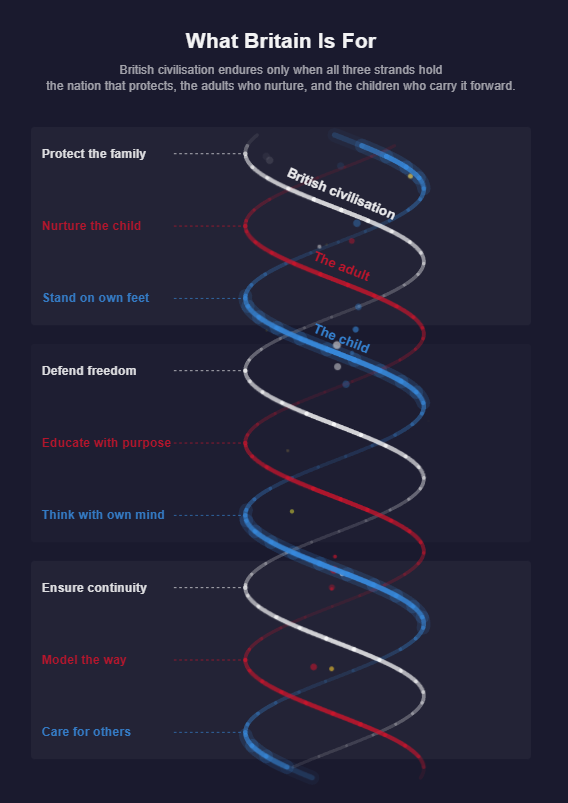
Every generation inherits a civilisation. A civilisation that we believe gives our people the best life, built over generations, for the current and future generations, via an accumulated substrate of family, faith, settled neighbourhood and custom.
Every generation has a duty to hand it on and both the people and the place, are inseperable - they shape each other.
Once Restore answer this most fundamental question - what is Britain for? - their policies can be maximally shaped and strongly argued from the most principled position there is.
Other notable points:
* Restore disambiguates Britons (ancestry) from citizens (legal). This is neccessary and powerful for future policies that prioritise the former. Although they add confusion back in by saying that "English
identity can be shared more broadly" - I would recommend clarifying what they mean by "English identity" because to me that is intrinsically linked to ancestry anfd cannot be 'opted into' (just like a male can't become a female by simply them saying so, or worse, acting out sterotypes).
* Citizenship is high-value, has a high bar and is rescindable. Crucially it is marriage that is the door. This is how to sustainably welcomed new blood, ensured the commitment is the highest it can be and manage the rate of absorption.
* 'Equal before law, not identical in policy' is the first time I've seen this explained that avoids the accusation of creating second-class citizens.
* Defence of Britain's Christian culture. Whether you are religious or not, Christianity has shaped Britain and we owe it much more than I have realised in my life.
* Restore says "Having at least one British-born parent represents a tangible inter-generational connection to this country that a Restore Britain government will legitimately recognise in appropriate areas of national policy." I prefer a multi-generational lineage, else non-integrated ethnic blocks will persist. But with any scheme, the risks of abuse will need to be mitigated.
I'm glad this is published, I'll be reading the feedback and I'm sure Restore will continue to do so too.
Restore Britain's philosophy of national belonging.
Where we've gone wrong and how a Restore Britain Government will reverse it.
This is our position.
https://t.co/IOocBlcKpL
@ukhomeoffice Do you mean less boats or less people?
Because there may be less boats but the boats are now bigger and carry more people.
But I'm sure you wouldn't gaslight the public, the people you are supposed to protect, would you?
@GMontville98763 Certainly, governments are responsible for the lions share of deindustrialization and constraining new business.
Their mismanagement of the UK's workforce and political aims of importing people to fill the gaps their policies created is verging on treasonous.
What is Britain?
It is a whole way of living, built up over a very long time. It is the language and the everyday humour, the common law, the habit of fair play, the odd trust between people who will never meet and still somehow feel like one nation. That is the real wealth of the place, and almost none of it is written down anywhere. It is carried, in the people who were raised inside it and raise the next lot the same way.
Which means the people and the shared life of the place are a single thing. You cannot keep the shared life while losing the people who carry it, and a people who let that shared life dissolve lose the ability to act as one. They come as a pair, and that pair is what we really mean when we say "the country."
That pair is being hit from two sides at once. On one side we have lost confidence in the shared life, half stopped believing it is worth much, so we barely pass it on to our own children and we flinch from defending it.
On the other side we have taken in more people, faster, than any country could fold into its common life, and gathered them in places where there was little settled common life left to fold into.
The dangerous part is that the two feed each other.
A country that has lost faith in itself has nothing confident to bring a newcomer into, so the newcomer stays apart, in his own world with his own rules. The more who stay apart, the less the place holds together as one society. And the less it holds together, the fewer people, long-settled or newly arrived, find any reason to believe in it or join it.
Round it goes, each turn a little weaker than the one before. That is the loop we are actually in, and it is why arguing about numbers alone, or culture alone, never quite lands.
So what turns the loop the other way?
Two moves, and they are the same recovered confidence seen from two sides.
Believe in the shared life again, enough to teach it without apology and to expect those who come to take it up.
And slow the arrivals to a pace we can genuinely fold in, so the people who come are taken into the life of the place over time and become part of it, the way every wave that ever settled here was in the end, instead of left to set hard as a world apart.
Do both together and the loop runs in our favour. A country sure enough of itself to teach and to welcome on its own terms folds its newcomers in, and folding them in keeps it the kind of country worth believing in. That is where we began, with something whole still here to hand on, if we choose to keep it.
@Rothmus Using Optimus like this will *accelerate* the decline of civilisation.
Having more babies but being absent and selfish parents will worsen what we can already observe - neglected children growing into maladjusted adults.
A society even fuller of maladjusted adults.