The gap between US earnings growth and the rest of the world has never been wider:
Earnings of US companies have grown nearly +1,300% since 1990.
By comparison, earnings of global companies excluding the US have risen +500% since 1990.
In other words, US earnings growth has been 2.6 times larger than the rest of the world.
This comes as global ex-US profit growth has remained roughly unchanged between 2008 and 2025.
The US economy is in a league of its own.
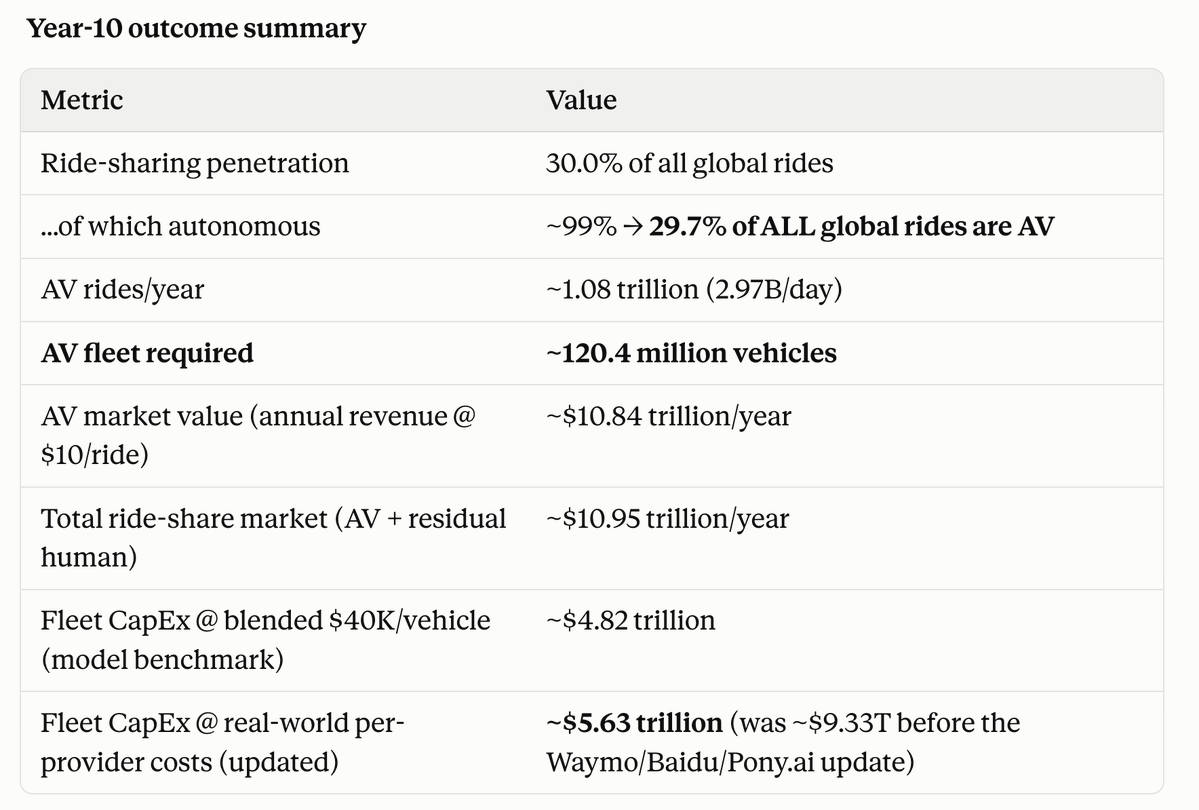
My hyper-bull case is that 30% of global rides will be driven by AVs in 10 years.
This will require ~120M+ cars doing ~25 rides a day ~360 days a year.
It will cost ~$5T to build these cars at ~$40,000 each.
12M cars are built a year on average, but there will be a slow and steady ramp; perhaps 250k in 2027, 500k in 2028, 1m, 3m, etc (build your own model).
Predict Tesla will be #1 in this space with 40% market share -- which would mean building ~50M cars in a decade.
Zero to 40% market share and 5M cars a year on average is an insane ramp up -- but Tesla is the company best positioned to do this.
Uber will be in second place with 35% market share, with two dozen partners putting absurdly cheap Chinese, Japanese, and purpose-built robotaxis into their fleet -- as no car maker wants to go head-to-head with Tesla building cars AND building a network.
Waymo will buy a car maker in the next 12 months, creating a hybrid of Tesla and Uber: full-stack cars built in its factory, deployed on its network, and also added to Grab, Lyft, Uber, and other networks to increase utilization.
The big story?
Someone will need to fund FIVE TRILLION DOLLARS WORTH OF CARS
120M+ cars @ $40,000 each on average; some will be 15-20k two-seaters, some will be premium SUVS at $80,000.
$7-10T+ in annual revenue is at stake for AVs alone.
At a 20-40%+ gross margin, $1-2T+ in EBIDA/cash flow, we will be talking about ~20-30T in market cap.
Waymo and Uber are worth ~$120B and $150B; Tesla is worth $1.4T at the moment.
There's 18-28T in market cap about to be created.
Please run this through your own LLMs and models... move the variables around however you like. $5 average ride, $10 average ride, $50k average vehicle cost, etc.
10% of total rides... 50% of total rides...
... however you slice it, this will be the largest market in the world for AI over the next decade.
After that, human robotics will be the TAM/biggest market cap opportunity in the world... but we can do that model next.
Introducing Starbase, Louisiana – a high-cadence launch site that will enable Starship to open a pathway to the stars for humanity.
Thank you to @LAGovJeffLandry and the great people of Louisiana for all of their support as we work together on this audacious project → https://t.co/zGKVOGSxfW
I am proud to announce that Florida has become the first in the nation to set guardrails on our TANF State Plan to stop these taxpayer-funded benefits from being used to purchase inappropriate, luxury, and non-essential goods and services. We will continue supporting Floridians who genuinely need assistance, while working to improve accountability and transparency so that these programs operate as intended.
Boring Company is about to explode.
They just closed about $3B in new funding and they are now aggressively hiring tons of people including business development (sales). This tells me they’ve reached the level of technical maturity they want so they can blitz municipalities worldwide to build Loop projects.
We currently know about Las Vegas (12 stations, 8 more by end of year, 104 within a few years), Nashville (40+ stations), and Dubai (20), but other cities are coming.
They currently have 7 tunnel boring machines in operation, with an additional 4 more anticipated to be put into service by the end of 2026. They currently build a new machine every two months.
Loop is Boring’s big urban transit innovation. It is a hybrid system, allowing EVs to pop out of tunnels and drive on surface streets for a bit. Stations can be small surface parking lots (one of Vegas’ new stations will be at a Mexican restaurant), or be placed beside a hotel’s entrance portico.
Small cheap stations mean you can build lots of stations resulting in a design rule of less than 100 feet for customers to walk as opposed to a subway’s 1/4 mile design target.
And unlike a subway, Loop is a point-to-point express system. No stopping at intermediate stations along the way or changing train lines in the Loop system.
AI? Absolutely. The boring machines are mostly autonomous now and the EVs driving passengers will be autonomous soon. Obviously these systems will eventually tightly integrate into Tesla’s Robotaxi network.
Being a Musk company, Boring has wrung tons of cost out of the system, making Boring more than 10x cheaper than legacy tunnel boring. Among other things, this has resulted in both Las Vegas and Nashville systems being completely privately funded through a combination of hotels paying for their own Loop station and rider fees that still cost less than an equivalent (but slower) taxi ride.
Any city investigating ways to lighten urban traffic load should be calling up Boring.
Far more than that.
As I’ve said publicly, bandwidth demand will increase massively due to AI & robotics. Their need for data transfer is orders of magnitude more than humans!
Even if the communications market merely doubles in size, I would expect Starlink to reach at least 25% market share outside of China (maybe one day in China too), which would be over half a trillion dollars in revenue per year.
It’s not out of the question that Starlink carries more than 50% of Internet traffic long-term, which would probably be over a trillion/year. There is no obvious impediment to that outcome so far.
The bond market situation is crazy.
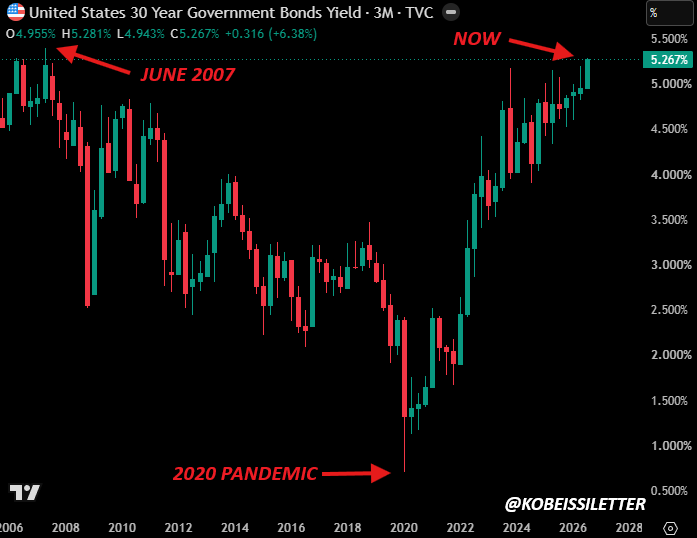
While everyone focuses on AI, US borrowing rates just hit the highest level since June 2007.
Credit card "serious delinquencies" are at the highest since 2010 and mortgage rates could near 8%.
What's happening? Let us explain.
(a thread)
For my first post, I’m sharing a letter @NVIDIA signed on why open models matter.
AI will transform every industry, power every company, and be built by every country.
Open models strengthen safety and cybersecurity, accelerate innovation and diffusion, and enable sovereignty.
The world needs both frontier closed models and frontier open models.
https://t.co/AUKzoQ5Ikb
New in Claude Cowork: teach Claude a skill.
Record your screen while you do a task, talk through it as you go, and Claude turns it into a skill it can run again. Find it under Record a skill in the + menu of the Claude desktop app.
Available on Pro, Max, and Team plans.
Trial lawyers are lobbying against self-driving cars because they're too safe. They need people to be killed and injured so that they have material for lawsuits.
🚨 BREAKING: Claude can now map out your retirement better than most people charging $2,000 ever will.
Here are 6 prompts to figure out exactly when and how you can retire.
(Save this before it disappears).
Introducing Honen
Turn your company context into interactive courses that self-improve over time
We partnered with NVIDIA to bring AI literacy to 250,000 learners
We're ensuring no person or company gets left behind
Get started at https://t.co/rH0oOr37Kv
This is concerning. For the first time, a Chinese model Kimi K3 has taken #1 on the Frontend Code Arena and is scoring at or near the frontier on other benchmarks.
Meanwhile America is tying itself in knots: politicians and bureaucrats are banning new data centers, piling on state regulations, and pushing for new federal agencies to pre-approve frontier models.
This is how you lose the AI race. The rest of the world won’t play by our rules if we bog ourselves down. Permissionless innovation is how America won the internet and became the technological envy of the world. We can do it again with AI -- while addressing risks in a targeted way -- or we’ll watch our lead evaporate.
Today we're shipping screen-aware dictation.
First, we built a speedy speech-to-text (very fast, ~450ms).
But, many products do this!
So we went further. Now dictate using your screen as context. In Claude Code, it writes the prompt. In G-Mail, it replies in your voice.
Demo:
Elon Musk was asked by a room full of Stanford students what single trait separates people who change the world from people who don't. Everyone expected him to say intelligence. Or work ethic. Or vision.
He said pain tolerance.
The room wasn't sure if he was joking. He wasn't. He explained that intelligence is common. Ambition is common. Even good ideas are relatively common. What is genuinely rare is the ability to absorb punishment day after day, year after year, and keep building anyway.
He said most people he's met who are smarter than him quit after the first real failure. Not because they weren't talented. Because the pain of failure exceeded their tolerance for it. They found something easier and redirected their intelligence there.
He said the entire history of SpaceX is just a story about absorbing explosions, literally and financially, and refusing to interpret them as signals to stop.
Nobody writes that on a motivational poster. Nobody puts "pain tolerance" on their LinkedIn profile. But it's the actual filter. Not who can dream the biggest. Who can bleed the longest.
🚨 BREAKING: Claude can now create a retirement plan that rivals the advice many consultants charge thousands of dollars for.
These 6 powerful prompts will help you understand exactly when you can retire and the steps needed to get there.
📌 Save this post now—you’ll want to come back to it later.
Marc Andreessen went on Chris Williamson's podcast and broke down exactly how Elon Musk runs multiple companies at once
No other CEO on Earth does this:
1. Every week, Musk shows up at each of his companies, identifies the single biggest problem that company is having that week, and fixes it. Then he does that for 52 weeks in a row. At the end of the year, each company has solved its 52 biggest problems. Meanwhile, most large companies are still having the planning meeting for the pre-planning meeting for the board presentation with the compliance review and the legal review attached.
2. This is not a new operating method. It is actually how the great industrialists of the late 1800s and early 1900s ran their companies. Henry Ford, Andrew Carnegie, Thomas Watson, who built IBM. Total devotion from the leader to fully and deeply understand what the company does, be in the trenches, talk directly to the people doing the work, and be the lead problem solver in the organization. Andreessen says he is not aware of another current CEO who operates this way.
3. The framework Musk uses is the bottleneck. In any manufacturing chain, there is always one thing holding everything up. Sometimes it is raw materials at the start. Sometimes it is warehousing at the end. Sometimes it is in the middle. The job is to find it and remove it. Musk has universalized this concept across every company he runs. In any given week, there is one main bottleneck. He micromanages the solution to that one thing and delegates almost everything else.
4. Musk delegates almost everything. Andreessen is clear about this. He is not involved in most of what his companies are doing. He is involved in the one thing that is the biggest problem right now. Once that is fixed, he moves to the next biggest problem. Everything else by definition, is running better than the bottleneck, so it does not need him.
5. When Musk identifies the bottleneck, he goes directly to the engineer who actually understands it. not the VP of engineering, not the director, not the manager. The individual contributor who has the actual technical knowledge. He sits in the room with that person and fixes the problem alongside them. He does not ask for a report to be reviewed in three weeks. he shows up at the keyboard or on the manufacturing line and works through it overnight if necessary.
6. This is why technical people who work for Musk say it was the best experience of their lives. Andreessen's framing: if you are stuck on a problem you cannot solve, Elon Musk is going to show up in his Gulfstream, sit with you in front of the keyboard, and help you figure it out. For an engineer who genuinely cares about the work, that is an almost incomprehensible level of support from the CEO of the company.
7. Business school teaches the opposite of this: management as a generic skill applicable to any industry. Soup company or a rocket company, the management principles are the same. process, balance sheet, meeting schedules, compliance, executive motivation, interpersonal conflict resolution. Andreessen says those skills are useful in many contexts. They just give you nothing; you need to do what Musk does. And Musk pushes as far as he can away from all of that so he can spend all of his time doing the things only he can do.