The sportswear sector has turned up. The major players are shown below.
Nike $NKE and On Running $ONON are the laggards. Puma $PUM and adidas $ADS have been slightly stronger, but the standout performers are Japan’s Asics and Hong Kong’s Anta $ANPDY.
Roughly six billion pairs of trainers are sold each year in a market worth US$150 billion. Asics excepted, the derating of the sector has been going on for five years, and it has been slow to recover.
But that now appears to be happening, and we add a company with notable value to the Venture portfolio in our latest note to clients.
Michael Saylor's Strategy reports $21 billion operating income almost entirely from Bitcoin price gains.
• $21.2B capital raised year to date.
• Stronger cash reserves.
• 848,517 BTC held, up 26% year to date.
$MSTR
LATEST: ⚡ Michael Saylor says Bitcoin’s “most profound breakthrough” is converting economic energy into digital form and securely binding it to a person, company, machine or nation.
@Coinbase tells users to follow ‘foolish’ steps scammers use to withdraw funds from wallets https://t.co/8r4DxQEGBr via @cryptoslate
Huge SEO News: Claude is embedding a hidden watermark in all AI-content that will "travel with the text".
Google will soon have ZERO problem detecting AI:
For 3 years now, we haven't had a way to get any first-hand/official insight into how our average target customer may be prompting AI platforms, like ChatGPT, Claude, or Gemini.
It was recently noticed and confirmed that AI Mode records those prompts as queries in the "Performance" section of the Search Console.
This was noticed by "yes" queries, which were confirmed to be follow-up questions in AI Mode. I see those as well...
Looking at the clients' reports, this idea already looks useful, as I can click to the "Pages" tab for each of those queries to see which assets LLMs are pulling from the client's website. Lots of additional opportunities there (update, optimize, create similar ones, etc.)
Another idea is to pull longer, conversational queries using the following regex: 👇
([^” “]*\s){10,}?
This can reveal some cool AI Mode prompts as well.
Note: This must be common knowledge, but since I was confused about that as well, here's your reminder... For high-traffic properties, you will only be able to see queries that send at least some clicks, only. Since AI Mode might be sending none, you will miss those unless you access the SC data through the API. (h/t to @glenngabe 👏)
Reddit discussion: https://t.co/dih0lGj7yg
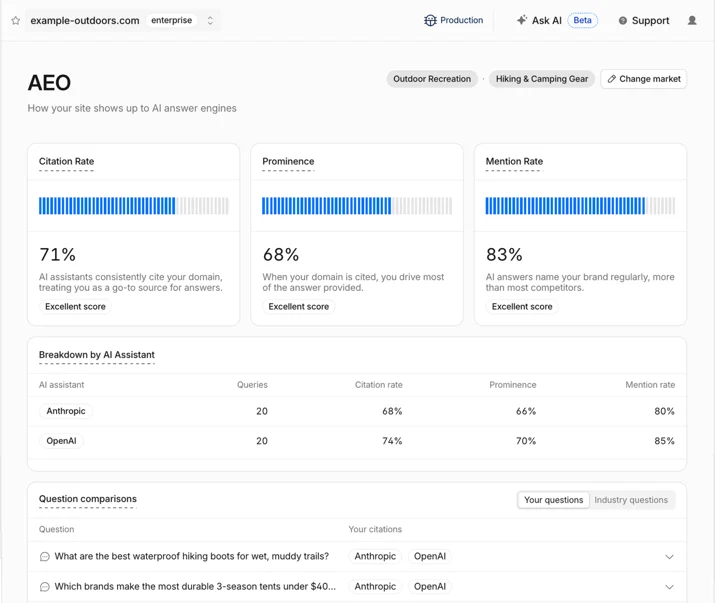
Whoa, Cloudflare is launching AI visibility reporting (for free I believe). For companies providing those services and tracking, this is a huge heads-up. You can sign up for the beta today ('Register interest'). See below:
"To evaluate how an AI model perceives your market presence, we build a benchmark across each industry and category before scoring a specific site. We query AI assistants with likely prompts in that category — without specifying your brand — and record which sites are cited, where they appear, and how prominently they feature."
"Alongside the answers, an AI Operator Activity shows the real crawl and referral traffic on your site, per operator (OpenAI, Google, and so on): who reads your content, who sends visitors back, and the errors they hit on the way (403 blocked, 404 dead link)."
https://t.co/3ZGBEKaeT9
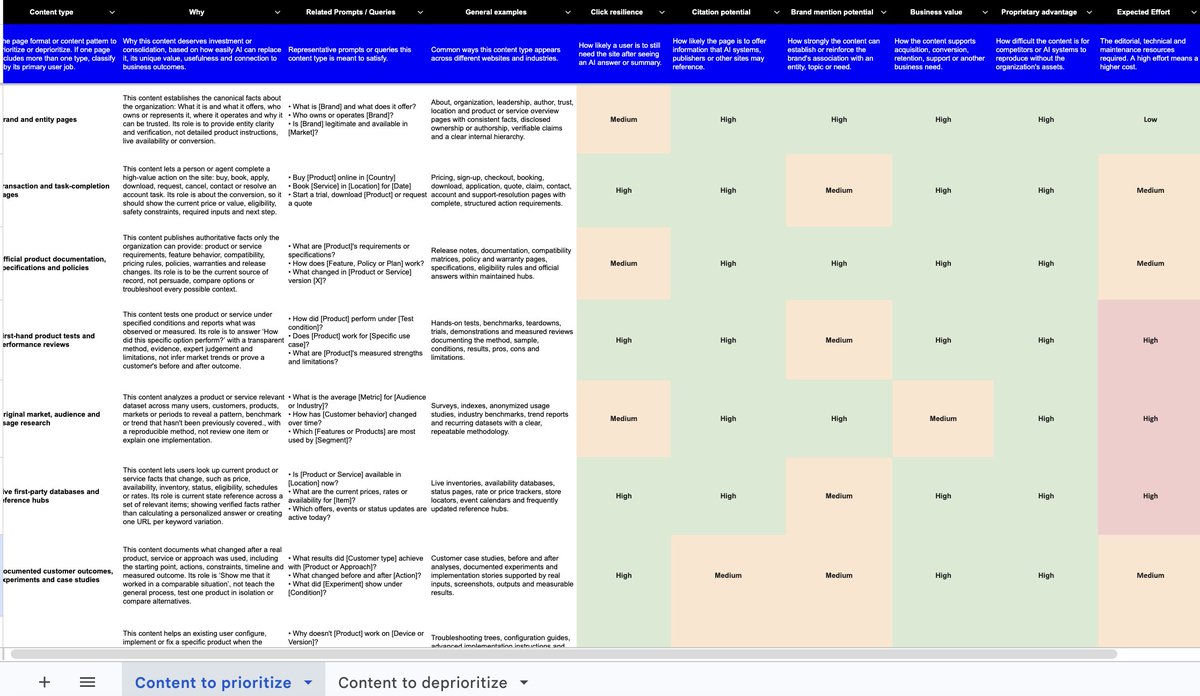
Content Prioritization in an AI Search Era: A Framework + Worksheet 👇 What type of content is still worth creating when AI platforms can answer queries without sending a click?
To translate this into something actionable that I can share with clients, I’ve created a content prioritization framework in an AI search era, taking into account the reason a user would still visit the content, its proprietary value, and connection to business outcomes.
The framework uses six directional dimensions that can be used to assess investment options, then reprioritize them with your site’s actual users, priority prompts, performance and business model.
Recommended content to prioritize:
1. Brand and entity pages
2. Transaction and task-completion pages
3. Official product documentation, specifications and policies
4. First-hand product tests and performance reviews
5. Original market, audience and usage research
6. Live first-party databases and reference hubs
7. Documented customer outcomes, experiments and case studies
8. Product specific implementation and troubleshooting guides
9. Evidence led comparisons and selection guides
10. Personalized tools using live or proprietary data
11. Curated community and practitioner knowledge
12. Original reporting and source analysis
13. Scalable pages featuring genuine, useful insights powered by unique first-party data
Recommended content to deprioritize:
1. Standalone commodity definitions without brand or journey context
2. Rehashed explainers and how to guides without original value
3. Fragmented FAQ and keyword variant pages serving one intent
4. Third-party news and press release rewrites without original input
5. High volume tangential topics without a credible business journey
6. Biased or mass produced ‘best’, comparison and alternatives pages
7. Generic calculators, quizzes and generators without distinctive inputs
8. Programmatic pages built from public or competitor data
As you can see, many times the problem isn’t necessarily with the format itself, but how it's executed and whether it provides an actual reason to be visited, cited or associated with the brand.
Read more and get access to the framework along with the worksheet: https://t.co/wT3H1BqTZv