AI Engineer. One-person team: me plus AI agents covering every engineering role | Built the AI marketing & leasing system behind 14 communities & 4,000+ units
Nobody was laid off when we handed marketing and leasing to AI at our Texas communities. The on-site roles got lighter, not smaller.
At each community the property manager and the leasing assistant did both jobs themselves — listings and ads on one side, Facebook, the phone and the inbox on the other. Neither is what they were hired to do, and more than half the leads were lost.
Now the thinking happens for them. A board stays open on their screens all day: which guests are coming in, who to call next, what to say when the call connects. What used to take their judgment is now an instruction they carry out.
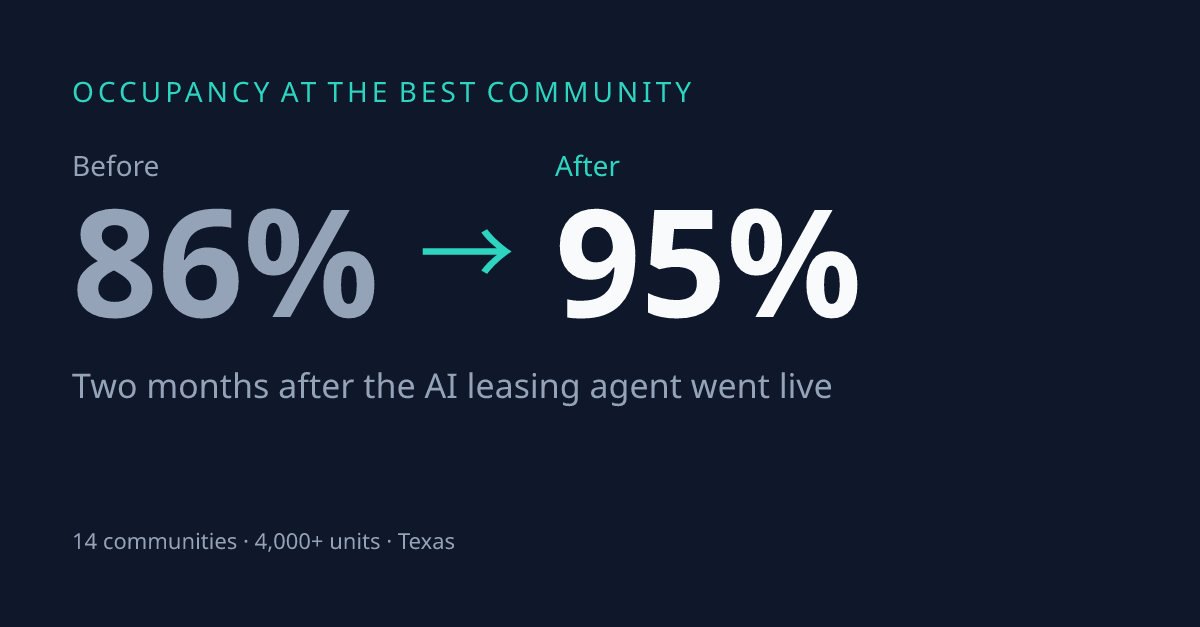
Across 14 communities and 4,000+ units, leads and signed leases are up 40-70% on average versus before launch. At our best community, tours in the first two months rose 186%, and that lift took the property from 86% to 95% occupancy in those same two months. The tours are the cause; the occupancy move is what followed.
The line I hold is: AI thinks, people act. It recalls and tracks more than any of us can. It can't offer warmth. So judging, sorting and scripting go to the AI; meeting the guest, answering the phone, hosting the visit stay with a person.
Neither role was removed. Nobody was cut, no retraining, and hiring is easier now that the job doesn't ask for ad buying or copywriting. Managers are back with residents and on the property itself.
I would like to hear how other operators split this — what do you insist stays with a person?
Palantir invented the forward deployed engineer role around 2010. This year OpenAI, Anthropic and Google are all hiring for it — one market scan counted 224 open FDE roles across 39 AI companies.
The version of that job I keep thinking about isn't the one where you fly in.
I work for a Texas property manager. We didn't buy a third-party AI product or build a technology team. I'm the only engineer; I built our AI marketing and leasing system alone. It runs across 14 communities and 4,000+ units.
An outside FDE is placed inside a client for a few months, then leaves. I've stayed in the same business. The problem is mine, and so is the cost when I get it wrong.
That changes what gets built. A leasing manager used to hand-enter every guest and every event into the PMS. Now the AI takes a lead from first touch to signed lease and writes those records back on its own. I don't think anyone sitting outside the business would have known that was worth fixing.
It also leaves me with a question I can't answer: is this a repeatable pattern, or just the shape of one company? I've only seen it from inside this one.
Twenty years of enterprise software, much of it client-side, is roughly the mix the role asks for.
So, operators: do you buy the AI product, or build it? Has anyone else ended up as the one engineer inside?
I'll be at Blueprint Vegas this year, on two roundtables: one on AI and leasing, including coaching and renewals, the other on how marketing, operations and technology fit together.
Most leasing AI conversations I end up in start from which product to buy. I've only ever stood on the other side of that decision: building it in-house, alone, inside one Texas property manager.
I'm the one-person engineering team behind an AI marketing and leasing system now running on 14 communities and 4,000+ units. Leads and signed leases are up 40-70% on average. At my strongest community the lift reached 186% — completed on-site tours over those first two months — and that is what carried it from 86% to 95% occupancy in two months. That 186% is the number I trust least: it's an A-class property, and I don't know how much of it travels to B and C class.
So the question I'm carrying into the room: how many management companies are actually building their own AI? When an operator weighs buying against building, what decides it — cost, control, data, staffing?
I have one company's worth of evidence and no clean answer.
If you've built in-house, or sat through the evaluations and picked a product, find me at the conference. I'll be the one asking.
https://t.co/7qJhDESxd0
I'm going to YASC San Diego, Oct 7–9, with a question, not a pitch.
I built the AI marketing and leasing system at one Texas property manager. Fourteen communities, about 4,000 units. Compared to the same periods before launch, leads and signed leases are up 40–70%, and one A-class community went from 86% to 95% occupancy in two months. That didn't happen because of the software alone. The on-site teams were the other half.
The part I keep returning to is generalization. The A-class property performed better than the B and C properties, and I suspect its residents are the reason. I don't have a second A-class property to test that, so it stays a guess. One company, one state, one set of teams. That is a narrow window to draw conclusions from.
Yardi operates at a scale I can't see from here. I want to ask their engineers how they think about AI when it has to work across thousands of operating teams, markets, and staffing models. I also want to hear from other property managers: what AI leasing tools did you try, and what did not work?
I'd rather have my assumptions corrected than confirmed. If you're at YASC, find me. I'll be the one asking questions.
The Economist says the jobs apocalypse is postponed. In multifamily it never arrived. What AI replaced was bad job design, not people.
My AI marketing and leasing system runs on 4,000+ apartment units in Texas. Before it, marketing and lead follow-up were bolted onto already-full jobs. Managers wrote listings; assistants watched Facebook and the phone. No training. No time. More than half the leads vanished.
The AI took over both. No one was laid off. Managers and assistants went back to resident service and property quality. Leads and signed leases are up 40–70% versus the same period before. One community went from 86% to 95% occupancy in two months.
The company didn't retrain anyone, and hiring got easier. What got replaced was not people. It was asking untrained employees to do specialist work part-time. In multifamily, AI hasn't replaced people. It replaced work that was never done well.
https://t.co/h4pAKK6rhh
Most leasing AI does sales: answer leads, book tours, follow up. Almost none does marketing: bringing traffic in. Ours does both. Best property: on-site tours +180%, occupancy 86% to 95% in two months. Marketing creates the lift; sales just counts it.
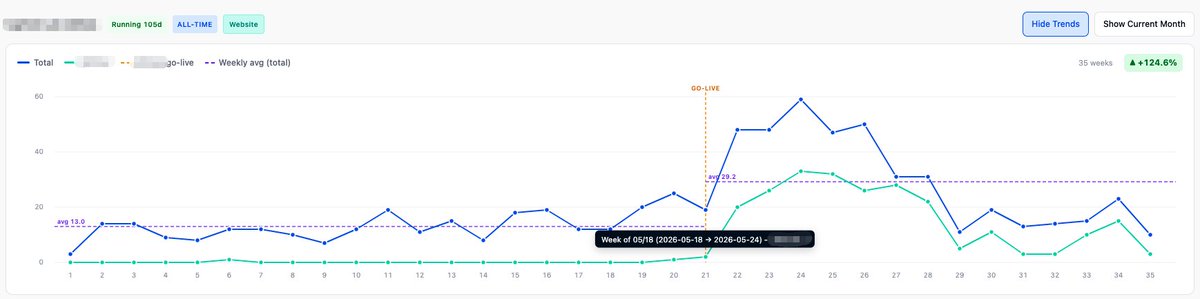
Best property: weekly tours 13.0→29.2 (+124.6% over 14 weeks). 86%→95% occupancy. It's the only Class A we run — Google Ads only there. B/C units get Facebook, not the same result. No second Class A to test against. Want to change that.
@ParksAssociates Will there be sessions on AI that handles the entire leasing cycle, from lead to signed lease? Real-world data: 40-70% lifts in leads and leases across 14 Texas communities.
86% to 95% occupancy in two months at one apartment community, completed tours up 180%. The AI marketing and leasing system behind it runs on 4,000+ units, built by one engineer plus AI agents since March 2026. Four changes did it. Details on LinkedIn.