Research Associate position available at the University of Edinburgh Quantum Software Lab to work on a joint project on orchestration of heterogeneous quantum computers with Fujitsu. Apply here: https://t.co/U1Bk5OtVSJ
A sound and complete finite system of equations to manipulate Toffoli+Hadamard quantum circuits you say, so you can automate circuit optimisation, you say? Why of course, here you go: https://t.co/cZSdfG6cOs, with Wang Fang and @Manchegobaby.
🚨 New preprint alert 🚨
Always wanted to know the connection between analytic limits and categorical limits? Tired of establishing directed colimits of contractions when directed colimits of isometries suffice? You're in luck!
See https://t.co/vUY9KGw2N2. With Matt Di Meglio.
Excited to announce the EPSRC Centre for Doctoral Training in Quantum Informatics! Run by Edinburgh, Oxford, UCL, Strathclyde, and Heriot-Watt; 16 fully funded PhD studentships for 2025 start. Deadline 15 Jan.
Pass it on, and get in touch if you have Qs. https://t.co/KSy0UcSwcw
Excited to announce the EPSRC Centre for Doctoral Training in Quantum Informatics! Run by Edinburgh, Oxford, UCL, Strathclyde, and Heriot-Watt; 16 fully funded PhD studentships for 2025 start. Deadline 15 Jan.
Pass it on, and get in touch if you have Qs. https://t.co/KSy0UcSwcw
Interested in a fully-funded PhD in Quantum Informatics, and wondering what the programme is like? Join us for a Postgraduate Virtual Open Day on Tuesday 12 November, 14:00-15:00 (GMT)! https://t.co/pFZiq3YXnE
The Centre for Doctoral Training in Quantum Informatics is hiring a Centre Manager. If this exciting post is for you or someone you know, look here! https://t.co/Ver6VjrG4m
New research alert! About causality. In relativity this usually means that there is a path from one point in spacetime to another. Can you phrase this without points, in terms of regions? Yes you can! Read all about it at https://t.co/qIRga3zPSO, with @nestamatician.
Now you can study causality even if you're not sure the ultimate fabric of spacetime is continuous in the sense of having points (and there are valid reasons to think that). Or in other settings! We're hoping to study causality in concurrent computation.
At least seven fully funded PhD positions are available at the University of Edinburgh in Quantum Computing!
More information: https://t.co/bosrhycAzQ
Deadline: 31 March 2024
For a look behind the scenes, have a look at this wonderful making-of post Matt wrote.
https://t.co/LGsTauKs9N It captures nicely what it's like to do math in a way you don't often see in the finished product.
The saga continues! Axioms for the category of finite-dimensional Hilbert spaces and linear contractions, with Matt Di Meglio, now on https://t.co/vpKRTE541f.
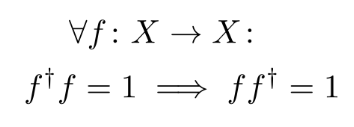
This paper circumvents Soler's theorem beautifully. It directly links limits (well, suprema) of positive real numbers to limits in a category. Finite dimension is then modelled as follows:
The main problem is that a cornerstone to building up complex numbers from categorical axioms is Soler's theorem. But that relies on the existence of an infinite-dimensional space, so cannot be used here!
I really like this paper, with @jjcarett2 , @Manchegobaby, and Amr Sabry: "With a few square roots, Quantum Computing is as easy as Pi", https://t.co/wzE97Jno3t, to appear at POPL24.
Finally, the interpretation of the map V is a square root of NOT is fascinating. In some sense, these results say that quantum computing is nothing but classical computing, except that you're allowed to stop (some) operations halfway.
It is also sound and complete for various gate sets: two programs in this language are equal if and only if their interpretations as matrices are equal. Thus you can reason about quantum programs using equations only, which can be automated!