Anthropic reached a $1.5 billion settlement in a copyright case brought by a group of authors who accused it of misusing their books to train its Claude AI model, the largest known settlement of its kind https://t.co/LgIIIb8lSI
Introducing a limited preview of GPT-5.6 Sol, our next generation frontier model, as well as GPT-5.6 Terra, a balanced model for efficient, everyday work, and GPT-5.6 Luna, a fast and affordable model for high-volume work.
https://t.co/OoM83SyISN
If you're a king, queen, president, prime minister, emir, sultan, or any leader of a country, make the development of innovative LLM infrastructure, AI algorithms, and supporting hardware TAX-FREE for at least the next decade. Not for companies that simply use AI, but for those building better AI models and the infrastructure behind them. Provide incentives to bring back expat talent.
If you do, your country might have a chance to survive what’s coming.
Our Anthropic bill is about to jump from $400K → $1.4M/yr.
Not because usage exploded, but because we're about to cross 150 seats.
Past 150 seats you're forced into Enterprise tier. Seats stop including any usage, every token bills at standard API rates. At our current run rate that's 3.5x overnight.
Unfiltered thoughts on AI spend:
1. We should spend tokens to grow as aggressively as possible. But most people (me included) aren't conscious of what they're spending.
2. Visibility comes first. People see their personal number and they're shocked. I accidentally spent $4,000 in 3 days in Claude Code.
3. For engineering the spend is clearly worth it. Pay for the best model, it saves more than it costs.
4. For a lot of other roles it's questionable. Apps nobody uses, skills someone already built. No ROI.
5. Spend limits are coming. We already require approval for more tokens on our support team.
The era of token-maxxing is coming to an end.
The recent discussion around Anthropic's Opus models highlights a mistake I still see enterprises making:
Building their AI strategy around a single LLM.
A year ago the question was:
"Which model is the smartest?"
Today, as companies start paying real AI bills, the better question is:
"Which model is good enough for this use case?"
The smartest model isn't always the best choice.
Sometimes a smaller, cheaper, or open-source model delivers 95% of the value at a fraction of the cost and latency.
That's why I'm increasingly convinced that LLM-agnostic architectures will win.
The AI market is moving too fast to become dependent on any single provider.
The companies that succeed won't be the ones that picked the right model.
They'll be the ones that can switch to the right model when the market changes.
Are you optimizing for the smartest model or the right model?
Another example on why companies adopting AI on the enterprise, should not put all eggs in one LLM provider. Having a third party platform that's truly LLM agnostic is the way to go.
Anthropic's Opus 4.7 and 4.8 models are experiencing degraded performance, which is causing a higher rate of failures for users selecting these models in Notion AI.
To mitigate impact, all Anthropic models have been disabled in the model picker and requests have been rerouted to alternative providers. Most users should now be able to continue using Notion AI with minimal disruption, though Anthropic-specific features remain unavailable.
Please refer to https://t.co/2jxfCbG6UZ for the details.
@deedydas Can you please elaborate on what's the best case where this is actually true? We are implementing too the three things mentioned above at Gaspar AI, however imo, our defensibility derives from distribution access, building agents that actually work and lastly customer obsession.
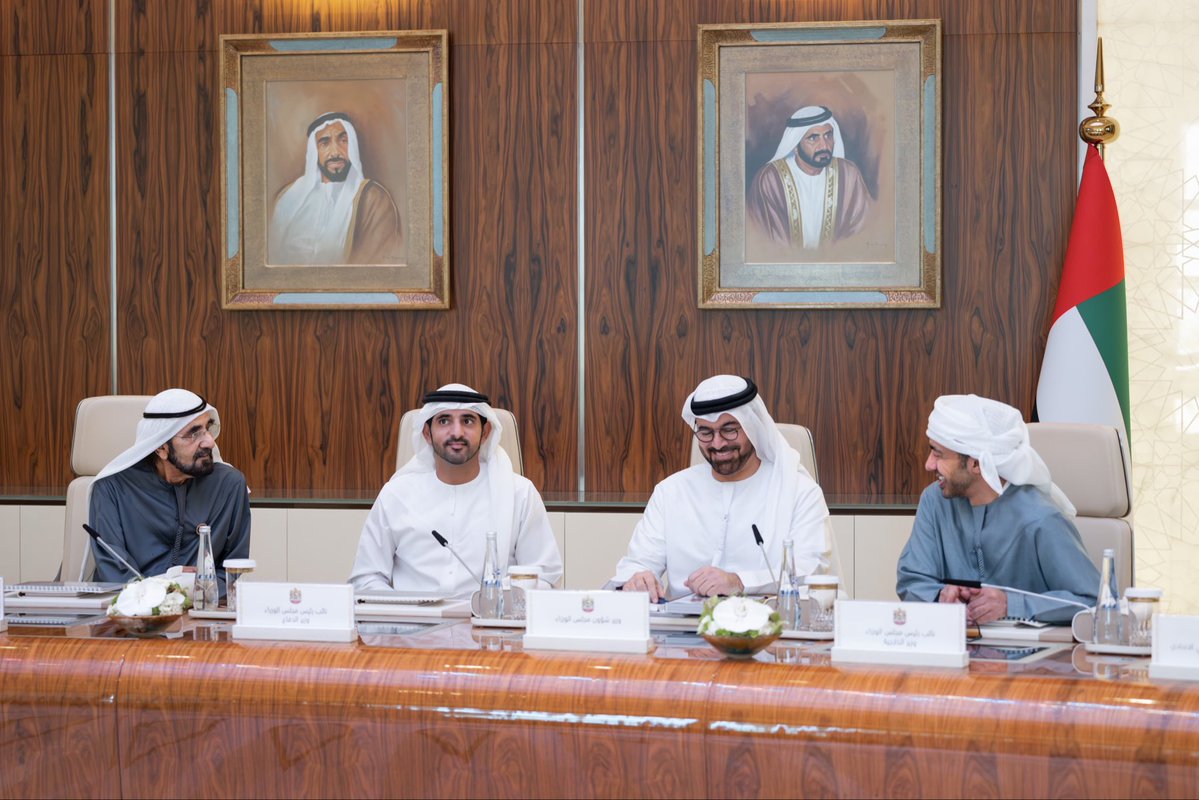
Under the directives of the President of the UAE, we launch a new government model. Within two years, 50% of government sectors, services, and operations will run on Agentic AI, making the UAE the first government globally to operate at this scale through autonomous systems.
AI is no longer a tool. It analyses, decides, executes, and improves in real time. It will become our executive partner to enhance services, accelerate decisions, and raise efficiency.
This transformation has a clear timeline. Two years. Performance across government will be measured by speed of adoption, quality of implementation, and mastery of AI in redesigning government work.
We are investing in our people. Every federal employee will be trained to master AI, building one of the world’s strongest capabilities in AI-driven government.
Implementation will be overseen by Sheikh Mansour bin Zayed, with a dedicated taskforce chaired by Mohammad Al Gergawi driving execution.
The world is changing. Technology is accelerating. Our principle remains constant. People come first. Our goal is a government that is faster, more responsive, and more impactful.
Happy to share that in our latest customer engagement, Gaspar's agent reached 98% level of accuracy based on the customer queries. This is how we differentiate from other similar tools.
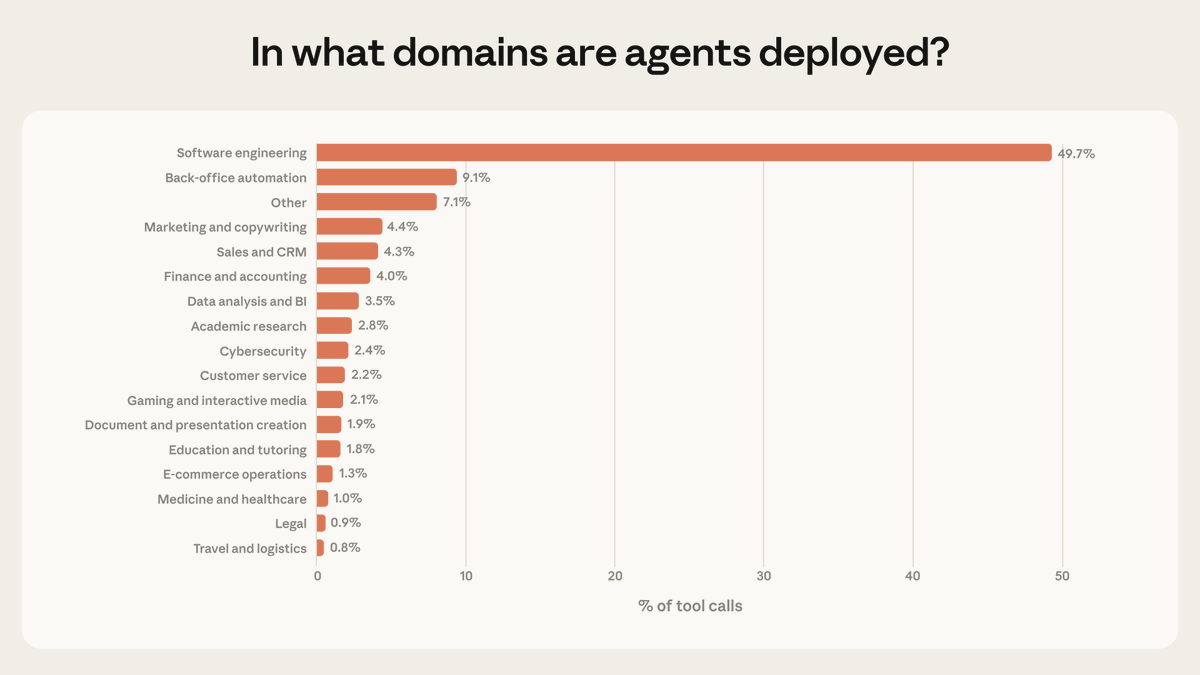
Software engineering makes up ~50% of agentic tool calls on our API, but we see emerging use in other industries.
As the frontier of risk and autonomy expands, post-deployment monitoring becomes essential. We encourage other model developers to extend this research.