What is the GRID Data Platform, and what does it do?
I thought I'd start my 'miniblog' series off with some of the fundamentals.
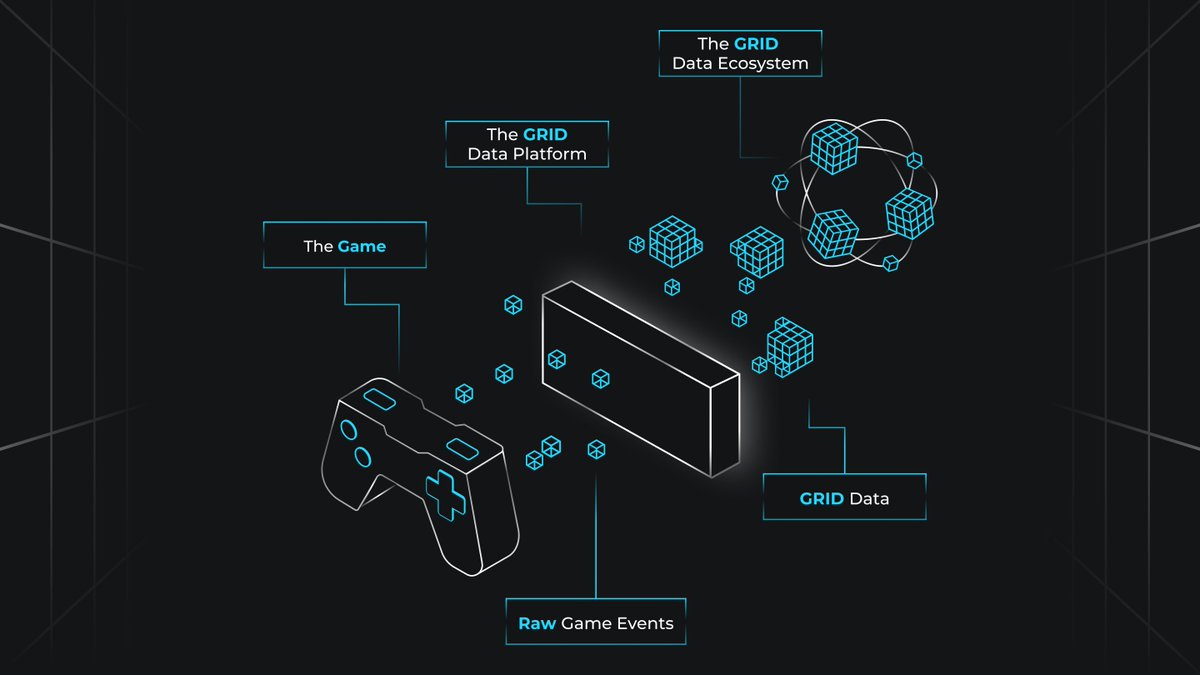
@GRIDesports builds and operates the GRID Data Platform, technology designed to collect, enrich and distribute data from games. The overarching goal being to empower a sustainable, data-centric ecosystem.
Let’s dive into a bit more detail about each of these steps in the pipeline.
1. Data Collection 🧲
Enter, GRID Game SDK. This software is provided to game developers, allowing them to extract data (in real-time) about what is happening in the game, down to the most granular details. These details are then transmitted in small chunks, reducing the infrastructure load and easing integration efforts.
2. Data Enrichment 🏦
As the data arrives at the platform, the first thing necessary is to aggregate all of the small details, building up one comprehensive, usable state. Once this is done, further enrichment occurs, which includes calculating derivative data points, generating deeper statistics and insights, and running the data through models to generate predictions.
3. Data Distribution 📨
What use would this all be if no one could use it? So finally, the GRID Data Platform has a suite of APIs (the GRID Data Feeds) that enable people to consume the different types of enriched data produced (live data, statistics, predictions, etc.), so that they can build their products on top of it. Additionally, the GRID Data Portal framework makes rich UIs available on top of the data, making it accessible for a variety of use cases.
That's what the GRID Data Platform does, in a nutshell.
There’s a lot of fun challenges involved in the details of scaling and operating such a platform. These will be some tales for another day!
#esports #gaming #data #platform #engineering
As @IEM Rio gets underway, a throwback to Kraków!
It was incredibly humbling to see the GRID logo on one of the biggest stadiums in a sport I have loved since I was 13 💙🧡 (keep watching until the end!)
Thank you to everyone who helped make this happen, and to @CounterStrike for being awesome :-)
I've been talking about the importance of official data accessibility in esports for many years now.
In the age extremely cheap automation, this is simpler and doesn't just apply to esports:
Accessibility of official data is key.
100% great advice.
For a while I wanted to start a coding bootcamp that purely taught and progressed students by contributions to open source projects.
It would be much more effective at training developers rapidly than the "build a terminal noughts and crosses in Java" projects.
People also ask me all the time what to do. I think it was around 2014/2015 when I told them, get good at contributing to big open source projects. This can be Kubernetes, Vitess, a Programming Language, you pick it up.
Working on these projects teach you a lot of things. Not just coding, but also how to talk and navigate human issues. How to deliver code, how TO not break existing stuff and so on.
With Agents and LLM tools, I think it became even more important if you want to be a step ahead of everyone + also have experience. It actually reminds me of a medieval guild. You join as an apprentice, do the hard work, learn the tools, make mistakes (under guidance), and slowly earn trust of other people through your contributions.
I still don't understand how people just totally skip contributing and growing with OSS projects. There are many ways, but this one is solid, and free as well. All it takes is your hard work.
@fatih Absolutely true. Gets you (sometimes better than) real-world professional job experience. Plus, there's endless fun and interesting projects to work on!
I've rarely interviewed a poor candidate that came from an OSS background.
@geoffreylitt Soon enough (and already the case for some tasks) "I did it" will just be assumed that it was with AI assistance.
Might be more necessary to have a shorthand way of letting people know you did it the old fashioned way!
@deedydas I do think we’ll be at a point soon where it truly is indistinguishable in most cases - so it’s key that there’s a widespread sense that the human message matters. This will help us stay on the right track.
@deedydas An important topic. Thanks for writing about it.
We need solutions (technical and non-technical) in place to identify AI generated content, but we also need to keep highlighting why this is important.
Easy for AI momentum overwhelm the discussion until it’s too late.
@EcZachly Robust, dependable and trustworthy data pipelines are a prerequisite to efficient adoption of AI (or indeed any automation that delivers tangible value for an org).
In a time where accessibility of automation is exploding, greater need for data engineers makes sense.
@lexfridman I’d love a deep dive into data acquisition: sources and challenges for both pre-training and RAG, the current landscape, and emerging sustainable business models for high-quality data. Looking forward to listening!
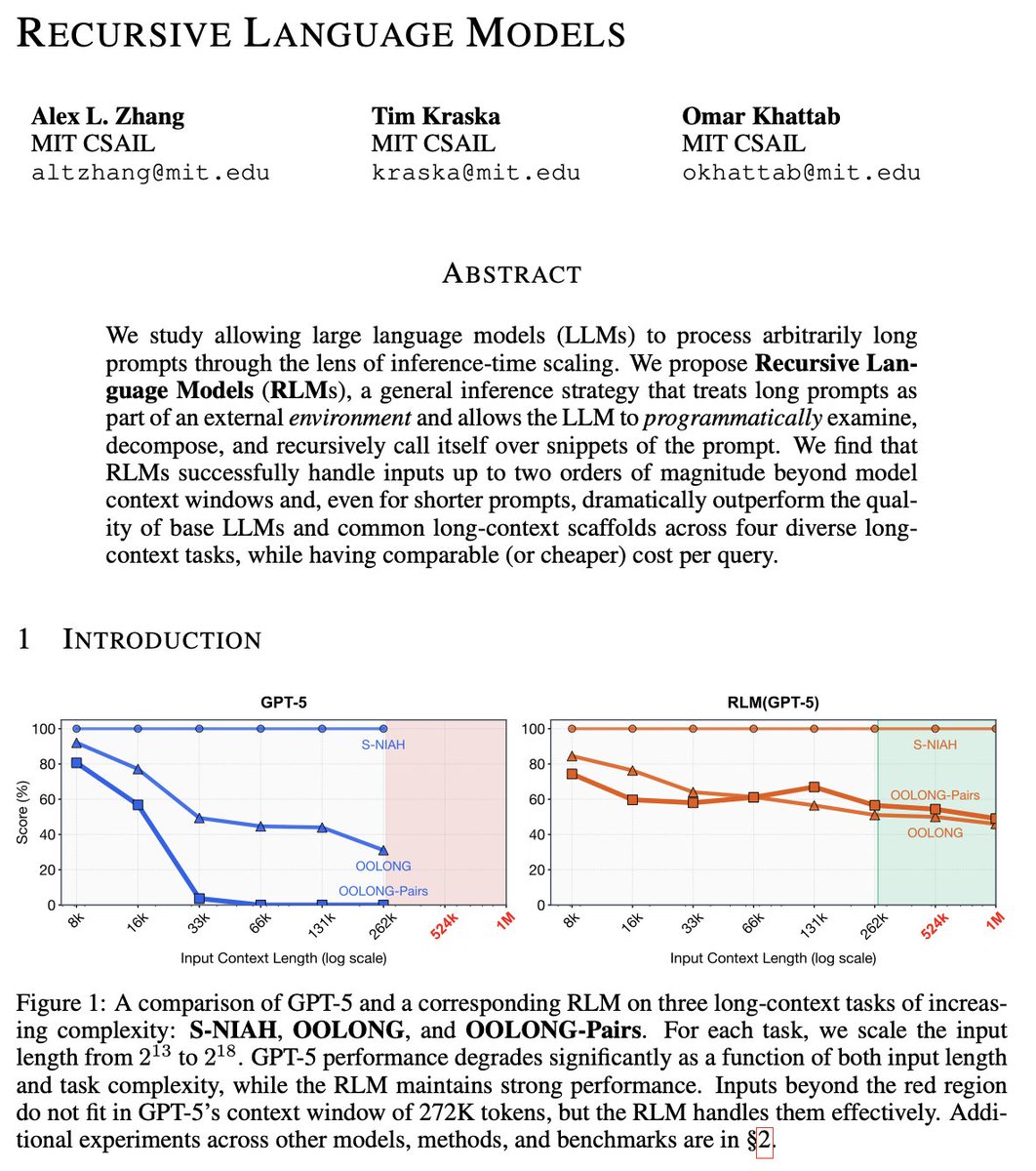
Much like the switch in 2025 from language models to reasoning models, we think 2026 will be all about the switch to Recursive Language Models (RLMs).
It turns out that models can be far more powerful if you allow them to treat *their own prompts* as an object in an external environment, which they understand and manipulate by writing code that invokes LLMs!
Our full paper on RLMs is now available—with much more expansive experiments compared to our initial blogpost from October 2025!
https://t.co/x47pIfIkTb
@rakyll I’ve been thinking about this too and agree. As you mentioned elsewhere - code won’t be the moat that results in software sales of the future, data will be.
@mitchellh@RogerAlsing Great example. Using AI while still thinking critically about the issue being solved, and the best way to deploy the AI in doing so (which included giving visibility to you on how it was used).
This is the way!
@GergelyOrosz I struggle to understand anyone assuming anything about the use of AI that applies to them (especially in their profession).
Those not starting to use it to validate such assumptions (and having a strategy to re-validate them, given the pace of progress) will get left behind.
A very Happy New Year to all 🎇
As the first day of 2026 comes to a close, I've had some nice time reflecting on some key moments of 2025.
A few of my personal highlights:
✅ Successful GRID product launches that set the direction for the coming year: GRID Play and GRID Bet.
🎙️ Speaking on a panel ("You had me at in-game data" :-)) at GRID's own Gamescom side-event.
💡 The Product Engineering full-team meet up with plenty in-depth discussion on the most key technical challenges, and how we're going to solve them.
Looking forward - 2026 is a year I'm really excited for.
Not only are there are many more GRID milestones in the works (#staytuned 📻), but it's also just exceptionally exciting to be working in technology at such a transformative and impactful time in history.
Thank you to everyone who made 2025 what it was, let's make 2026 just as great 🫶
The software industry's AI transformation is fascinating.
There's still plenty for engineers to do (and plenty that can go wrong if they don't do it), but the empowerment these tools offer when used well is mesmerising.
What is extremely interesting is the development of techniques and best-practices that work at scale in order to channel this investment into sustained high value output. Lots to do here, but the reward is huge!