gm
I built genlayer arena a live multiplayer quiz and gaming platform powered by @GenLayer intelligent contracts.
here’s what i’ve shipped so far
now live on https://t.co/LTp3XgL7YH
majorly 3 interactive games are implemented
real time multiplayer duels ·
live player chat ·
on-chain score tracking
live social features available includes:
arena duels — real-time quiz battles with public matchmaking and private rooms
live messaging — private player-to-player chat with unread notifications
spectator mode — watch active matches live and share spectator links with others
the games currently live includes:
genlayer quiz — 20 questions across 3 difficulty levels with multiplayer duels
gen word search — find genlayer-related terms inside a 14×14 puzzle grid
gen puzzle — a sliding tile puzzle featuring the genlayer mascot
every game result is sent directly to the contract. duel scores are tracked on-chain in real time, and with just one env switch, the platform moves from stub mode to fully live on-chain execution.
overrated: announcement threads.
underrated: consistent shipping.
for a long time, i judged projects by how good their announcements looked.
clean graphics, big promises, long roadmaps, and everyone in the replies saying “this is huge.”
i’ve learned that none of that means much if the team isn’t actually building.
the loud part gets all the attention because it’s easy to share.
everyone sees the announcement. everyone gets excited.
the quiet part is what most people ignore.
regular updates. product improvements. bug fixes. small releases that don’t make headlines but keep pushing the project forward.
that’s what changed for me.
i stopped asking, “who has the best marketing?” and started asking, “who keeps shipping even when nobody is watching?”
that’s one of the reasons i paid attention to @rallyonchain.
beyond the announcements, i kept seeing progress. features rolled out, improvements made, and a team that looked focused on building instead of chasing hype.
if a friend asked me what to look for before believing in any project, i’d tell them this:
don’t get distracted by the loudest announcement.
pay attention to the teams that keep showing up and shipping.
over time, that’s what separates projects that last from projects that disappear.
overrated: announcement threads.
underrated: consistent shipping.
for a long time, i judged projects by how good their announcements looked.
clean graphics, big promises, long roadmaps, and everyone in the replies saying “this is huge.”
i’ve learned that none of that means much if the team isn’t actually building.
the loud part gets all the attention because it’s easy to share.
everyone sees the announcement. everyone gets excited.
the quiet part is what most people ignore.
regular updates. product improvements. bug fixes. small releases that don’t make headlines but keep pushing the project forward.
that’s what changed for me.
i stopped asking, “who has the best marketing?” and started asking, “who keeps shipping even when nobody is watching?”
that’s one of the reasons i paid attention to @rallyonchain.
beyond the announcements, i kept seeing progress. features rolled out, improvements made, and a team that looked focused on building instead of chasing hype.
if a friend asked me what to look for before believing in any project, i’d tell them this:
don’t get distracted by the loudest announcement.
pay attention to the teams that keep showing up and shipping.
over time, that’s what separates projects that last from projects that disappear.
underrated: deleting before adding.
most people think improving their content, work, or ideas means adding more. more words, more features, more complexity.
i used to think the same way.
i kept trying to make my posts better by adding stronger hooks, more context, and more clever lines.
but sometimes the biggest improvement was simply removing the parts that didn’t need to be there.
the reason this is underrated is because adding feels like progress. deleting feels like losing something you worked on.
but the things we remove are often the parts that make the final result weaker.
i started paying more attention to what i could cut instead of what i could add. shorter posts became clearer.
simpler ideas became easier for people to connect with.
even when creating content for @rallyonchain, i noticed the posts that felt the most natural weren’t the ones with the most information.
they were the ones where every sentence had a reason to exist.
if i had to explain this to a friend who ignores my advice, i would say
you don’t always need to create something bigger.
sometimes you just need to remove what is hiding the best part.
the best version of your work is often already there. you just have to get rid of what doesn’t belong.
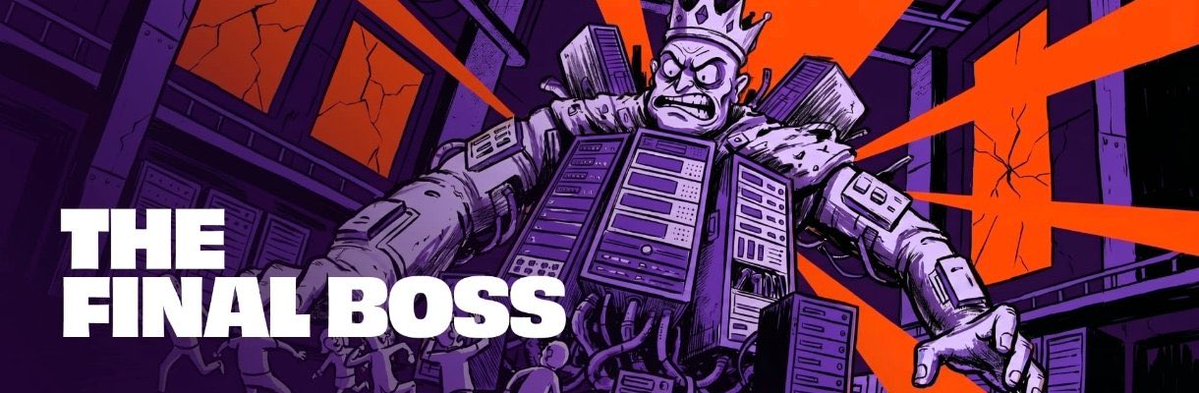
Every final boss has a challenger rising through the ranks.
If Solana is the final boss, my pick for the challenger closing the gap is Ethereum.
The reason is simple, Ethereum is fighting back through its strongest advantage, trust.
Solana has dominated the conversation around speed, low fees, and consumer adoption, but Ethereum is attacking from a different angle.
It has the deepest liquidity, the largest developer ecosystem, years of battle tested security, and a network effect that is extremely difficult to replicate.
The shift I see happening is Ethereum becoming more scalable through Layer 2s while keeping the security and decentralization that made it the foundation of crypto.
Solana may have the momentum with fast growing users and a strong community, but Ethereum has something that takes years to build: confidence.
For Ethereum to take back the spotlight, it needs to keep improving user experience, reduce complexity, and prove that its ecosystem can compete with the speed and simplicity users are demanding.
The battle between these two isn’t just about technology.
It’s about which vision of crypto wins the next generation.
@RallyOnChain
my pick for the final boss of crypto is solana.
not because it’s the biggest.
because i think it’s become one of the hardest ecosystems to replace.
i tried thinking about what it would actually take for another chain to completely take solana’s place.
faster transactions? there are chains that can compete.
lower fees? that’s no longer a unique advantage either.
but then you realize that’s only part of the story.
you also need a massive developer community that’s constantly shipping.
you need deep liquidity, strong user activity, and an ecosystem people actually enjoy using every day.
you need builders, institutions, and users who believe the chain will still be relevant years from now.
that’s when it clicked for me.
solana isn’t just competing on speed anymore. it’s competing on everything that’s been built around it over the years.
technology can be copied.
communities, liquidity, and trust take much longer to build.
that’s why i’d give solana the final boss title.
who’s your pick?
if it isn’t solana, tell me your final boss and give two reasons why replacing it would be much harder than people think.
@RallyOnChain
Today we are one step closer to @GenLayer Mainnet.
We are doing an internal test run for Epoch 0 to rehearse for the Clarke launch. All Labs + Foundation together in this exercise! ❤️🚀
We will sunset Asimov shortly, and will move onto Bradbury Phase 2, reseting the testnet. Clarke follows.
Congratulations to @FUDmarkets on adding Robinhood chain support, and opening the market $CASHCAT was missing.
Of course, that speed comes from GenLayer, where AI-powered consensus resolves markets 😆
More details below 👇
📅 GenSync — Wednesday, July 8th
AI & Blockchain Quiz
🕐 13:00 UTC
👉 https://t.co/aI9p16auWG
🧩 GenPuzzles with @spacejunnk
🕐 15:00 UTC
🌍 GeoGuessr with @Andrew62905879
🕓 16:00 UTC
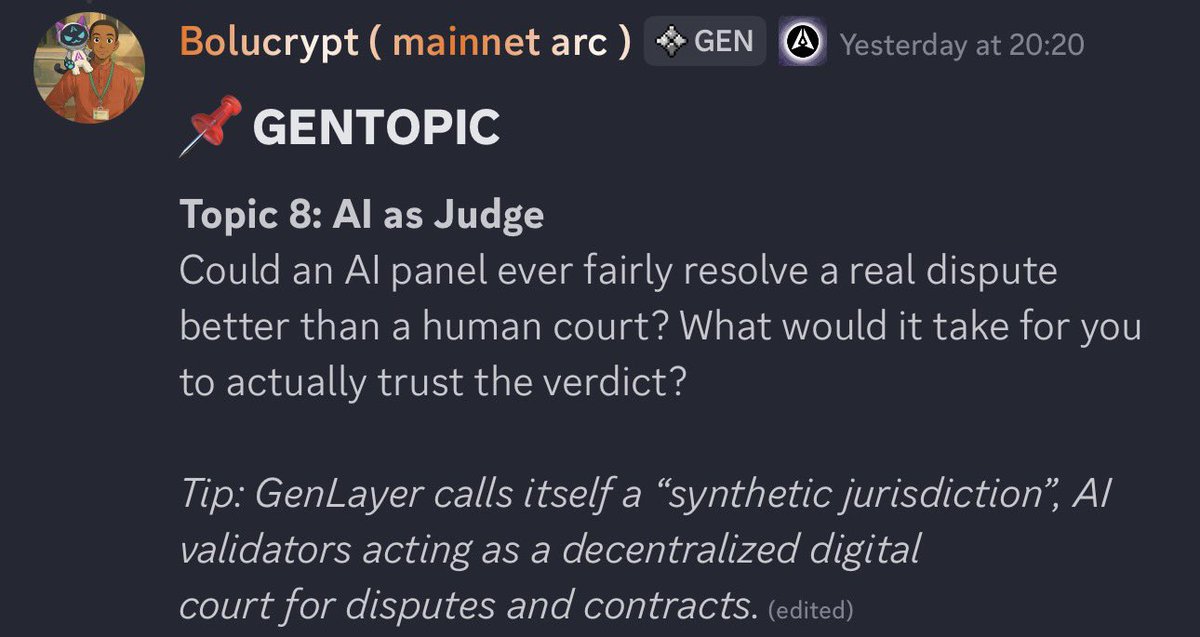
📍 GenTopic of the Day
👉 https://t.co/KRHEXihROF
🗣️ GenDebate
👉 https://t.co/NviStKYH5p