The Thunder this decade:
2020-21 — Missed Playoffs
2021-22 — Missed Playoffs
2022-23 — Lost in Play-In
2023-24 — Lost in Western Conference Semifinals
2024-25 — Won NBA Finals
2025-26 — Lost in Western Conference Finals
2026-27: ???
Lou Williams says Shai Gilgeous‑Alexander showed every trait you want in a “young star” during his rookie season with the Clippers.
“In our game you want your young star to be coachable, a worker, one of the guys, the toughest, smartest, SGA was all of those things. When that trade happened for Paul George, I swear to god.. when he called me, the first thing I asked him was ‘was Shai in the trade?’ That was the first thing I asked him. Because that’s how much I believed in him as a rookie. He was one of the first rookies that I was on a team with that I was like ‘hey that boy there is a star.’ He is a star and it wasn’t even about the talent, it was just his approach. And now you see how intentional he is, how he approaches the game.”
(Via @undergrndlounge) | #ThunderUp
Because we get asked a lot.
The Technological Republic, in brief.
1. Silicon Valley owes a moral debt to the country that made its rise possible. The engineering elite of Silicon Valley has an affirmative obligation to participate in the defense of the nation.
2. We must rebel against the tyranny of the apps. Is the iPhone our greatest creative if not crowning achievement as a civilization? The object has changed our lives, but it may also now be limiting and constraining our sense of the possible.
3. Free email is not enough. The decadence of a culture or civilization, and indeed its ruling class, will be forgiven only if that culture is capable of delivering economic growth and security for the public.
4. The limits of soft power, of soaring rhetoric alone, have been exposed. The ability of free and democratic societies to prevail requires something more than moral appeal. It requires hard power, and hard power in this century will be built on software.
5. The question is not whether A.I. weapons will be built; it is who will build them and for what purpose. Our adversaries will not pause to indulge in theatrical debates about the merits of developing technologies with critical military and national security applications. They will proceed.
6. National service should be a universal duty. We should, as a society, seriously consider moving away from an all-volunteer force and only fight the next war if everyone shares in the risk and the cost.
7. If a U.S. Marine asks for a better rifle, we should build it; and the same goes for software. We should as a country be capable of continuing a debate about the appropriateness of military action abroad while remaining unflinching in our commitment to those we have asked to step into harm’s way.
8. Public servants need not be our priests. Any business that compensated its employees in the way that the federal government compensates public servants would struggle to survive.
9. We should show far more grace towards those who have subjected themselves to public life. The eradication of any space for forgiveness—a jettisoning of any tolerance for the complexities and contradictions of the human psyche—may leave us with a cast of characters at the helm we will grow to regret.
10. The psychologization of modern politics is leading us astray. Those who look to the political arena to nourish their soul and sense of self, who rely too heavily on their internal life finding expression in people they may never meet, will be left disappointed.
11. Our society has grown too eager to hasten, and is often gleeful at, the demise of its enemies. The vanquishing of an opponent is a moment to pause, not rejoice.
12. The atomic age is ending. One age of deterrence, the atomic age, is ending, and a new era of deterrence built on A.I. is set to begin.
13. No other country in the history of the world has advanced progressive values more than this one. The United States is far from perfect. But it is easy to forget how much more opportunity exists in this country for those who are not hereditary elites than in any other nation on the planet.
14. American power has made possible an extraordinarily long peace. Too many have forgotten or perhaps take for granted that nearly a century of some version of peace has prevailed in the world without a great power military conflict. At least three generations — billions of people and their children and now grandchildren — have never known a world war.
15. The postwar neutering of Germany and Japan must be undone. The defanging of Germany was an overcorrection for which Europe is now paying a heavy price. A similar and highly theatrical commitment to Japanese pacifism will, if maintained, also threaten to shift the balance of power in Asia.
16. We should applaud those who attempt to build where the market has failed to act. The culture almost snickers at Musk’s interest in grand narrative, as if billionaires ought to simply stay in their lane of enriching themselves . . . . Any curiosity or genuine interest in the value of what he has created is essentially dismissed, or perhaps lurks from beneath a thinly veiled scorn.
17. Silicon Valley must play a role in addressing violent crime. Many politicians across the United States have essentially shrugged when it comes to violent crime, abandoning any serious efforts to address the problem or take on any risk with their constituencies or donors in coming up with solutions and experiments in what should be a desperate bid to save lives.
18. The ruthless exposure of the private lives of public figures drives far too much talent away from government service. The public arena—and the shallow and petty assaults against those who dare to do something other than enrich themselves—has become so unforgiving that the republic is left with a significant roster of ineffectual, empty vessels whose ambition one would forgive if there were any genuine belief structure lurking within.
19. The caution in public life that we unwittingly encourage is corrosive. Those who say nothing wrong often say nothing much at all.
20. The pervasive intolerance of religious belief in certain circles must be resisted. The elite’s intolerance of religious belief is perhaps one of the most telling signs that its political project constitutes a less open intellectual movement than many within it would claim.
21. Some cultures have produced vital advances; others remain dysfunctional and regressive. All cultures are now equal. Criticism and value judgments are forbidden. Yet this new dogma glosses over the fact that certain cultures and indeed subcultures . . . have produced wonders. Others have proven middling, and worse, regressive and harmful.
22. We must resist the shallow temptation of a vacant and hollow pluralism. We, in America and more broadly the West, have for the past half century resisted defining national cultures in the name of inclusivity. But inclusion into what?
Excerpts from the #1 New York Times Bestseller The Technological Republic: Hard Power, Soft Belief, and the Future of the West, by Alexander C. Karp & Nicholas W. Zamiska
https://t.co/8igjazz1On
To my Oklahoma family;
this piece comes straight from the heart.
I hope you’ll take a moment to read it and feel what I felt.
Thank you for allowing me to be a small part of it.
I came to @okcthunder to play basketball. I left carrying 168 lives.
When I was traded to the Oklahoma City Thunder, I was thinking about basketball, nothing more.
I didn’t know that before I ever stepped on the court, this place would show me something that would stay with me far longer than any game.
Like any player, my mind was on the game. A new team, a new city, a new opportunity. I expected the usual routine when I landed in Oklahoma City. Physicals, practices, meetings, and a jersey waiting in a locker.
But before any of that, Sam Presti pulled me aside and told me there was somewhere we needed to go.
He didn’t explain much, and I didn’t think to ask. I was focused on the next step in my career.
What I didn’t understand was that, before I could represent the place I was about to play for, I needed to understand it.
So instead of heading to the facility, he took me to the Oklahoma City National Memorial & Museum.
I walked in without knowing what I was about to see, and within minutes, everything slowed down.
There are 168 chairs at the memorial, each one representing a life lost on April 19, 1995. They are arranged in quiet rows, each engraved with a name, each standing where a person once stood in that building. Then you notice something that is impossible to process the first time you see it. Some of the chairs are smaller.
They belong to children.
There is no speech that prepares you for that, no headline that captures it. You simply stand there, and the silence carries a kind of weight that is hard to describe but impossible to ignore.
As you walk through the memorial, you pass between two gates marked 9:01 and 9:03. At first, they seem like simple numbers, but then you understand what they hold. One marks the last minute before the attack. The other marks the first minute after. And in between those two gates is 9:02, the moment when everything changed.
That minute does not feel like history when you are standing there. It feels present.
The reflecting pool stretches across what used to be a city street, its surface calm and still. When you look into it, you do not just see water. You see yourself standing in a place where unimaginable loss occurred, and for a moment, everything else in your life becomes quieter.
Nearby stands the Survivor Tree, an American elm that was damaged in the blast but endured. It is not untouched. Its scars are part of what it represents. But it is still standing, and in that, it carries a kind of strength that does not need to be explained.
We did not speak much while we were inside. It did not feel like a place for conversation. Some places ask for words. This one asks for reflection.
When we stepped outside, Sam Presti looked me in the eye and said, “This is what this state has been through.”
Then he said something I will never forget.
“Every time you step on that court, you are not just playing in front of fans. You are playing for a state that carries this with it. Give them everything you have. They deserve that.”
In that moment, basketball felt different.
Not smaller, but clearer.
Because what I had just seen was not only about what was lost. It was about what remained. A state that had experienced unimaginable pain and still chose to come together, to rebuild, and to move forward without losing its humanity.
From that day on, every time I stepped on the court, I carried that with me.
On the nights when I was tired, when I was hurt, when I was dealing with challenges that felt heavy in the moment, I would think about those chairs, about that minute, about the people behind those names. And I was reminded that what I was going through did not compare to what this state had endured.
https://t.co/XfNLliRVaO
I’m sharing this for educational purposes in case it helps some newer folks. I bought $QQQ Sunday evening at 603. Naturally many think here at 640 it must be time to sell or short. I mean look at the size of the move. Or 🛑 guessing and look at facts. Markets rarely make a new high after months of going nowhere only to crap out. History doesn’t tell us the future but it often gives us data and probabilities. Earnings are the lifeblood of stocks and half of the market leaders are saying things like sold out through 2028. Multiples which used to be more important are quite reasonable in many names that make up the $QQQs . Names like $AMZN that have lagged the market for 5 years have changed character. While many scream about Trump and Iran I’m looking under the hood and it’s a far more positive story. That said would I first enter names now ? God no but find those bullish stocks & sectors, look for those pullbacks into the MA’s and you will find opportunity. Yesterday as optical names were soft and $LITE traded down for its 4th or 5th day we went long. I thought it needed a rest but once it was done napping the same leader would lead again. I foresee a lot of this going forward in several sectors. Perhaps the indices are due some chop and a slight pullback but waiting for the big crash might be the wrong move here
Missed the first giveaway?
Today's your second chance to get a free @simplemodernco Trek Pivot at 5:30PM at Loud City HQ located at 800 NW 4th St.📍 First 200 fans take one home!
"We're saying something because he's busting everybody's ass, that's why."
—@stephenasmith on SGA's potential game-winning 3-PT shot being called off for a push off 👀
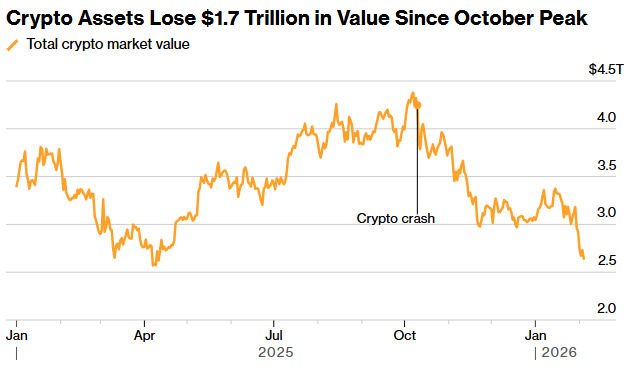
🚨 BITCOIN JUST WENT THROUGH THE WASHING MACHINE
Bitcoin slid 4.6% to $69,271 on Feb 5, 2026 — the lowest since Nov 2024 and 45% below the Oct 2025 peak. Since then, the crypto market has erased $1.7 trillion in value.
What actually broke the floor:
$1.5B left spot ETFs in a week, futures leverage snapped, and $775M in liquidations flushed weak hands — all while tech stocks sold off and bailout hopes were shut down.
Why this matters:
With Fear & Greed at 11, this looks less like a trend change and more like a forced reset. In past bull cycles, this phase clears excess before rebounds start.
This wasn’t fear selling.
It was leverage being erased.
Repost before panic replaces context.
Follow for clean market-structure signals.
#Bitcoin #CryptoMarkets
When the American empire finally collapses, historians won't be stunned by the greed of the elite; they'll be stunned by the loyalty of the poor. The working class didn't just vote against their own interests. They worshipped the billionaires robbing them. They slashed their own benefits, gutted their own healthcare, and cheered while the rich wrote off private jets as tax deductions. Not because it helped them. But because they were told it would hurt someone else. And that, right there, is how you rig a democracy without even breaking a single law.
This was a comment I saw under my content. I must say… Perfectly articulated.