From @DroversCTN, @USDA confirmed the sample from a cattle ranch near La Pryor, Texas, is screwworm. It's a threat the U.S. hasn't faced in 60 years. You can read more about the confirmed case here:
https://t.co/DN31cBqCKZ
Frustrations over the skyrocketing costs of doing business, trade policies and lack of E15 expansion have put producers’ votes – many in competitive political battleground states – in play ahead of this fall's midterm elections, according to an exclusive poll of Farm Journal readers. https://t.co/kw4klm3qtj
An entire small-town police department in Kansas raided a newspaper's offices and its reporters' homes because the paper got a tip about a well-connected person's DUI
https://t.co/nsfmsVBwfX
The critical question people don’t ask in media earnings calls: what is your break even SVOD (subscription video) target scenario? And what is your plan to get there?
My pov: increasing prices is critical from here. If people cannot successfully do that because they face price elasticity, they have to reconsider their path. Because no one is growing very much.
How many subs must a global SVOD service have anyway and what are the key levers? I’ll look at a generic service.
KEY ASSUMPTIONS
US ARPU is $13.99 but there are some promos and some goes through Amazon so your pocket price (amount you actually get) is $9.50. Assume avg ROW (rest of world) pocket price is 85% US Pocket Price, which is $8.08.
Assume your ROW subs = 1.2US subs. (I’m dealing with India completely separately here. Assume 20MM subs there at $1/mo. Assume India is a break even operation so it doesn’t affect the rest of the calculation.)
In this case, for every million USCAN subs, you wind up with $230.28MM/yr. total (excluding India).
Assume you spend $8B on original content per year. After licensing, marketing, foreign originals and overhead, your total annual cost is $24B (NFLX is $25B).
TARGET SUBS
That means you need 104MM USCAN subs to break even. Way too many. Disney has 46. NFLX has 75.5. That doesn’t work at all.
SOLUTIONS
>Raise Prices
What happens if our US pocket price goes from $9 to $15?
Now you need 66MM USCAN subs. Achievable.
>Cut Costs
What if you keep pocket price at $15 and reduce annual cost from $24B to $16B? Now your break even USCAN sub target is 44MM. Much, much better 👏. Now profit is realistic.
We can see here why people need to
⁃raise prices
⁃carefully examine third party distribution deals, and
⁃streamline selection such that only high impact titles are amortizing against the service. Everything else to FAST or cross-license.
The big opportunity for Disney is to keep raising prices (and to release great content that keeps people around).
PAR DRILL DOWN
Paramount financials say they only spend ~$8B/yr on Paramount+. They have an ARPU of ~$9.25 ($111/yr), including ads. So they could theoretically break even at 72MM global subs (+12MM/20%). They have 60MM and added 750K in the last quarter. It’s a somewhat long and uncertain road to 72MM at that pace.
I wd argue Paramount needs to increase their ARPU and also increase their growth rate. They have a low ARPU imo because the service on a relative basis — despite some highlights — isn’t that appealing and doesn’t offer brand consistency or benefit from high brand awareness. Assuming they don’t combine with someone else, real improvement will require stronger selection and more budget (which may increase losses in the near term). If they don’t do this, they probably remain loss making for years (and don’t think +750K subs per quarter is any kind of guarantee). I would say this slow road, where you keep bleeding cash and maybe slowly growing (with little hope of ever being very profitable), is a risky road. The trouble is that PARA’s other businesses aren’t growing either. Broadcast and cable are in secular decline. Movie studios on their own tend to go up and down year after year.
Combine, or be more aggressive, or … it’s risky.
Is there a more niche, targeted SVOD service opportunity where your total costs are, say, $3B? Target subs: 8.25MM. I think there is, but you have to have an exciting angle and brand.
There isn’t time to get into it here, but I think services could reduce customer acquisition cost and churn by being more brand focused — projecting a clear and consistent brand for a specific (but large) audience. Except for Disney and increasingly NFLX, no one really does this, opting instead for a “here’s all the random, unrelated stuff we have made” strategy. That’s churn-maxing.
The trouble of relying on a "make money while you sleep" revenue strategy for so long, as so many big media companies did with advertising and cable subs, is that you might actually be asleep when the business model changes and you have not future-proofed your own business.
It doesn’t hurt to ask if whatever you’re trying to achieve is worth spending your finite time addicted to media that enrages, consumes, and intensifies the sense of alienation.
I disagree that this is 'because of Meta's de-investment in news'. If we look at consumer behavior around news on social channels, we see that the public's interest in news on social channels is also decline. So, this decline would have happened regardless.
Data shows adults in the US & globally are getting news less often on social media compared to 2020
— That's largely because Meta's de-investment in news is not being offset by news consumption on TikTok, YouTube, etc. And the news cycle has slowed.
@axios
https://t.co/wDLn6UCiSm
“most of the use of publishers’ original content by AI systems for both training and output purposes would likely be found to go far beyond the scope of fair use as set forth in the Copyright Act and established case law.” https://t.co/fuYxF3YiI4
The Chicago Cubs HAVE THE WORST RECORD IN THE NATIONAL LEAGUE. And on the night they earned this embarrassing milestone they gave away bobble heads of one of the greatest players in the history of the franchise with the wrong jersey number on it. What a joke. #TakeThat
Happy to close this chapter. Fundraising success 100% due to brilliant team + remarkably strong audience and revenue growth out of the gate. Onward!
Semafor Raises $19 Million, Replacing Money From Sam Bankman-Fried https://t.co/w9XNMVPNBC
One of least explored parts of media startups crisis is ownership, or really lack of it. Everyone wants to start media cos, raise lotsa money, dilute ownership, no one wants to own it long-term. The ownership mentality missing explains in large part crisis in digital media today.
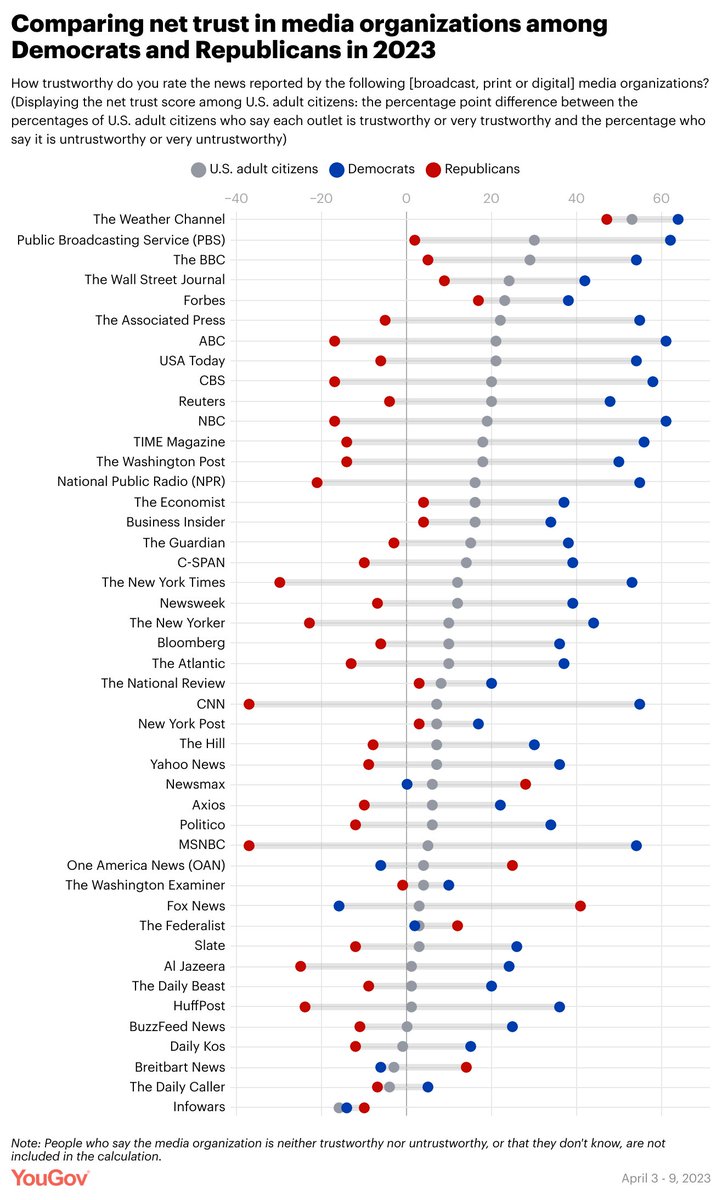
NEW Trust in Media 2023 Poll:
Americans are sharply divided along partisan lines on how much they trust the news reported by national media organizations.
https://t.co/5VTrkTr0MU
YouTube's Podcast Deals With NPR, Slate and New York Times Are Flopping
"Slate’s shows averaged around 75 views per video over the past week while NPR was around 179. The New York Times performed slightly better, especially The Daily. But that show, one of the biggest in the world, still only received around 1,000 views on average over the past week."
https://t.co/8pnQ8vZdH1
🚨NEW research: 70-72% of local journalists are experiencing moderate to high levels of personal and work-related burnout, according to our survey of 500+ U.S. journalists.
This is the first study to measure journalist burnout after the COVID-19 pandemic
https://t.co/kAjkAeFDeY
NEWS: Vice Media is canceling "Vice News Tonight" and sunsetting the Vice World News brand as it slashes its workforce and works to restructure the company. https://t.co/BByXhLPQWo
It is game over for generalist digital media news companies, layoffs & other cutbacks won’t help. They may drag along for a bit, but done for. They are victims of oldest sin of digital: caught in middle, neither giant nor focused/vertical enough. https://t.co/xbPJ8pdCxn