Frank Turek's view elaborated:
Graded absolutism teaches that moral laws are not all of equal weight. When two divine commands come into unavoidable conflict, we are obligated to obey the higher law rather than the lower. Unlike the lesser-evil view, graded absolutism argues that choosing the higher law is not sin. The law itself never changes, but a person may be exempt from a lower obligation because the circumstance is unavoidable.
Scripture repeatedly recognizes greater and lesser moral obligations. Jesus speaks of the "weightier matters of the law" (Matt. 23:23), the least and greatest commandments (Matt. 5:19), and "the greater sin" (John 19:11). Paul calls love the greatest virtue (1 Cor. 13:13), and Jesus says there is no greater love than laying down one's life for another (John 15:13). James 2:10 does not teach that all sins are equal; it teaches that breaking even one command makes a person guilty as a lawbreaker, not that every sin carries the same moral weight.
When, then, is lying permissible? Only in an unavoidable moral dilemma. The Hebrew midwives and Rahab appear to fit this category. While some argue they could have remained silent, silence may have produced the same deadly outcome. In such cases, preserving innocent life takes precedence over telling the truth. A helpful analogy is a husband who promises to be home for dinner but is delayed because he stops to save someone's life. He technically breaks one obligation in order to fulfill a greater one.
These situations are exceedingly rare. Graded absolutism is not a subjective system where we decide which commands matter most. The hierarchy of moral duties is established by Scripture, not personal preference, and requires careful biblical discernment.
This framework also sheds light on the cross. If justice were God's highest attribute in every circumstance, Christ's suffering would seem unjust. Yet Scripture presents His voluntary sacrifice as the supreme expression of God's love and mercy, through which justice is ultimately satisfied.
A common objection asks how lying could ever be consistent with God's truthful nature. Norman Geisler (Frank's mentor) writes,
“Very simply, the answer to this is that lying as such does not flow from God’s nature. A lie can never by justified by an appeal to him who is truth. However, while lying as such is never justified, lying to save a life is. But ‘lying to save a life’ is really an act of mercy and mercy is an attribute of God.”
One can live in the same home as their five year old child while listed on the state's child abuse and neglect registry or under an open DCF investigation, but the moment they choose to educate those children at home, it is suddenly too dangerous.
It's all about control and taking away parental rights.
Thanks for the response. I have heard this and I have a few reservations about it. To me, it seems like the bar for "sufficient knowledge" keeps shifting in Catholic explanations, to the point where even clear and persistent rejection of core dogmas like the Papacy gets softened or excused by appeals to upbringing and invincible ignorance. CCC 818 and similar texts create a wide safety net for Protestants (generally speaking) that can make the older, sharper teachings on the necessity of the Church seem much more optional in practice.
If knowing rejection of defined truths no longer carries real weight for most people, it blurs the line between material error and formal heresy. Some (including myself) see this as a moving target that protects the system more than it clarifies the truth. This is why a "notable subset" (not necessarily a majority) seemed to me a fair assessment based on traditional and historical teachings. I'm not celebrating it. I actually think it's super sad. I think it's very important though.
If you are a Protestant want to know whether you are saved (i.e. going to heaven) in the eyes of Roman Catholicism or Eastern Orthodoxy, here's what you need to know from the traditional and historical perspective:
Thanks! Unfortunately, CCC 1271 does not impact the syllogism. It only affirms that valid Trinitarian baptism creates a real but imperfect communion and sacramental bond with the Church. This allows Catholics to call Protestants "brothers" and recognize a foundation of unity.
It does not say this imperfect state saves those who knowingly reject defined dogmas (papacy, Real Presence, etc.) and remain visibly separated. The historic teaching (Florence, Extra Ecclesiam Nulla Salus) still holds: obstinate formal heretics/schismatics are outside the Ark of Salvation unless they repent and enter full communion. What you posted does provide more info to the relationship but does not abrogate the earlier dogma.
Sadly, the syllogism stands.
I'm neither Roman Catholic nor Eastern Orthodox.
I shared this because questions keep coming up about it.From their traditional and historical teaching (Council of Florence 1441, etc.),
Yes, if a Protestant knowingly rejects core doctrines like the Real Presence in the Eucharist, apostolic succession, the necessity of the sacraments as they define them, etc... and refuses to repent and enter full visible communion, that person is considered a formal heretic outside the Church and thus on their way to hell. That's their official position, not mine.
I posted the historical texts for clarity so Prots, RC's, and EO's can see plainly what these groups have taught, not to endorse it.
Thanks for the response. It's fair that there may not be 100% certainty. But it seems there is a historical precedent for reasonable certainty. This why the wording is specific to specific kinds of protestants: "Protestants [who] have received sufficient instruction on the Orthodox faith and, in a notable subset of cases, show clear and convergent manifest signs of understanding yet persistently reject core dogmas (the seven Ecumenical Councils, apostolic succession, icons, the Real Presence, Holy Tradition, and salvation as theosis through synergy) while maintaining visible separation from the Orthodox Church."
Does that help or do you disagree?
I need help finding a good church for when I visit Texas, New York, and Florida, but all lot of them don't list their doctrinal statements.
Here are some things my wife and I are looking for:
-The earth is young (6000 years) and God created it through evolution in six days.
-The pope has apostolic succession but we don't have to listen to him.
-Miraculous works of the Spirit ceased (healing, prophecy and ect) except for speaking in tongues.
-Women should use sign language to maintain silence while teaching in pastoral roles.
-Christians shouldn't drink alcohol, but the marijuana brings us closer to God.
-Infant baptism is ok I guess, but only believers baptism can save you.
-The New King James Version is the only inspired version.
- Salvation is through faith alone, but works are needed to stay predestined.
- The church has replaced Israel, but America replaced the church and we should support Israel unconditionally.
Thanks in advance.
@AvalonCircle Yeah these are my non-negotiables but there's some other things that would be nice that we are flexible. Like no instruments during worship unless it's bethel music.
These same people will read patristics (who were far from unanimous on a variety of issues) and interpret them (or other historically adjacent texts) for themselves while claiming it's so much easier to interpret them than the Bible.
Logic exists because God exists. Texts can be understood because human languages convey objective meaning. Truth is knowable, even truths about an infinite God expressed through analogical language. History is knowable (otherwise Christianity itself collapses). Therefore, sound hermeneutics, especially the grammatical-historical method, is required to rightly understand any historical text, regardless of the author’s alleged authority.
All of this must be in place before someone even picks up the Bible (though we often assume it without explicit reflection).
These same people will read patristics (who were far from unanimous on a variety of issues) and interpret them (or other historically adjacent texts) for themselves while claiming it's so much easier to interpret them than the Bible.
Logic exists because God exists. Texts can be understood because human languages convey objective meaning. Truth is knowable, even truths about an infinite God expressed through analogical language. History is knowable (otherwise Christianity itself collapses). Therefore, sound hermeneutics, especially the grammatical-historical method, is required to rightly understand any historical text, regardless of the author’s alleged authority.
All of this must be in place before someone even picks up the Bible (though we often assume it without explicit reflection).
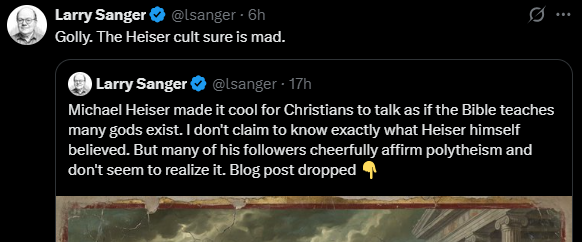
The Irony is actually sad.
Larry Sanger (@lsanger ) Get's mad at people for not reading his article where he name-drops Heiser as a force for polytheism but then he blocks people who quote him: "I've researched a lot more [about Heiser] than [people who have read Heiser]...[but] I haven't read [Heiser]."


![christiancoms's tweet photo. The Irony is actually sad.
Larry Sanger (@lsanger ) Get's mad at people for not reading his article where he name-drops Heiser as a force for polytheism but then he blocks people who quote him: "I've researched a lot more [about Heiser] than [people who have read Heiser]...[but] I haven't read [Heiser]."](https://pbs.twimg.com/media/HIrm2NXWcAAkdPr.png)
![christiancoms's tweet photo. The Irony is actually sad.
Larry Sanger (@lsanger ) Get's mad at people for not reading his article where he name-drops Heiser as a force for polytheism but then he blocks people who quote him: "I've researched a lot more [about Heiser] than [people who have read Heiser]...[but] I haven't read [Heiser]."](https://pbs.twimg.com/media/HIrm2NVX0AAjHys.png)
![christiancoms's tweet photo. The Irony is actually sad.
Larry Sanger (@lsanger ) Get's mad at people for not reading his article where he name-drops Heiser as a force for polytheism but then he blocks people who quote him: "I've researched a lot more [about Heiser] than [people who have read Heiser]...[but] I haven't read [Heiser]."](https://pbs.twimg.com/media/HIrm2NTWMAAFxNf.png)



![christiancoms's tweet photo. The Irony is actually sad.
Larry Sanger (@lsanger ) Get's mad at people for not reading his article where he name-drops Heiser as a force for polytheism but then he blocks people who quote him: "I've researched a lot more [about Heiser] than [people who have read Heiser]...[but] I haven't read [Heiser]."](https://pbs.twimg.com/media/HIrm2OSWcAIHfOt.jpg)