Still the best hour on graph engineering ever recorded, Andrew Ng breaking down how to build agentic knowledge graphs from scratch:
00:00 - what agentic knowledge graphs actually are
03:05 - building a graph from scratch
13:58 - the architecture behind multi-agent systems
22:57 - building a real one with Google ADK
01:06:02 - why graphs are the future of AI agents
I've seen $500 courses that teach less.
Watch it, then take it further with my step-by-step guide on graph engineering below.
It’s hard to hire well at a new startup. Things can be chaotic, there’s not a lot of process, and decisions are made impromptu often by the founder. Yet making a bad hire early on can be disastrous, and slow things down.
I’m here to argue it’s one of the first things that deserves a lightweight process within a startup, and here’s how to implement it without it feeling bureaucratic.
I posted these steps a few days ago…
so you wanna hire someone?
- define a new role with clear requirements
- sharp interview questions that test each requirement with 3-5 questions
- see some work product
- ask for references, but assess "get shit done" and super strengths, and disallow middling references
- clear decision-making power for the hiring manager
And don’t do this:
- consensus-based vibes-driven interviews that take forever and you end up hiring someone nice but not actually great
Yes, this does look like along list of bullets, but really, it’s just a few steps. Once you know what you want, then having a somewhat consistent set of questions that you ask, each candidate is the first step. If you decide for a new marketing hire that they have to be an expert in working on events, they have to be very organized, and they have to be fine in an entrepreneurial environment, then you should be able to build a list of a dozen questions. You can even use ChatGPT if you want to!
During these questions, I would press for examples of prior work, what they specifically did on these projects, and try to take a few notes. If you have multiple people in the interview loop, have them all focus on a different batch of questions — worth a little coordination. At the end, I recommend making a quick pros and cons list, as well as a single recommendation if hire or no hire.
I learned a long time ago to never make a hire without seeing their work product. For an engineer that might be an exercise where you pair program with them on a small project. For marketing I might want to see a short brief and a calendar timeline for the project idea. When I hire investors, I have them write up a memo, and then I quiz them about their ideas. I might even have them pull up a spreadsheet and do some changes to their financial model in real time.
You can bullshit your way through an interview, but when it comes to work product, there are such big differences in competence that after some calibration you’ll spot it right away.
This is also why it’s very important to look at a handful of candidates before even trying to make the first offer. You need to calibration process. If your pipeline is dry, then the other thing to try is to just sit down one on one with a few great folks who have jobs and are hard to hire, just to calibrate. Ask how they would hire someone like themselves, and what they would look for.
I’m generally a skeptic of culture fit. It’s a way that teams often hire people like themselves - this is the vibes based consensus that I was speaking to at the beginning. What matters to me is the work product, and references, and I think highly competent people come in many shapes and sizes. The one cot I’ll give is that some teams have very specific work styles early on. They might be 24x7, or they might start super late in the day, or be all in person. These obviously add constraints.
Doing references well is very hard because everyone you ask will typically be pretty positive about a candidate. This is particularly true if the references are provided by the candidate. Expect that they have been coached and will say certain things to scratch whatever itch you’re trying to scratch. As a result, you have to ask for the extremes. How many product managers worked at litter last company? Were they number one or two within all the PMs? Why not? What type of person would a must have hire alongside this person? Why?
If done well this might just be a few hours and a few meetings. But then this person might work for you for years. Important to get right.
The “Dinner Party Asshole” test is a solution to a common problem:
Startups often struggle at pitching their team, even though for the earliest stage companies, it’s incredibly important to do it well to raise capital — as I’ve described it below
Pre-seed- Bet on the team 👨💻
Seed- Bet on the product 📱
Series A- Bet on the traction 🏒
Series B- Bet on the revenue 💸
Series C- Bet on the unit economics 💰
To figure out if you are properly pitching yourself in your team, run the thought experiment of describing yourselves at a dinner party. If you are pitching yourself hard, then if you are a kind human, you will turn red and blush with wild embarrassment. The reason is that a proper pitch includes many of your credentials, your achievements, the ways in which you and your team are highly unique, and we simply don’t talk like this at dinner parties. And yet this is exactly what you should do when you talk to investors, partners, customers, and potential employees.
Be the dinner party jerk, pitch yourself hard. Don’t hold back. Your shyness and cordiality is not helping.
I find that most founders tend to focus, primarily on describing their idea to the exclusion of everything else. I’ve heard thousands of “elevator pitches” and they generally focus on the idea and not the team, the market, differentiation, or anything else. And they downplay their achievements or omit them.
Of course what you emphasize depends on your background. It’s often described that there are repeat founders and first time founders, but furthermore, there’s another axis, which is about obvious credentialing versus not. For first time founders that are starting a gaming company, for instance, but have already spent years at a top company in the field, a quick modification to the elevator pitch, mentioning that, is both beneficial and quite obvious. But what do you do, you’re an uncredentialed first time founder?
Then the question becomes, what is your “earned secret“ behind the idea? Having a pithy story about how you were a Shopify seller, and that’s how you got to building any commerce product, is incredibly helpful. And if you have some metrics or an observation about the market that’s non-obvious, showing your expertise in the field, is even more valuable. If you have various credentials either professional, or academic or open source, achievements, it might be worth working those in even if not directly related.
The other very awkward thing is to use facts and figures to describe yourself. If in your previous work, you worked on an app that served millions of people, or for your current company, you recently launched and got your first 10,000 users, you should save these numbers. Any traction and any validation is incredibly helpful proving your case. And of course, this is another thing that would make you a dinner party jerk.
You might be going through a moment of introspection now and asking why am I like this? Why do I downplay achievements when I should be amping them up?
My answer to this, is conformity. In real life, we often subconsciously conform to the people around us. If you go off at a friendly gathering about all the cool stuff you’ve done, and why you’re going to be great, there’s a fear that you’re exaggerating the differences between yourself and others. There’s a fun theory from evolutionary psychology that shyness is an evolved trait to keep us safe in a world where we grew up and tribes of a few hundred people, and a few wrong words might follow us around for our lifetimes.
This is also my theory for why people are reluctant to engage on social media and share their knowledge, when it’s obvious that it might be very helpful to them professionally.
TLDR; there’s pitch mode and dinner party mode. Learn to turn the former mode on!
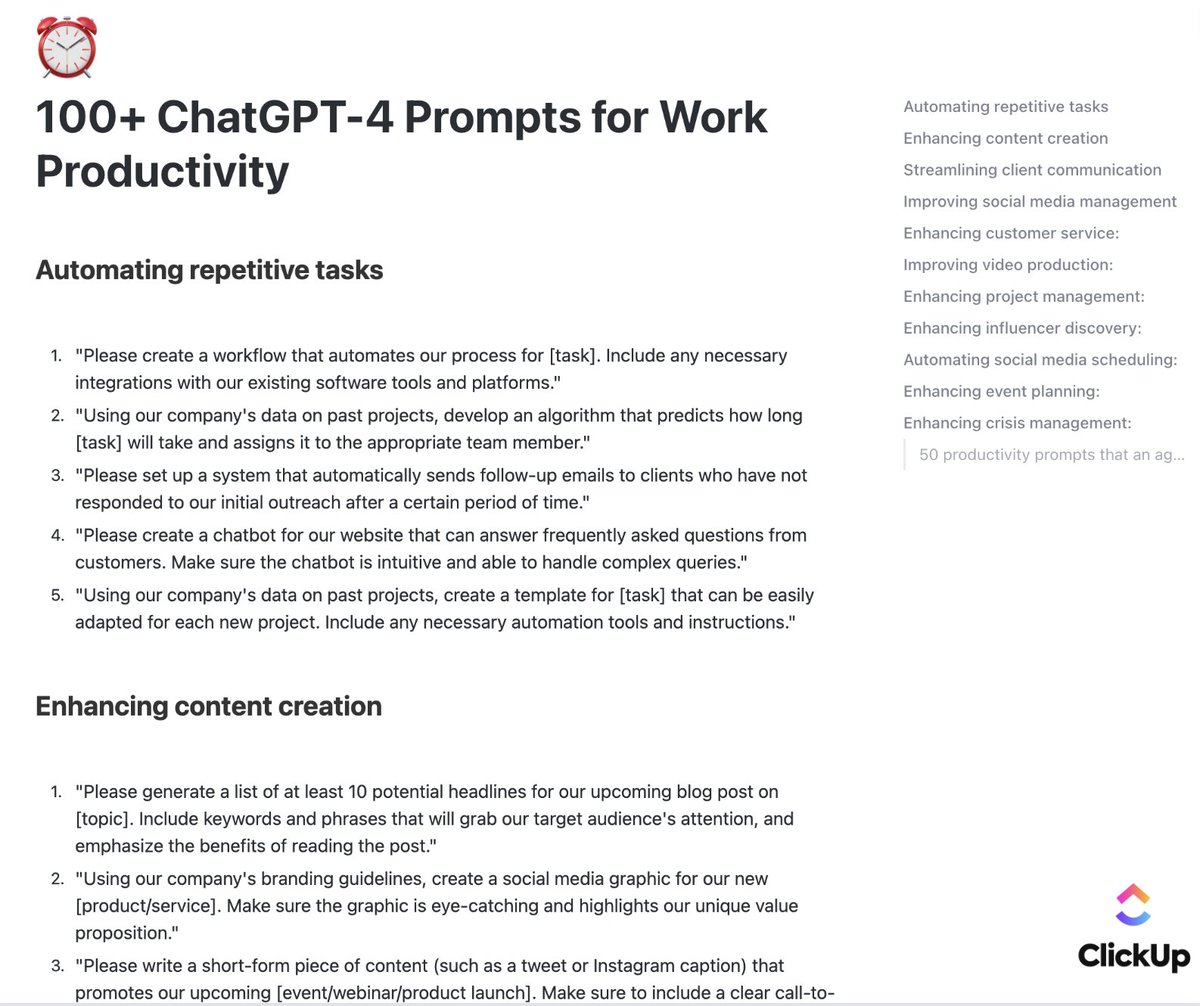
GPT-4 is 10x faster than GPT-3!🦾
It can save you 100s of hours.
So... we've compiled 100 work productivity prompts!
And for the next 24 hours, it's free.😏
To get it, just:
1/ Follow us @ClickUp
2/ RT this tweet
3/ Reply "Work"